


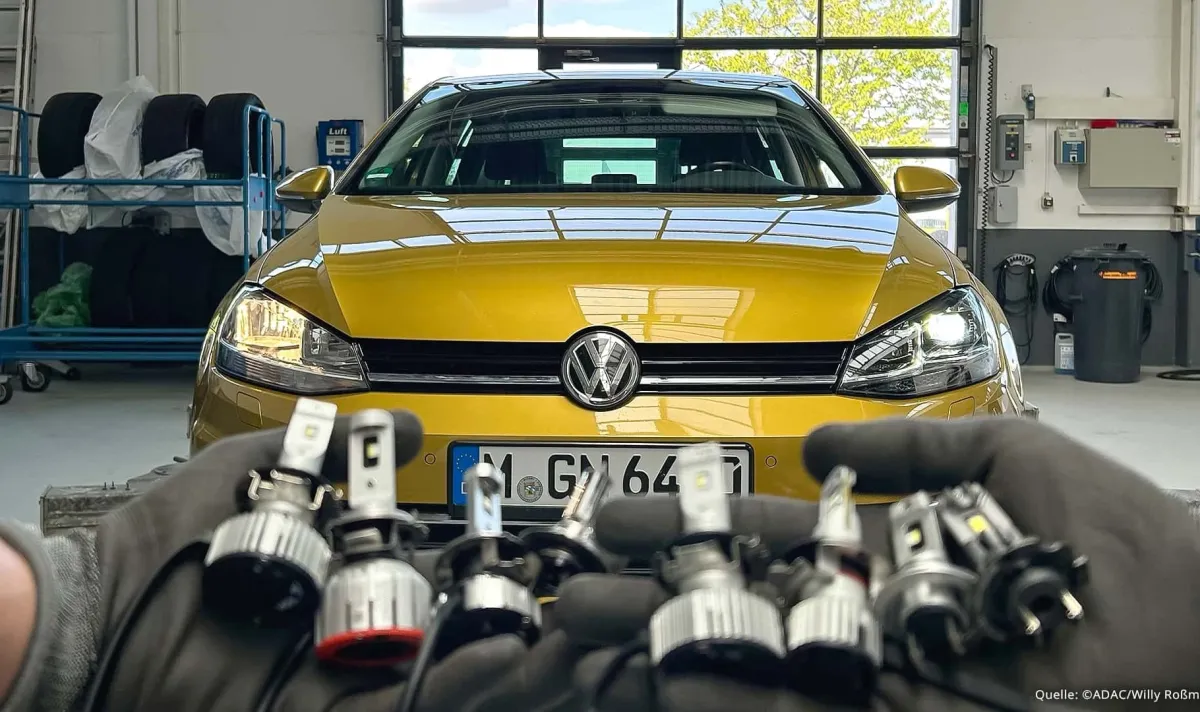

Modern LED technology has long conquered the automotive industry, but millions of older vehicles still rely on classic halogen headlights. To help drivers improve visibility without buying a new car, manufacturers offer specialised H7 LED bulbs for retrofitting. However, ADAC’s latest major test, covering laboratory measurements, precise bench tests and real-world road trials behind the wheel of a Volkswagen Golf 7, shows that not every such investment pays off.
The test results are unequivocal: high-quality retrofit LED lights really can provide dramatically better illumination of the road. Four of the seven products tested earned the high overall rating of “good”. First place was shared by the Bosch LED Powerlight+ and Philips Ultinon Pro 6000 Standard, both scoring 2.1, with their low-beam light patterns being fully comparable to the factory LED systems of modern cars. Close behind were the Osram Night Breaker Speed 450 and Philips Ultinon Pro 6000 Boost gen2, while Osram’s more budget-friendly offerings achieved satisfactory results despite minor weaknesses in the distribution of the light beam.
At the opposite end of the spectrum was the cheapest product tested, bearing the Oushi brand and costing around €50. The bulbs performed very poorly in the tests, with their cheap construction leading to premature failure and creating dangerously intense glare for oncoming traffic. ADAC issued a serious warning to drivers to avoid such products, as they do not have the required national type approval, while the ECE compliance advertised in online shops does not provide legal authorisation to drive on public roads in Europe. Their use not only compromises safety but also makes the vehicle’s registration invalid if inspected by the authorities.
In terms of reliability, high-quality LED bulbs clearly outperform their halogen counterparts. With the exception of the cheap Chinese failure, all the other test participants have an impressive projected service life of more than 150,000 kilometres. Installation itself, however, can prove a serious challenge. Products designed similarly to standard halogen bulbs can be installed easily by any driver, but models with large integrated heat sinks require professional intervention.
Experts from the automotive club recommend that more complex LED systems be replaced at a specialised workshop, where the headlights can be precisely adjusted on a test stand after installation. Despite their higher initial price, high-quality retrofit LEDs quickly pay for themselves through their long service life and energy efficiency, provided that drivers carefully check for a valid compatibility certificate for their specific vehicle model.
Ultimately, the lesson from the tests is crystal clear: saving money on a car’s lighting system can prove extremely costly on the road. Unknown brands such as Oushi and mass-market cheap Chinese alternatives without genuine certificates not only fail to improve visibility but also become a serious safety threat because of their dangerous glare for other road users and their short service life. Therefore, the most sensible choice for every driver remains investing in established manufacturers that guarantee both a precise light beam and full compliance with legal requirements.