


Inflation fell more than expected across the European Union in June, easing pressure on the European Central Bank (ECB) and reviving hopes that the energy surge triggered by the Middle East war is finally fading.
As Europe reels from one of the worst heatwaves on record, the latest inflation data offers rare cooler news.
Price growth in the eurozone slowed sharply in June, according to a preliminary estimate from Eurostat, a good sign that the surge triggered by the Middle East conflict may be wearing off.
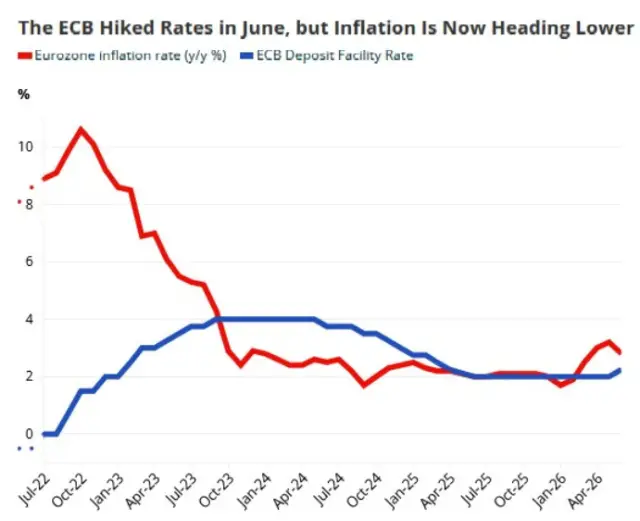
The annual Inflation in the currency bloc fell to 2.8%, down from 3.2% in May, the highest level since September 2023.
It also fell below the 3.0% economists had expected. Prices actually fell 0.1% last month, the first monthly decline this year after a series of increases.
The key interest rate, which excludes volatile energy and food prices, fell to 2.4% from 2.6%. This figure is more important to the ECB than the headline data because it gives a clearer picture of whether inflation is stalling.
Energy remains the biggest source of inflation, moving from 8.7% year-on-year. Even that is cooling quickly, however: in May the rate was 10.8%.
The surge in oil and gas prices that followed the outbreak of war began to reverse after the US-Iran ceasefire and the reopening of the Strait of Hormuz.
Inflation in services fell from 3.5% to 3.2%, in food, alcohol and tobacco it slowed from 1.9% to 1.6%, and in industrial goods excluding energy it held steady at 0.9%.
Where prices rose the slowest and fastest
Malta had the lowest annual rate in the bloc at 1.9%, just ahead of France and Estonia, both at 2.0%.
Germany (2.4%) and Finland(2.7%) also ranked comfortably below the eurozone average of 2.8%.
The picture looked much different further east.
Lithuania topped the table with 5.5%, followed by Bulgaria, which only joined the eurozone in January, with 5.3%. Croatia and Cyprus were not far behind, at 4.2% and 4.0% respectively.
On a monthly basis, prices actually fell in several countries between May and June.
They fell by 0.4% in Belgium, Bulgaria, Estonia and Luxembourg, and by 0.3% in France, Austria and Finland.
The steepest monthly increases came in the opposite direction: prices jumped by 1.0% in Malta and 0.8% in Cyprus, with Spain and Lithuania recording gains of 0.6%.
Major economies slow down
Each of the largest members of the eurozone reported lower inflation.
In Germany, the harmonised rate used to compare EU countries fell to 2.4% from 2.7%, below expectations.
The national indicator fell to 2.3%, well below the 2.9% recorded in April, its highest level in more than two years.
The move was driven by a collapse in energy inflation, which more than halved to 3.4% from 6.6%, while core inflation held steady at 2.5%.
France saw an even sharper decline. Its harmonized rate fell to 2.0% from 2.8%, and the national indicator hit 1.8%, the lowest level in more than a year.
Once again, energy did most of the work, with fuel inflation slowing to 11.2% from 16.6%. French prices fell 0.2% in the month, their first decline since January.
Consumer prices in Europe: Which countries are the most expensive and cheapest?
Germany: Growth halved as state boosts investment
Italy was the exception among the big four, with its harmonised rate barely budging, falling to 3.1% from 3.2%.
The reason lies in household energy bills. Italian electricity and gas tariffs lag behind the wholesale market, so they continued to rise even as petrol prices at the pump started to fall.
Regulated energy prices rose to 9.3% year-on-year in June, from 5.6% in May, with regulated electricity alone jumping to 7.1% from 2.3%. On the open market, the moves were even bigger: electricity rose to 12.6% from 8.4% and gas to 9.9% from 8.2%.
Economy too weak to overheat
Joe Nellis, an economic adviser at accounting and consulting firm MHA, said the June data was a snapshot of two forces moving in opposite directions.
The war in the Middle East has raised the cost of energy, transportation and manufacturing. At the same time, businesses are wary of investing and households are spending cautiously, so there simply isn't enough momentum in the economy to push prices up quickly.
“Put simply, the eurozone economy is not generating enough momentum to push prices up at a high rate,“ he said. Nellis expects the pressure to continue to ease.
Wage growth is hovering around 3%, energy markets are calming down and a truce between the United States and Iran has reduced the risk of another oil shock.
The ECB raised interest rates in June, he said, but “there is no need to panic“
He thinks another hike this year, to 2.5%, is possible, although anything more aggressive seems unlikely as long as the economy remains soft.
“Given the weak economy and inflation that appears manageable, the ECB will be wary of adopting a significantly more restrictive monetary policy stance,“ he added.