


A significant technological and scientific breakthrough in Bulgarian medicine was achieved at the National Cardiology Hospital (NCH). For the first time in our country, an invasive cardiology team successfully combined two of the most advanced technologies for the treatment of severely calcified coronary arteries - rotational and orbital atherectomy, performed under the precise control of optical coherence tomography. The new approach allows the treatment of patients who until recently were considered almost incurable by invasive means. Dr. Alexander Alexandrov, Head of the Department of Invasive Cardiology at the National Cardiology Hospital, spoke to FACTI.
- Dr. Alexandrov, the first combined procedure in our country with rotational and orbital atherectomy was performed at the National Cardiology Hospital. What makes this method so significant for Bulgarian cardiology?
- The case is a technological and scientific breakthrough. For the first time in Bulgaria, we have managed to combine the two most powerful technologies for mechanically dealing with calcium in one procedure, under precise visual control. Until now, we have had these methods separately, but combining them “closes the circle“ and allows us to treat patients who until recently were considered incurable by invasive means. This is a clear signal that Bulgarian medicine in cardiology is already offering world-class solutions.
- What are the main challenges in the treatment of patients with severely calcified coronary arteries and why do standard methods often prove insufficient?
- Severe calcification turns arteries into “stone pipes“. Under such conditions, the standard balloons we use for expansion often burst or fail to deploy evenly. If we place a stent in such an environment, it will not adhere well to the wall, which is a prerequisite for serious complications such as re-occlusion or thrombosis. Calcium is the biggest enemy of the stent and standard medicine is often powerless against it.
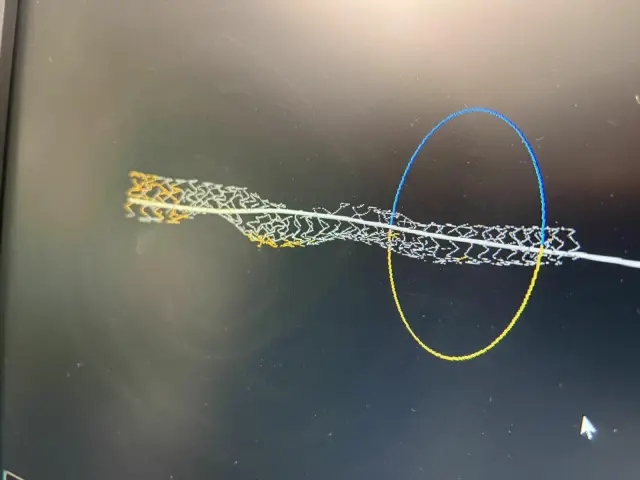
- How exactly do the two technologies - rotational and orbital atherectomy - work and how do they complement each other during the procedure?
- Imagine a fine "sawing" of a stone. Rotary atherectomy uses a diamond tip that rotates at up to 180,000 revolutions per minute, cutting a tunnel through the toughest blockages. Orbital atherectomy uses centrifugal force – its tip moves in an ellipse (orbit), which allows us to treat the vessel in greater depth and remove calcium from wider areas. The two technologies complement each other perfectly: the rotary opens the way, and the orbital prepares the stent bed deeper in the wall.
- What is the role of optical coherence tomography (OCT) during the intervention and how does it help for greater precision and safety?
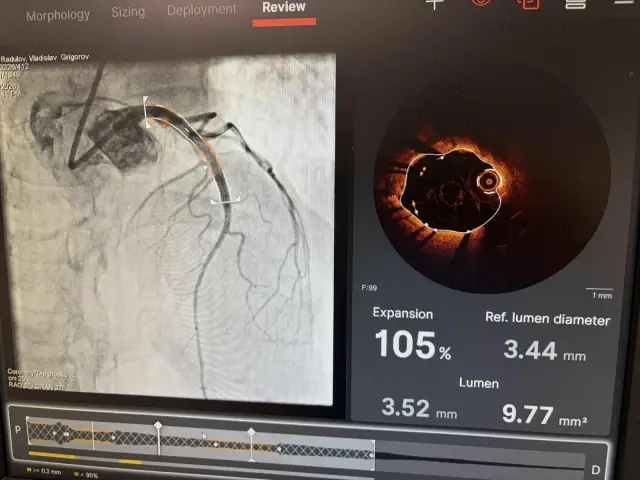
- Optical coherence tomography is our “microscope“ inside the body. With it, we don't just take an X-ray, but
see a 3D image of the inside of the vessel with a resolution down to microns.
OCT allows us to accurately measure the thickness of the calcium plaque, decide exactly where to apply the atherectomy, and finally make sure that the stent is deployed perfectly to the millimeter. This minimizes the risk of errors and guarantees patient safety.
- For which patients is this combined approach suitable and can it be an alternative to open heart surgery?
- The approach is extremely suitable for elderly patients, diabetics and people with chronic kidney disease, in whom calcinosis is most severe. Often these patients are too risky for a major open surgery. For them, our method is a “lifeline“ – we perform the procedure through a small hole in the wrist, and the recovery is extremely fast.
- How complex and risky is such a procedure and what preparation does it require from the invasive cardiology team?
- This is aerobatics - “Formula 1“ in our profession. The procedure requires exceptional concentration and technical skills. Every movement must be precise to the millimeter to avoid the risk of vessel perforation. The team at NKB undergoes many years of training and international specializations in order to work synchronously. This is not just about technique, but about experience and clinical intuition.
- Does this success mean that Bulgarian invasive cardiology now has the technology and expertise comparable to world medical centers?
- Absolutely yes. This case proves that in Bulgaria, and in particular at NKB, we work according to the same protocols and with the same equipment as in the best clinics in Germany or the USA. There is no longer a need for a Bulgarian patient to seek help abroad for the most complex heart problems - they can be solved here, on site.
- What are the next steps - can this innovative procedure be applied more widely and for more patients in Bulgaria?
- Our goal is for this procedure not to be an exception, but a standard for the most complex cases. We continue to train young colleagues and expand the application of intravascular imaging (IVA). Innovations at NKB have always been aimed at making medicine safer and more accessible for Bulgarian patients.

Hope for the most severe heart patients and how a new method changes treatment! Dr. Alexander Alexandrov to FACTI
Bulgarian medicine in cardiology already offers world-class solutions, says the physician
Mar 20, 2026 09:00 634
