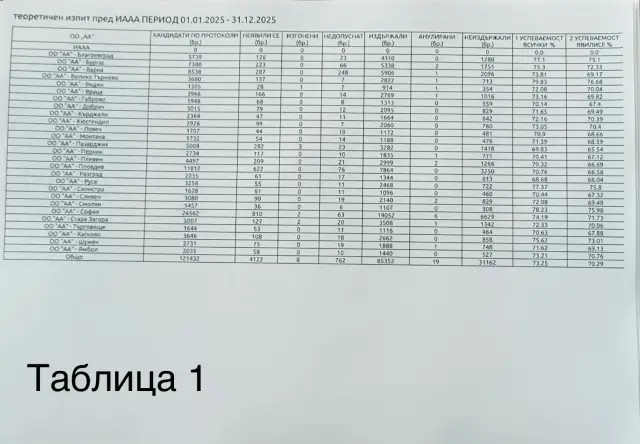
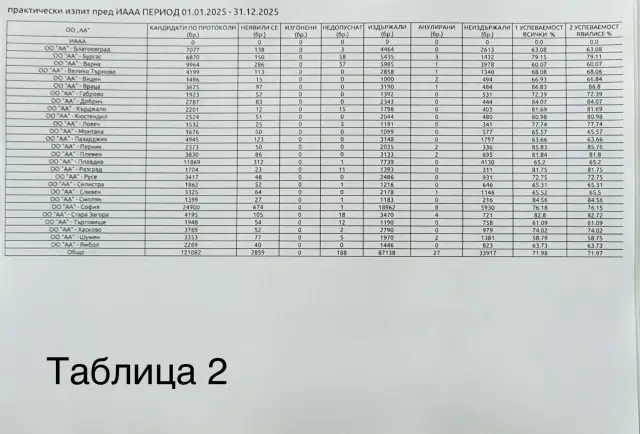
There is a sustainable and adaptive corruption system in driving exams, according to data from the report of the Institute for Road Safety, sent to the media. After analyzing the data for 2025 (Table 1 and Table 2), a clear conclusion is reached about the existence of “exam tourism“ – concentration of candidates in certain regions with an abnormally high success rate.
This practice leads to the systematic admission of unprepared drivers on the road and creates a direct threat to society.
Evolution of corruption mechanisms
Corruption in exams has transformed from elementary schemes to high-tech and difficult-to-prove practices.
1. Theoretical exams („leaflets“)
From manipulations of paper tests, the system has moved to:
• micro-earphones and hidden cameras;
• external „operators“, submitting answers in real time;
• unregulated access to testing devices.
Despite digitalization, fraud does not disappear, but adapts.
2. Practical exams
Driving remains the most vulnerable point due to subjective assessment.
The following are observed:
• mediation of driving instructors;
• pre-arranged payments;
• coordination through non-verbal signals;
• facilitated routes for “paid“ candidates;
• ignoring violations.
The exam often becomes a formality.
Data and evidence for „exam tourism“
The analysis of official data for 2025 shows clear statistical anomalies that support the conclusion of a systemic problem. (tab 1 and tab 2)
Key observations:
The highest levels of corruption are found in Pernik, Kyustendil and Vratsa.
1. Discrepancy in success rates
• Sofia – 76.15% practical exam
• Pernik – 85.76%
• Kyustendil – 80.98%
• Vratsa – 86.8%
A difference of up to 10% compared to the capital is a serious indicator of a different standard of assessment.
2. Anomaly between theory and practice
• In Sofia: theory 71.73% → practice 76.15%
• In Pernik: theory 67.12% → practice 85.76%
A difference of nearly 19% in Pernik shows that candidates perform worse on the objective test, but significantly “better“ in the subjective assessment.
3. Inflow of candidates
Cities such as Pernik, Vratsa and other regions report a number of candidates disproportionate to their population, which is an indicator of an external flow - mainly from Sofia.
4. Almost no canceled exams
While there are canceled exams in Sofia, in other regions they are almost zero - a possible signal of under-control.
Summary:
The combination of high success rates, a discrepancy between theory and practice and an inexplicable influx of candidates represents a classic model of “exam tourism“.
“Exam tourism“ - mechanism and causes
Main factors:
• geographical proximity to Sofia;
• lower traffic complexity (formal justification);
• local dependencies between participants;
• lack of rotation of examiners.
This creates sustainable regional centers in which exams are held with low control.
Systemic failure and institutional inaction
Despite public requests for reforms in the Executive Agency “Automobile Administration“, real results are lacking.
Direct threat to road safety
The consequences are severe:
• admission of unprepared drivers;
• building a culture of impunity;
• increased risk of serious road accidents.
Corruption in exams is becoming a direct factor in the loss of human lives.
Conclusion
The data and analysis clearly show: there is a sustainable model of “exam tourism“, supported by corrupt practices.
Without structural reform, the system will continue to reproduce a risk to road safety.