“Europe is entering a decade in which electricity will be even more important for economic development, security and geopolitical influence.“ This was stated by the Bulgarian MEP from the Group of the Progressive Alliance of Socialists and Democrats in the European Parliament, Christian Vigenin, during the 11th Congress of the Nuclear Industry of Central and Eastern Europe, which was held in Warsaw.
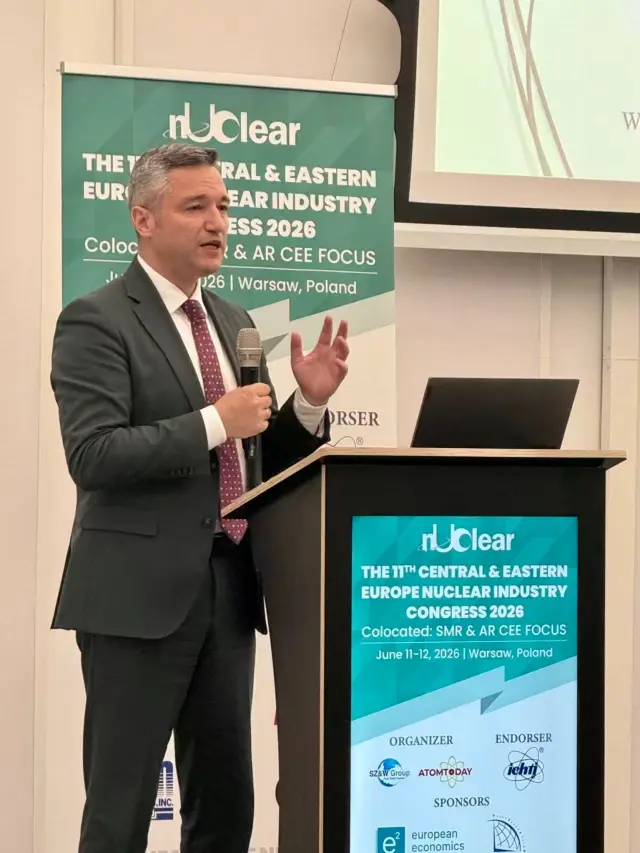
Vigenin participated as a keynote speaker in the discussion “Strategic View of the EU: Energy Security, Artificial Intelligence and Industrial Transformation“, dedicated to the challenges facing the European economy, energy and technological development in the coming decades.
“Energy security, artificial intelligence and industrial transformation can no longer be considered as separate policies. They are part of a common strategic agenda. The competitiveness of European industry will increasingly depend on access to secure and low-carbon electricity. The same applies to the development of artificial intelligence and digital infrastructure“, Vigenin emphasized.
According to him, recent years have shown that energy security is not just a technical or economic issue, but is directly related to the sovereignty, independence and sustainability of European countries.
“The war in Ukraine has shown how dangerous strategic dependencies can be. Europe has already taken serious steps to reduce its dependence on Russian fossil fuels, but the main lesson remains - we need an energy system that is secure, clean, affordable and resilient to political and geopolitical shocks“, he emphasized.
In his speech, Vigenin paid special attention to the role of nuclear energy in the future energy mix of the European Union. He recalled that nuclear energy provides over 23% of electricity production in the EU and remains one of the main sources of stable low-carbon electricity. According to him, Europe must simultaneously invest in extending the life of existing capacities, in building new reactors and in the development of small modular reactors.
The presentation placed particular emphasis on the importance of Central and Eastern Europe for the future of European energy. “Central and Eastern Europe is not on the periphery of this debate. It is here that a significant part of the next generation of European energy infrastructure will be built. The region combines experience in the field of energy security, nuclear expertise, industrial potential and strategic location. "European policy should consider the countries of the region not only as recipients of cohesion support, but as producers of sustainability and strategic autonomy," Vigenin is convinced.
The MEP pointed to Bulgaria as one of the important factors in the future development of nuclear energy in the region through the projects for units VII and VIII of the Kozloduy NPP, noting the strategic importance of the Belene site for future decisions in the sector.
Vigenin also paid significant attention to the rapid development of artificial intelligence and the growing need for electricity for data centers. “We often talk about artificial intelligence as software, algorithms and models. In reality, it is also a question of electricity, power grids, cooling, infrastructure and industrial capacity. European technological sovereignty will not be achieved only through regulations or funding for supercomputers. It will depend on Europe's ability to provide the necessary energy infrastructure for the development of these technologies“, the MEP stressed.
According to him, Europe's future industrial transformation must be seen not only as a green transition, but also as an industrial, social and strategic project.
During the forum, Vigenin also commented on the European Commission's proposals for the next EU multiannual financial framework for the period 2028-2034. “The new European budget should support strategic technologies, research, innovation, energy infrastructure and human capital development. However, there is a risk that excessive concentration of funds in traditional innovation centers in Western Europe will deepen disparities within the Union. If we want Europe to be globally competitive, we need to use the potential of all regions, including the countries of Central and Eastern Europe“, he recommended.
In conclusion, Christian Vigenin called for a faster transition from political ambitions to concrete actions. “Strategic autonomy is not a slogan. It means the ability to keep the lights on, power our industry, protect our citizens, develop our own technologies and make decisions freely. The next chapter of European strategic autonomy will not be written only in Brussels, Paris or Berlin. It will also be written in Warsaw, Prague, Bratislava, Budapest, Bucharest and Sofia“, summarized Vigenin.
For contact with the Group of the Progressive Alliance of Socialists and Democrats in the EP: https://www.socialistsanddemocrats.eu/