


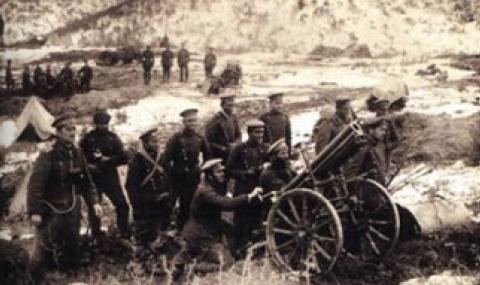

On September 16, 1918, the Entente units began a massive offensive against the Doiran position. It was defended by the 9th Pleven Division.
By the beautiful Doiran Lake, the Entente has amassed colossal forces - 4 English, 2 Greek and one French division. The 9th Pleven Division is alone. There are no reserves. Knowing the balance of forces, our people are preparing to die. Many officers put on their ceremonial uniforms, the soldiers put on the white shirts they had prepared for the last time.
On September 16, 350,000 shells were fired at them, including gas, but General Vazov's fortifications still spoke for themselves — we give 9 killed and 40 wounded. At 5:00 a.m. on September 18, three English and one Greek division go on the attack.
At this moment, 220 artillery guns begin to spit fire. General Vazov does not spare the shells - there is no time left. 400 Bulgarian mortars turn the slopes of the hills into hell. 440 machine guns simply mow down the attackers. The Bulgarians, who escaped from the bunkers, maintain such dense fire that only 20-30 percent of the attackers reach the trenches. And there they are met with a terrible and crushing counterattack like a knife.
The enemy is stopped and turned into flight, which soon covers the entire Doiran front. More than 10,000 corpses in British uniforms remain on the battlefield. The desperate British General Milne sends the two reserve divisions on a detour through Belasitsa to try to break through between the 9th Pleven and 11th Macedonian divisions. Ours let them go 50 meters and kill them point blank with their machine guns and flamethrowers. 10,000 Greeks burn on the slopes of Belasitsa.
On September 19, General Milne collects everything he can carry in weapons to replenish his depleted units. But even the last attack is drowned in blood. The furious Bulgarian artillery mows down with drum fire, and for the first time uses gas shells. This is the bloodiest battle in the entire First World War, with the highest density of dead per kilometer of front. In no war have the British suffered so many casualties at once as at Dojran.
In all this slaughter, the Ninth Pleven Division suffered only 494 killed and 1,208 wounded. On September 20, intelligence reported to General Vazov that there were no enemy units in front of him. He asked Sofia if he could advance on Thessaloniki, which was no longer defended by anyone. He was not allowed to do so. Thanks to the Dojran victory, however, in the armistice agreement being prepared there, Bulgaria, which had lost the war, was saved from occupation.
In 1936, a meeting of veterans of the First World War was organized in London. The Bulgarian delegation was led by the specially invited General Vladimir Vazov. At Victoria Station, it was personally greeted by the Mayor of London, holder of the highest English noble title. General Vazov was accommodated in Lord Harboly's castle, where Napoleon had resided. The parade of veterans includes 3,000 reserve soldiers and 200 battle flags. When our delegation appears, Field Marshal Lord Milne commands:
"Take down the flags! General Vazov is passing by - the winner of Doiran!"
The Bulgarian victory at Doiran - the greatest in our entire 14-century history - is studied in all military academies. It has recorded an incredible statistic: nearly 70,000 killed by the Entente against less than 500 dead Bulgarians. Seven divisions - completely destroyed by one.