


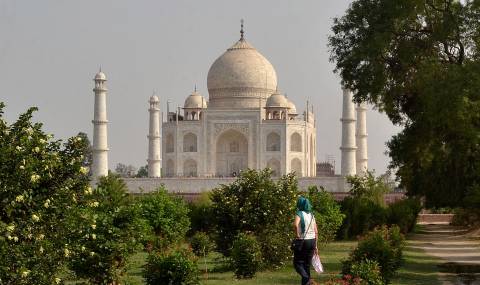

On June 17, 1631, Mumtaz Mahal died during childbirth. In her honor, her husband, Emperor Shah Jahan, built the Taj Mahal palace tomb. The construction of the mausoleum took 21 years, and 20,000 workers were involved in its construction.
In 1628, Prince Khurram took the imperial throne under the name Shah Jahan (lord of the world), and his wife was named Mumtaz Mahal (the exalted one in the palace). Mumtaz died at the age of 39 in childbirth during a military campaign. In the last moments before her death, she asked her husband to build her the largest and most magnificent tomb in the world. Shah Jahan vowed, and therefore it is believed that the construction of the mausoleum was started on the day of her death, June 17.
A large garden on the banks of the Jamuna River, owned by Raja Jai Singh, was chosen as the site for the construction. The main architect of the construction was Isa. The dome of the Taj Mahal is made in the shape of a teardrop, which, according to Isa, is the teardrop of Allah. Isa's main assistant was Jahanara - Shah Jahan's eldest daughter.
The entire Taj Mahal complex is 580 m long and 300 m wide, and in the space enclosed by a high wall, in addition to the mausoleum and the mosque, there are stables and inns for distinguished guests. The mausoleum itself has a square base, slightly rounded at the corners, with a large central arch in the middle and smaller arches on both sides. At each corner is a small dome, and the central one - resembling a huge pearl - Muhammad describes the throne of Allah as a white pearl placed on four pillars.
The facade of the mausoleum is covered with carvings and inlays of colored stones, with verses from the Koran combined with floral motifs. The gate of the complex, completed in 1684, is 30 m high, the purpose of which is that the tomb should not be seen until one passes through the gate. The original gate door, stolen by Hindu troops in the 18th century, was made of solid silver, and 1,100 nails with heads made of silver coins were hammered into it.
The garden (Char Bagh) of the complex symbolizes the Muslim paradise, in which, according to the Koran, four rivers flow - of water, milk, wine and pure honey. Today, however, the garden is actually a faint resemblance to the original, which was divided by water channels into four sections with 16 flower beds in each section, with 400 different plants in each bed.
On either side of the mausoleum are two identical red sandstone buildings. The western one is a functioning mosque, while the eastern one, known as the Dilsawab (answer), does not face Mecca and cannot be used for prayers.
The tomb is located on a square platform, on the sides of which rise four minarets. On each tower is inscribed a letter - R, X, M, H - which together read ar-Rahman (the Most Gracious), one of the 99 names of Allah.
The interior of the mausoleum consists of a central hall and four octagonal halls - these were intended by Shah Jahan as tombs for members of the imperial family, but Aurangzeb ignored his father's will. Under the hall is a crypt (maqbara) containing the tombs of Mumtaz Mahal and Shah Jahan. Replicas of the tombs are located in the central hall.
Shah Jahan was buried next to Mumtaz Mahal in 1666. Eight years earlier, he had been dethroned by one of his sons, Aurangzeb. He usurped power, and Shah Jahan spent the last eight years of his life imprisoned in the Red Fort, contemplating the Taj Mahal.