


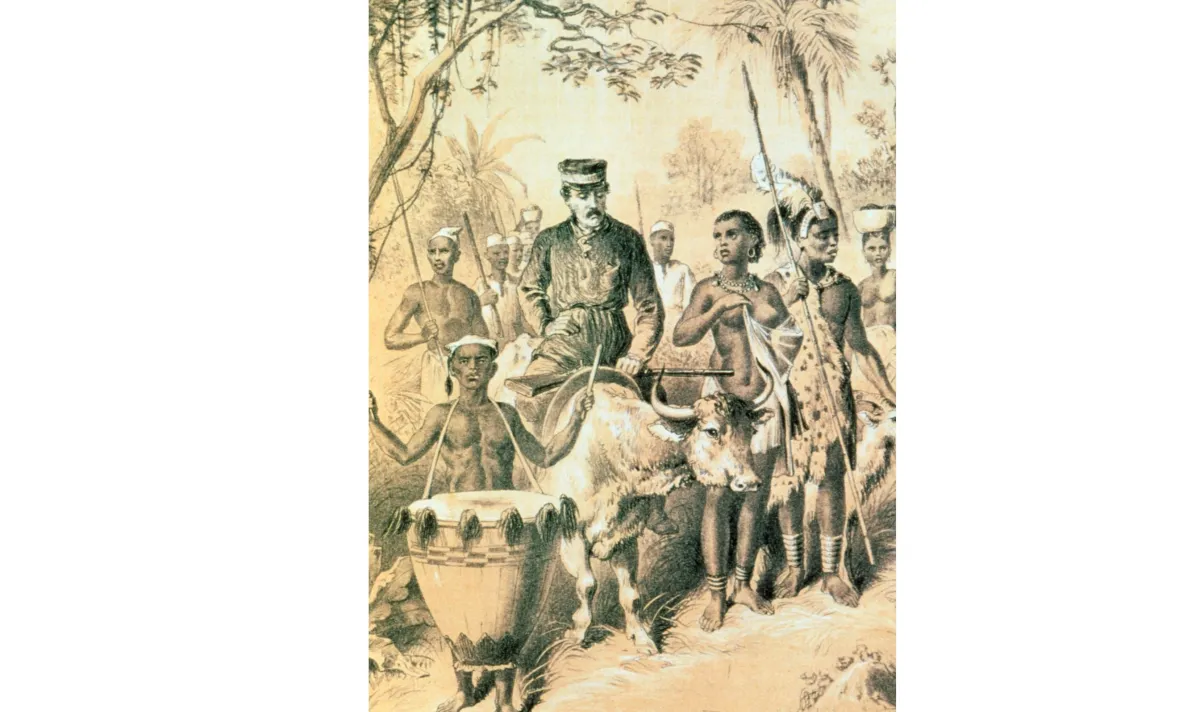

On November 16, 1855, David Livingstone approached by canoe the edge of one of Africa’s most impressive natural landmarks. Before him, the Zambezi River spread to a width of about 1,708 meters before plunging into the deep basalt gorges on the border between present-day Zambia and Zimbabwe.
The waterfall was already well known to local communities. The Makololo people called it Mosi-oa-Tunya – “The Smoke That Thunders,” a name associated with the roar of the water and the clouds of spray rising above the river. Livingstone reached the site with the help of Makololo people led by Sekeletu.
“Scenes so lovely must have been gazed upon by angels in their flight”
The Scottish missionary and explorer described his first view of the waterfall in his journal. “Scenes so lovely must have been gazed upon by angels in their flight,” Livingstone wrote of the landscape he saw from an island in the very bed of the river. The quotation remains among his best-known impressions from the expedition.
After reaching the waterfall, Livingstone named it Victoria in honor of the British queen. This is the name under which the natural landmark entered European maps and travel accounts, while the local name Mosi-oa-Tunya continues to be used today.
Dimensions That Depend on the Season
The waterfall reaches a maximum depth of 108 meters, while the area lies at an elevation of about 915 meters above sea level. The Zambezi passes through a series of eight gorges carved into the basalt rock. Spray from the water can be seen from dozens of kilometers away, while a permanent zone of high humidity and rainforest vegetation forms above the waterfall.
The reported flow rate of 1,088 cubic meters per second cannot be regarded as a constant figure. The amount of water changes considerably depending on the season, rainfall, and the level of the Zambezi. UNESCO describes Mosi-oa-Tunya/Victoria Falls as “the largest curtain of falling water in the world” – a designation that reflects the combination of the waterfall’s width and water flow, rather than its height alone.
World Heritage Shared by Two Countries
In 1989, UNESCO added Mosi-oa-Tunya/Victoria Falls to the World Heritage List. The site is transboundary – it includes protected areas in Zambia and Zimbabwe, as well as sections of the Zambezi River and the gorges below the waterfall. The organization defines it as significant both for its natural beauty and for the ongoing geological processes through which the water shapes the rocks.
More than a century and a half after Livingstone’s journey, the waterfall continues to bear two names. Victoria recalls the European description and mapping of the site, while Mosi-oa-Tunya preserves the memory of the name given by the people who knew the river and its roar long before the 1855 expedition.
Sources: nationalgeographic.com, theguardian.com