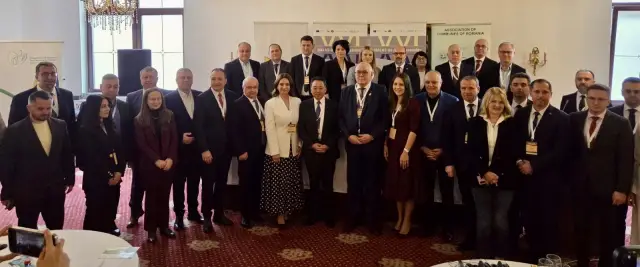
- Mr. Spirdonov, a few days ago you participated in the XXI General Assembly of NALAS - the network of local government associations from Southeast Europe. What ideas, solutions and good practices did you discuss with the other participants?
– Participation in the XXI General Assembly of NALAS was extremely useful because it brought together representatives of local authorities, national associations and international partners from the entire region of Southeast Europe. Such forums are important because they show that the problems of municipalities are often similar, regardless of the state – financing, administrative capacity, green transformation, digitalization, infrastructure, demographic challenges and the need for better dialogue between central and local government.
For me, the most valuable thing was that the conversation did not remain only at the level of general messages. We discussed specific solutions and good practices - how local authorities can be better prepared for European policies, how to use resources more effectively, how to introduce electronic services, how to improve the publicity of their work and how to more actively engage citizens.
A particularly important emphasis was the role of local government associations. They are a bridge between individual municipalities, state institutions and European partners. It is through such an exchange that we can transfer working models, avoid other people's mistakes and find faster solutions for our municipalities.
- You are the second term chairman of NAPOS-RB. What are the most important problems that the association is currently solving?
– The most important task of NAPOS-RB is to defend the role of municipal councils as real local parliaments. In public discourse, we often talk mainly about mayors and the administration, but municipal councils are the body that adopts the budget, regulations, local policies, development programs and controls the executive branch at the local level.
We are currently working in several main areas. First - increasing the capacity of the chairmen of municipal councils and the municipal councilors themselves through training, exchange of experience and practical guidelines. Second - improving the regulatory framework so that municipal councils work more effectively, more transparently and more predictably. Third - digitalization of processes, publicity of meetings, access to materials and better communication with citizens.
Another important issue is the status of the municipal councilor. In many municipalities, councilors work under a serious workload, but without sufficient expert, technical and administrative support. And they are expected to make responsible decisions on budget, territorial development, social activities, education, culture, infrastructure.
Our goal is not only to point out the problems, but to propose solutions and to be a partner of state institutions, the National Assembly of the Republic of Bulgaria and all organizations that work for stronger local self-government.
– How does the role of a chairman of a municipal council differ from that of a mayor, and why is it important for it to be better understood by society?
– The difference is significant. The mayor is a body of executive power in the municipality. He manages the administration, organizes the implementation of the budget, projects and daily activities. The municipal council is the body of local self-government that makes decisions on the most important issues – the budget, regulations, disposal of municipal property, local taxes, programs and strategic development of the municipality.
The chairman of the municipal council is not a “second mayor“. His role is different. He organizes the work of the council, chairs the meetings, ensures compliance with procedures, supports the work of the standing committees and creates conditions for normal dialogue between political groups, the administration and citizens.
This is a balancing and institutional function. The chairman must maintain the authority of the municipal council as a body, regardless of the political differences within it.
It is important for society to understand this role, because local democracy does not end with the election of a mayor. Many of the decisions that directly affect people's lives are made in the municipal council hall. The more informed citizens are about this institution, the stronger the public control and the better the quality of the decisions.
– In 2024, changes were made to the Law on Local Self-Government and Local Administration. Which of them really help municipal councilors and which create difficulties?
– The changes from 2024 have a clear positive direction – more transparency, publicity and accessibility in the work of municipal councils. The requirement that the agenda and meeting materials be publicly available, that the meetings be broadcasted, and that the questions and answers to them be maintained in an electronic register is a step forward.
This helps both municipal councilors and citizens. Councilors get a better working environment, and citizens can more easily track how decisions are made, who defends what position and what arguments are behind a given decision. This increases trust in the institutions.
The difficulties are mainly practical. Not all municipalities have the same administrative, technical and financial capacity. For a large municipality, online broadcasting, electronic systems and machine-readable documents are completely achievable. For small municipalities, this is sometimes a serious challenge.
Therefore, our position is that legal requirements must be accompanied by methodological assistance, training and resources. It is not enough to simply introduce new obligations. It is necessary to ensure that they are implemented qualitatively in all municipalities, regardless of their size.
– A new government is to be formed in a few days. Will the leadership of NAPOS-RB seek interaction with the cabinet and on what topics?
– Of course. Local government cannot be considered as a periphery of the state. Municipalities are the closest level to citizens and it is there that it is most clearly seen whether a policy works or not.
NAPOS-RB will seek dialogue with the new government on topics that are important for municipal councils and local self-government as a whole. These include a stable regulatory framework, predictable financing of local policies, clearer rules for the adoption and implementation of municipal budgets, digitalization, training of municipal councilors and administrative capacity.
We will insist that local authorities be included in a timely manner in the discussion of draft laws that affect them. Very often, problems arise not because there is a lack of desire for reforms, but because decisions are made without sufficient consultation with the people who must then implement them on the ground.
We are convinced that the state needs strong municipalities, and strong municipalities need a working partnership with the state.
– Will you put the dialogue on financial decentralization on the agenda?
– Yes, this is one of the key topics. Financial decentralization is not just a matter of more money for municipalities. It is a matter of trust, responsibility and real local independence.