


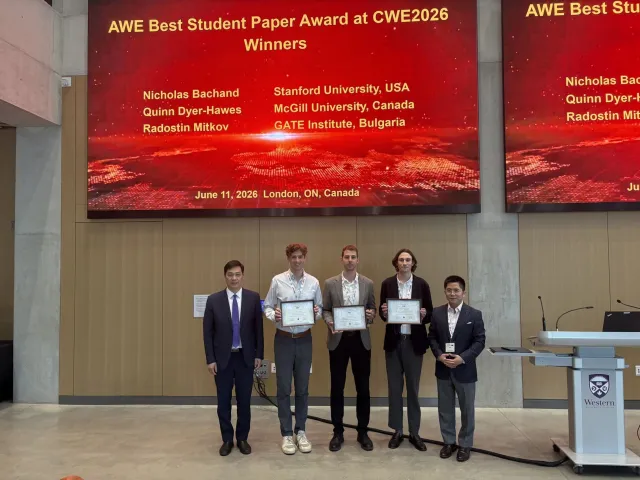
Researcher from the GATE Institute at Sofia University "St. Kliment Ohridski" Radostin Mitkov was awarded the AWE Best Student Paper Award for scientific research, distinguished among over 100 studies from around the world. The recognition was granted during the International Symposium on Computer Modeling of Air Flows in Canada - a forum that is held once every four years and brings together leading scientists in the field. The distinguished research examines one of the fundamental questions facing modern engineering simulations - how their reliability can be assessed and guaranteed in supporting real-world decisions related to the urban environment, infrastructure, air quality and building design. Radostin Mitkov speaks to FACT
- Mr. Mitkov, your scientific paper, which examines the reliability of computer simulations, was awarded the AWE Best Student Paper Award among over 100 studies from around the world. What won the jury over?
- Computer simulations for fluid dynamics (Computational Fluid Dynamics) or CFD simulations, as we often call them, allow us to see how air moves between buildings without doing expensive physical experiments. However, these simulations are not 100% accurate and there is always a certain uncertainty in the results obtained. Our task as engineers is to assess this uncertainty and possible errors.
Our work offers a unified model that simultaneously considers two main sources of errors, instead of analyzing them separately, as is often done so far. It also shows how the assessment of uncertainty can be taken into account in the final analysis of the simulation results. We believe that it was this focus on the reliability of the simulations that impressed the jury and contributed to the award.
- Why is this question so important for real-world decisions in urban environments and engineering?
- In urban environments, any major change, such as the construction of a new tall building or housing complex, can affect air movement and air quality. Engineers are increasingly using computer simulations to predict these effects in advance, even at the design stage.
However, if we do not know how reliable these simulations are, we risk making decisions that do not work in practice or may even worsen conditions. Therefore, it is important not only to get a result, but also to know how much we can trust it.
- You are working on models that analyze air movement between buildings. What can these simulations tell us about the quality of life in big cities?
- CFD simulations help identify areas with low ventilation, strong winds or unpleasant eddies that affect pedestrian comfort. This way we can assess where people are likely to feel strong gusts that make walking unpleasant or even dangerous, and where conditions are milder and more suitable for recreation.
Such types of analyses are not yet widespread in Sofia, as the more significant problem for the city is air quality. However, CFD simulations can also help us understand how pollutants are spread - for example, those from car traffic or related to industrial activity.
We can identify problem areas with stagnant air and high levels of pollution, as well as places where pollutants are removed more quickly. This allows for a better understanding of how the urban environment affects the spread of pollution.
- As part of the team that developed the Digital Twin of Sofia, how can this technology help the capital become a healthier and more sustainable place to live?
- The Digital Twin of Sofia is a virtual copy of the city, which is enriched with various data on buildings, infrastructure, transport, energy consumption, air quality and other characteristics of the urban environment.
This allows scenarios to be tested in a virtual environment that would be expensive or impossible to test in reality. For example, we can study how wind conditions around a new building will change or what will happen to the transport of pollutants during street reconstruction.
This way, we can assess potential effects in advance and avoid solutions that create unfavorable conditions in terms of strong winds or high pollution levels.
In addition, the digital twin facilitates communication because the results can be visualized in an accessible way. This way, both citizens and local authorities can more clearly see the potential effects of a given urban development decision.
- To what extent are artificial intelligence and machine learning changing the way wind processes and pollution in urban environments are studied?
- Artificial intelligence and machine learning are entering the study of wind processes mainly through models that can accelerate simulations. Classical CFD calculations are heavy and take up a lot of time and computing resources, especially when high accuracy is sought in complex urban geometry.
Machine learning can be used to create models that provide us with a final result much faster than full high-resolution simulations. Such accelerated models allow us to analyze many more scenarios – for example, different options for the height and orientation of new buildings, as well as different wind directions and conditions.
This way, we can make a more complete assessment of the potential risks and benefits even before a given solution is implemented in the real urban environment.
- In recent years, there has been increasing talk about air pollution and urban “hot spots“. Can your developments help local authorities make better decisions about urban planning?
- Our developments can help identify pollution hotspots, and then explore potential options for their mitigation. When urban planning is based on well-tested models, the risk of unintended negative effects is reduced. This means more informed decisions about where to build new buildings, how to shape streets and squares, and where the most suitable places are for green spaces that can help with ventilation and influence the concentration of pollutants.
- You specialized at the Von Karman Institute for Fluid Dynamics in Belgium – one of the world's leading centers for aerodynamics. What did you learn there, what is different about this center…
- The Von Karman Institute for Fluid Dynamics in Belgium is a place where science works in very close connection with industry. There, models are developed and experiments are conducted in collaboration with companies from aviation, energy, engine engineering and other high-tech fields, so that scientific results can quickly reach real-world applications.
The most interesting thing that can be seen and learned there is precisely that good science must go hand in hand with engineering practice. The institute works simultaneously with physical experiments and computer simulations, but always with the thought of how a given new model or method can help a real airplane fly more economically, an engine to be more efficient or an energy system to be more sustainable.
This strong connection between academic research and industrial projects is a lesson that is also very valuable for work on urban environments and digital technologies.
- In your work, you combine computer simulations, big data and artificial intelligence. What are the biggest challenges facing such an interdisciplinary approach?
- Combining computer simulations, big data and artificial intelligence brings great potential, but also a number of challenges. One of the main ones is to preserve the physical meaning of the models when using data and machine learning.
It is important that algorithms do not become a “black box” that simply gives numbers without it being clear how physically realistic they are.
Another difficulty is related to the quality and compatibility of the data. Models using artificial intelligence rely on high-quality data, while CFD simulations strive to recreate reality, but are always associated with a certain amount of error and uncertainty.
That is why careful processing and validation are necessary so that systematic errors do not accumulate when combining different approaches.
- To what extent do Bulgarian scientists and scientific institutes today manage to be competitive on the world stage in the field of engineering and digital technologies?
- Bulgarian scientists and scientific institutes in the field of engineering and digital technologies have the potential to be competitive, especially when working on topics that are highly international – such as fluid dynamics, urban environment and digital models.
In recent years, there has been an increasingly active participation in international conferences and projects, including in areas such as CFD, urban modeling and digital twins. The challenges are mainly related to resources, access to large computing power, constant modernization of software tools and sustainable funding of long-term research.
However, when there are strong teams and good international partnerships, Bulgarian developments can successfully position themselves on the world stage and contribute to the development of sustainable cities, digital technologies and reliable engineering simulations.
- How can the developments you are making find practical application in real urban planning and environmental protection projects in Bulgaria?
- The developments we are working on can find direct application in real urban planning projects. For example, they can be used to assess the impact of new tall buildings on wind and ventilation in specific neighborhoods at the design level, before a decision is made to build.
Simulations can also help identify areas with potentially high concentrations of pollutants – for example, narrow boulevards, closed courtyards and places with intense traffic – and allow testing of various measures to improve conditions.
When this is combined with a clear assessment of the reliability of the models, these tools can become a natural part of the decision-making process in municipalities and help create healthier and more sustainable urban environments.
-------------------
Radostin Mitkov is a researcher at the GATE Institute – the first center of excellence in the field of big data and artificial intelligence in Eastern Europe. He is part of the Institute's Research Group for Reliable Computer Modeling. For a long time, he also worked for the “Cities of the Future“ team, which is behind one of the most innovative developments in Bulgaria - the Digital Twin of Sofia.
In 2025, Radostin specialized at the Von Karman Institute for Fluid Dynamics (Belgium) – one of the most prestigious institutes in the world in the field of aerodynamics and fluid mechanics. There he works on projects dedicated to the study of wind processes in urban environments, combining artificial intelligence and computer simulations for more precise and rapid analyses. The Von Karman Institute is a long-standing partner of leading aviation and space companies in the development of aircraft engines, drones and satellites, which places Radostin's research in the context of the highest international standards in engineering science.