



By Emilia Milcheva:
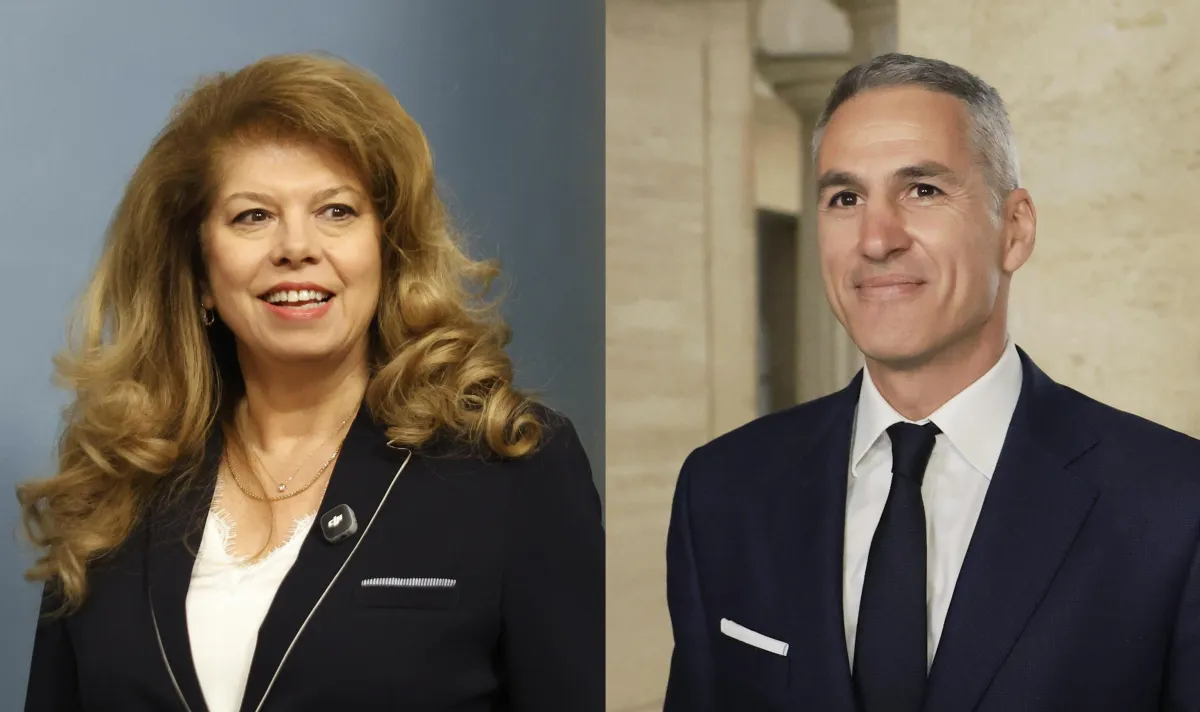
Iliyana Yotova and Andrey Gyurov have a week until the presidential runoff to raise new waves of support. Incumbent President Yotova, supported by the ruling party, must bring back to the polls voters who should be hers. And Gyurov - to win over those who never were.
The first round left them with almost equal results. For the second round, the reserves of votes are among the supporters of the dropped candidates and those over 70% who did not go to the polls at all.
Did Rumen Radev help at all?
Only a month ago, opinion polls gave Yotova a lead of at least 20 percentage points over Gyurov. It seemed logical: after nine years as Rumen Radev's vice president, she entered the race with the support of his "Progressive Bulgaria". However, the first round showed how great the gap between expected and actual support can be.
In the parliamentary elections in April, Rumen Radev collected over 1.44 million votes with the promise of change and destruction of the oligarchic model. After six months in power, expectations for him are measured by the results of his government, and they are not encouraging. Bulgaria is among the three countries in the EU with the highest inflation. And in an environment of a growing military threat in the Black Sea, the Bulgarian authorities seem more concerned about not angering Moscow than convincing their citizens that they can guarantee their security.
According to "Alpha Research", only about 29% of the April voters of "Progressive Bulgaria" participated in the presidential vote. Of these, 74% supported Yotova.
This is the significant difference between the two elections. In April, people voted for Rumen Radev. Now they were expected to vote for Iliyana Yotova, but the vote was not repeated even half as often. Whether because of disappointment with the new government, because of the expectation of an easy victory, or because Radev himself did not invest in Yotova's campaign the energy with which he won the parliamentary elections - there are probably more than one reason.
The wasted lead
Andrei Gyurov managed to close the gap not only thanks to the support of "We Continue the Change", "Democratic Bulgaria" and the democratic community as a whole. The image of a relatively new face, not worn out by many years of participation in politics, also worked in his favor.
Yotova herself also contributed to narrowing the gap. The scandal surrounding the pardon of convicted drug trafficker Ognyan Atanasov accompanied her throughout the campaign and visibly unnerved her. Instead of dispelling doubts as soon as they broke out, she first tried to shift the responsibility for her decision onto the medical commission. Then she had to explain how a prisoner pardoned for health reasons had once again found himself involved in a drug trafficking investigation. And when even more uncomfortable questions followed, she sent the materials to the prosecutor's office. From then on, any information on the investigation could be denied with the argument of investigative secrecy.
Yotova also demonstrated particular caution on the issue of the Russian threat to security in the Black Sea. She remained true to the line of Radev's government, in which the desire to avoid conflict with Moscow takes precedence over the need for a categorical position. To this, Yotova added frank demagogy - not to allow the sending of Bulgarian soldiers to Ukraine, although the president does not have the authority to decide this alone, and the parliament has already declared itself against such participation.
"Patriotic" or democratic wave?
In the runoff, Yotova and Gyurov will not only compete for the support of their own voters. They will have to convince people who preferred other candidates in the first round, and some of them - to vote against their previous political sympathies. This is where the more difficult part of the race begins, because the votes for the eliminated candidates do not belong to their party leaders.
The only reservoir is the so-called "patriotic vote" - the votes for the leaders of "Vazrazhdane", "Velichy" and MECH. With different rhetoric, but a common distrust of the EU and more similarities in their views on the war in Ukraine and the "peace" offered by Moscow, the three parties entered the presidential race. Thus, the first round also became a kind of census of their voters.
But these votes do not form a common electoral bloc. The voters of Kostadin Kostadinov, Radostin Vassilev and Ivelin Mihaylov have different motives for supporting them, and their attitude towards the two finalists is not necessarily the same either. The leader of MECH has already called on his voters to vote for Gyurov - or to stay home. For some of the voters of Kostadinov and Mihaylov, however, Yotova will be an acceptable choice.
The second reservoir is much harder to measure - the voters who stayed home. Among them are supporters of GERB and MRF, whose parties did not nominate their own candidates. According to the exit poll by "Alpha Research", only about 30% of the voters who voted for GERB in April went to the polls, and only 15% of those for MRF.
But the voters did not wait for instructions from the party headquarters. Of the GERB voters, 39% supported Gyurov, and 22% - Yotova. In the MRF, the ratio is the opposite: 39% for Yotova versus 28% for Gyurov. These are data only for those who participated in the presidential vote, but they show that neither Borisov nor Peevski can take their parties' votes for granted.
Political deals?
Judging by the Euro-Atlantic positions that Boyko Borisov has demonstrated recently, support for Gyurov would seem consistent. Just days ago, he signed alongside other former prime ministers such as Ivan Kostov, Kiril Petkov and Nikolay Denkov under a common call for a firm response to the Russian threat in the Black Sea. GERB MEPs in the EPP initiated a European Parliament resolution criticizing Radev's government for its insufficient reaction to Moscow. Radan Kanev and Ilhan Küçük (ALDE) also joined the initiative.
The GERB leader set the condition that his support be requested - he will not give it unsolicited. But Andrey Gyurov reiterated that they have not held and will not hold talks with party headquarters, but will address Bulgarian citizens directly. And it is difficult to imagine backstage negotiations with Borisov, who would hardly miss the opportunity to publicly demonstrate that he was wanted.
With the MRF, the unknowns are even more numerous. In 2016, the Movement supported Rumen Radev in the runoff without officially announcing it. Today, however, Delyan Peevski has a party that has undergone a split, and an electorate of which only 15% participated in the first round. After the actions against the MRF mayors in Belitsa, Sungurlare and Kardzhali, the low voter turnout looks more like a demonstration of controlled influence. Peevski shows he can not only mobilize his voters, but also leave them at home.
Unlike political deals, the TV debate expected this week between Yotova and Gyurov will be in full view - and could turn the race. In 1960, Vice President Richard Nixon faced Senator John F. Kennedy in the first televised presidential debate in the United States. Nixon was pale, exhausted and sweating under the spotlight, while Kennedy looked calm and confident. Up until then, the two were almost evenly matched, but after the debate, Kennedy took the lead. Sixty-six years later, cameras continue to capture every drop of sweat, every stumble and grimace.
Who will sweat in the debate on October 29 - that is the question.