


The Mars rover Curiosity has made one of its most impressive discoveries yet, coming across a vast area of the Martian surface dotted with regular, polygonal structures. The terrain looks incredibly similar to a giant honeycomb - a phenomenon the rover has seen before, but never on such a large-scale and continuous scale.
The unusual relief was recorded during the rover's ascent up the slopes of Mount Sharp, in a rugged area called Valle Grande by the scientific team. Each of the individual cells in the network is between four and eight centimeters in diameter. Unlike previous isolated finds, this time the polygonal pattern extends as far as the rover's cameras can see, covering both the flat areas and the steep slopes of the nearby six-meter-high Miraflores rock outcrop.
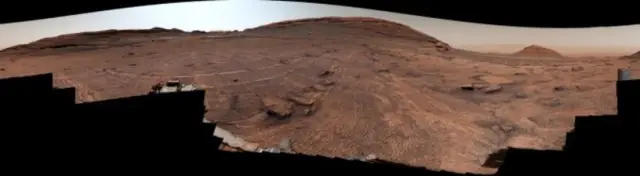
The discovery was made possible thanks to a detailed 360-degree panoramic image taken by Curiosity in mid-June 2026. Observations from orbit initially showed this area as a relatively smooth and bright surface, which is why the high density and exceptional preservation of details surprised the research team at the Jet Propulsion Laboratory in Pasadena.
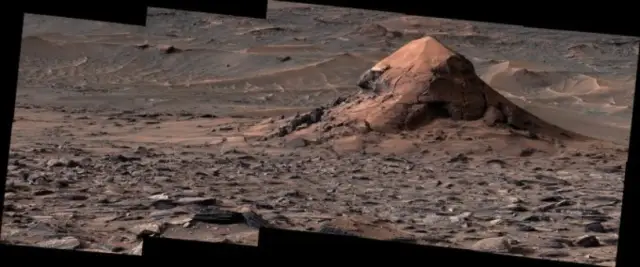
For an in-depth analysis of the geological phenomenon, scientists have harnessed the full arsenal of scientific instruments on the Mars rover. The MAHLI macro camera captured the structures from close range, while the APXS X-ray spectrometer and the ChemCam laser instrument analyzed the chemical composition. By vaporizing microscopic particles with laser pulses, the researchers compared the elements on the raised edges of the cells with those inside them, looking for differences in their origin.
The scientific community is currently considering several hypotheses for the formation of this structure. Similar geological patterns on Earth are often formed by the contraction and cracking of water-rich mud as it dries out. Alternative theories point to freezing and thawing processes or sediment pressure pushing fluids upward. Unraveling this mechanism is key to fully reconstructing the climatic conditions in Gale Crater billions of years ago, when the area was home to active lakes and rivers.