


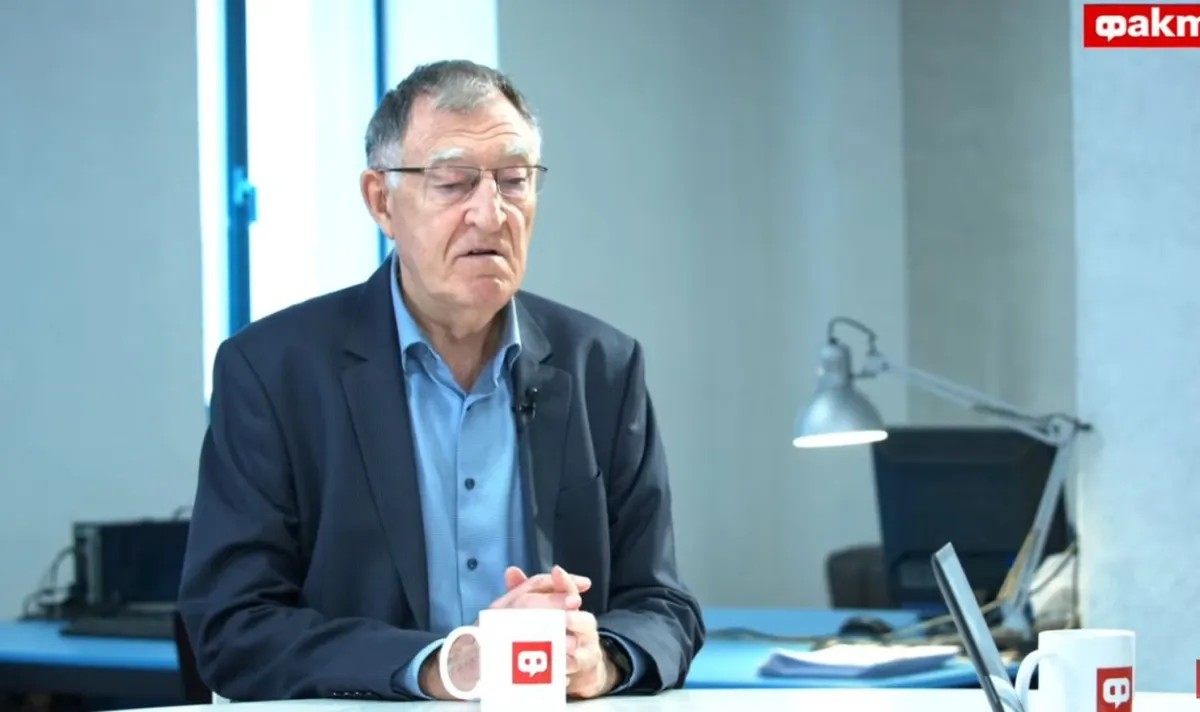

Unfortunately, every negative event in Bulgaria leads to a decrease in voter turnout. The expectations are that it will not reach 50% of the voters' list. This is obvious. Here is what else statistician Prof. Krasimir Kalinov shared with Lili Marinkova in the “FACTI“ studio and the “Conversation“ show.
- Mr. Kalinov, what are your expectations for voter turnout? It can be affected by both international events and concerns about national security, as well as domestic political circumstances, including the arrests of MRF mayors. Is it possible that all this will push voters away even more?
- Unfortunately, every negative event in Bulgaria leads to a decrease in voter turnout. My expectations are that 50% of the voter list will not be reached. Sociological agencies give 39-40%, but my long-term experience makes me think that this percentage is at least 10% higher. My personal expectations are about 30% turnout in the first round, and in the second it may fall below this percentage.
- What are these expectations for such a low turnout?
- There are many reasons. Some Bulgarian citizens have been living abroad for a long time and are not interested in our elections. In addition, the low turnout indicates a political crisis and passivity of a significant part of the people who have the right to vote.
- Can non-voting be considered a political position, and not just passivity?
- Yes. In my opinion, this is also an expression of some kind of policy, some kind of attitude. Because in order not to go to vote, you express some kind of, albeit negative, attitude towards the overall political situation and towards the candidates.
- Does this mean that the problem is not only with the voters, but also with the candidates themselves? You are saying that upon careful examination of their biographies and motivations, one can find that there is almost no choice?
- Exactly. If one thinks and carefully reads the biographies, positions, status and motivations of the candidates, one will see that there is almost no choice.
- How predictable is the behavior of voters and can low turnout change the difference between the leading candidate pairs?
- This is a very complex question. The processes of motivation to vote for one or another candidate have been studied for a long time, but to this day they are not fully understood. It is not clear what exactly influences the behavior of the electorate. If it were clear, politicians would very easily influence voters in their favor.
- Aren't the attitude towards the government and disappointment with the government the main factors in electoral behavior?
- These are parameters, of course, but they are not as reliable as we would like. A positive attitude towards the government does not necessarily mean that a person will vote for a particular candidate.
- How do you evaluate the pre-election surveys and the data on the support of the candidates?
- I deal with the technology of empirical surveys, and no technology is followed here. I assume that the difference is so great that the result was guessed one way or another. In my opinion, this is due to the inertia that society has had since the parliamentary elections on April 19 of this year. The further we move away from them, the more this inertia weakens.
- Can the decline in the popularity of the government be directly transferred to the results of the presidential elections?
- We cannot draw such a conclusion only from data for the last three days. We need to know how much the popularity of the government has decreased and whether this change will continue. We cannot automatically transfer such observations to the presidential elections.
- Do you expect voter turnout to be maintained in the second round?
- This is not at all certain. In the second round, the choice is limited to two candidates and many people may not have the motivation to vote for one or the other because they do not see them as their representatives and believe that they do not reflect their interests.
- Can parties and initiative committees further mobilize voters, for example through messages that the gap between candidates is fading?
- Parties and initiative committees often hold hidden trump cards and try to bring additional intrigue. Such a message can mobilize different party cores. It is also possible that there will be a vote in defiance by voters of parties that do not have their own candidates.
- Can the behavior of GERB and DPS voters be predicted solely based on the statements of their leaders?
- I don't think that the behavior of the general public can be modeled that easily. There is probably a certain group of people who unconditionally believe everything a leader says, but I think most of them are not. What would motivate the rest is difficult to predict in advance.
- What other factors can influence people's decision to vote?
- One of the factors is the type of elections themselves. People are not so interested in presidential elections. In local elections, they know the mayoral candidates and understand that the lives of people in the settlement depend on their work. Then the responsibility is different.
- Is it possible that the limited powers of the president also reduce interest in these elections?
- I don't think that powers are the main motive at the moment. According to the Constitution, the president is severely limited and practically does not depend on him as much as some candidates promise. The majority of candidate pairs should read the Constitution instead of demagogueing about what they will do. They cannot fulfill everything they promise.
- Do you have any doubts about the way in which the funds for media coverage of the candidates are distributed?
- Yes, there is also a commercial element, which in my opinion is more of a job for the prosecutor's office. It is about money that the state allocates for a specific purpose, and subsequently ends up in some unknown television stations and cable companies. It is striking that packages of seven or eight candidate pairs concentrate their funds in one television station. This raises questions that deserve investigation.
- Is it possible that the lower interest in the presidential elections is due to the fact that people are not interested enough in them?
- Yes, people are somehow not very interested in these elections. This is one of the reasons that make them vote less. If these were local elections, when you know the candidates for mayor and know that the work of half the settlement in which you live depends on them, then the responsibility is different.
- Do you think that the low interest also stems from the limited powers of the president, who is more of a symbolic figure under the Constitution?
- I don't think that the powers of the Bulgarian president are currently a motive. But he is so severely limited under the Constitution that practically nothing depends on him. In this regard, I would like to say that the majority of these 28 candidate pairs should read the Constitution instead of demagoguery about what they would do. They can't do it. Whatever they do, they can't. These are promises for the naive, not even middle-aged, but elementary-aged.
- How do you assess the way some candidates participate in the elections?
- The formal way in which they participate is quite outrageous, as is the admission of such elements that are included only for the sake of getting into the media.
- In addition to the political messages, are there any financial issues surrounding the participation of the candidates that deserve attention?
- There is also some commercial element, but that is not my job to comment on it. It is rather the job of the prosecutor's office.
- Why do you think that the prosecutor's office should deal with this issue?
- Because some money that the state allocates for a specific purpose suddenly ends up in some unknown television stations, cable companies, and so on. I understand if all 28 different television stations received funds because the candidates liked and chose them. But suddenly it turns out that packages of seven or eight candidate pairs are concentrating their funds in one television station.
- Do you know anything more about these cases? Is this a specific scheme?
- A report by the Institute for Public Environment Research has been released, in which everything is described very clearly. I don't know if this is a scheme. I'm just stating what I've officially seen. Whether it's a scheme, everyone can think, but that's what the relevant authorities will say. That's why I mentioned the prosecutor's office after the elections.
- So there may be nothing illegal, but there are still grounds for suspicion?
- Yes, most likely there is nothing illegal, but it stinks.
- Let's get back to the runoff. What reserves for additional support can candidates use?
- First, the reserves of the parties themselves. Candidates nominated by initiative committees, especially the first two, will have to mobilize their followers who did not vote. This is one reserve, but how achievable it is depends on many other factors and motivations. The second reserve is the parties that do not actually participate with their own candidates, but would support one or the other at least verbally.
- To what extent do you believe that such support from other parties can change the result?
- I'm not sure that even if they supported one candidate, this could in any way change the result or the status quo.
- You define the presidential elections as the most expensive in Bulgaria. Why?
- They are the most expensive in Bulgaria to date, because there is a definite increase in the money we spend on elections. This is already a trend. The thing is that you and I do not spend it directly, but others spend it, and they take it from us. This is scandalous. In my opinion, very few colleagues, one or two with whom we know each other, raise the issue of the cost of the elections.
- Are the Bulgarian presidential elections really more expensive than the presidential elections in the United States?
- Imight be completely serious. This duplication of paper ballots, the repair of some imaginary machines, the maintenance — all these items make over 150 million euros.
- You claim that the elections in Bulgaria are too expensive and that they should cost no more than 20 million euros. How do you calculate this amount?
- By taking the budget that the CEC announces. Moreover, there are missing items in this budget. The CEC does not determine everything. For example, the payment is in the budgets of the Ministry of Internal Affairs, for which the Council of Ministers allocates the money. Now I saw that they are asking for I don't know how many million euros for some additional activities. They are constantly asking for and giving out some money.
- Does this mean that the real cost of the elections is higher than the officially announced one?
- Yes, because the expenses are distributed in different items and not everything is visible in the CEC budget. I can't understand this, to be honest, and I'm not optimistic. The machines are very outdated and will soon have to be replaced. I can't imagine what will happen then.
- You also question the model in which a private company controls the technical side of the election process. What do you think is the problem?
- In Bulgaria, we have given the right to a private company — “Smartmatic“ — to control the entire process. A private company, no matter how much I like its boss and how much they claim to be the most honest people in the world, has one single goal: profit, profit at all costs. It is no coincidence that people say that a state monopoly is a bad thing, but a private monopoly is worse.
- In what way do you think this company could derive financial benefit from such a situation?
- There are different mechanisms. In any case, a machine here is bought at least six or seven times more expensive than it actually costs. I have experience, because I dealt with this years ago. There was a Bulgarian company that offered quite acceptable voting machines at exactly ten times the price, but it was removed in the most outrageous way.
- Is the fact that technical service depends on a single supplier a problem?
- Yes. In my opinion, the monopoly is being preserved. “Smartmatic“ does not want to negotiate in any way with either “Information Service“ or the Council of Ministers. They say: “Our authorized representative is SLA. Period.“
- And what worries you about the repair and maintenance of the machines?
- Everything — storage, testing, inspection and repair — costs money. In the previous elections, there were supposedly about 100 and several damaged machines. Now, suddenly, the offer includes 2,000 machines for repair, with smaller and larger repairs, and another 2,000 for preventive maintenance. This is inexplicable.
In my opinion, the money requested for these activities is greatly inflated, because there is no market economy and competition. There is a monopolist who says: “This is what I want. If you want it - if not, I cannot secure the elections.“
- Do you think that this model is also supported by political patronage?
- Absolutely. In my opinion, this is done with some implicit patronage of some of the deputies, because they could solve the issue. The easiest solution was to eliminate machine voting, correct the weaknesses in voting with ballots, conduct the necessary training and change the entire scheme for appointing the section election commissions. Then things could start to look normal European.
- Is there a risk of interference by private interests in the processing of election results through “Information Services“?
- I have information on this issue, but I think that the claims about significant influence of private interests are false. Private interests in “Information Services“ are less than 1%. A shareholder who owns one millionth of a share cannot go and determine what the company does. I have personally worked very actively with “Information Services“ and I think that there cannot be a breakthrough there.
- Then in your opinion, where are the main problems in counting votes?
- The breakthrough occurs at the section level. Especially in small settlements, the people who organize the elections are often relatives - brother, sister, uncle, aunt and so on. There, it is known in advance who will be voted for and what will be voted on. The problems are not so much in the conscious manipulation of the results, but in ignorance and the shameless filling out of the protocols.
- But wasn't machine voting introduced to avoid such problems?
- We can't completely avoid anything. Recently, there were partial local elections and the power went out in several places. In two sections, as far as I remember, this happened. What do we do then? The machine is working, but there is no power. We need to bring out paper ballots again.
- How do you assess the work of the current Central Election Commission and the recent changes to the Electoral Code?
- In my opinion, the current CEC is inexperienced and appointed based on political criteria. Within about ten days, it made several serious mistakes. However, these mistakes were also predetermined by the changes to the Electoral Code. For example, they expanded the powers of the sectional commissions to decide for themselves whether a machine is not working and whether voting should continue with paper ballots. Before, there was a permit regime: the sectional commission notifies the regional commission, which notifies the CEC, the CEC makes a decision and returns it. Now the sectional commissions only notify the regional ones and continue in the appropriate order. There are many problems in the code itself. There are also things that the deputies know because we have informed them, but they do not want to change because it is more profitable for them.
- What specific risks do you expect in the upcoming elections?
- I am worried that some of the machines may stop working or issue blank receipts, or not issue receipts at all. Then the number of receipts in the box and the number of votes that the machine has registered and recorded in the protocol may differ drastically. And according to the Electoral Code, it is the protocol that is the official document. I am afraid that the election results will again end up being challenged before the Constitutional Court. The other risk is in small settlements, where voting is only done with paper ballots. There, the poor preparation of the sectional commissions can lead to the same violations and errors in the protocols.
- Do you also have concerns about the CEC's methodological instructions?
- Yes. The sectional commissions work according to the CEC's methodological instructions, which were changing until the last moment. There were errors, incompleteness and omissions. The latest version came out just a few days before the elections and I didn't even bother to read it because it no longer made sense. Appointing the sectional commissions 25 days before the elections, and then starting to make changes on the day before the elections or immediately before them, is a gross violation of the normal organization of the electoral process.
- You also criticize the preparation of the members of the sectional commissions. Do you connect this with the way their remuneration is determined?
– Yes, I am asking this question as well. There is no other country in Europe that pays such high fees to the members of the section committees. In most countries, they even provide volunteers with sandwiches and drinks.
See more of the conversation in the VIDEO.