


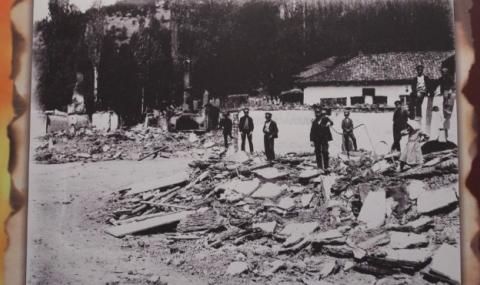

On May 15 and 16, 1917, the Serbs entered the Bosilegrad region through a paramilitary formation of Kosta Pechanac. This detachment moved in the Bosilegrad region for only 2 days, but as a result of its atrocities, 32 people were killed, 2 children were burned alive, and the property of 317 households was destroyed. This is how the historian Angel Dzhonev describes the Bosilegrad Massacre in his book dedicated to the massacre at the end of World War I.
The history of the Western Suburbs is a series of war crimes against the legitimate aspiration of the Bulgarians for the failed national unification. With this goal, Bulgaria entered the geopolitical conflict during World War I on the side of the Central Powers. Together with the allies, the Bulgarian army launched a military offensive against Serbia. In less than two months, the Serbian kingdom ceased to exist. The remnants of the Serbian army escaped through Albania. In the captured areas, the Central Alliance introduced its own administration. Bulgaria created the Macedonian and Moravian military inspection areas with district, subdistrict and municipal structures.
In 1916, the war continued on the southern front on the border with Greece, and on the northern front in Romania. Northern Dobrudja and Southeastern Macedonia were recaptured, but the Bitola region was ceded. The pressure of the Entente forces in this area was combined with the conduct of sabotage and sabotage actions in Pomoravie. This task was assigned to the Serbian lieutenant Kosta Milovanović Pečanac, who at the end of September 1916 was transported by plane to Pomoravica with instructions to organize the so-called Topliška Buna against the Bulgarian authorities in order to weaken the rear of the Bulgarian command and coordinate it with the attempts to break through on the Southern Front.
The action itself began with an attack on the Niš-Skopje railway line at Ristovac station and the massacre of wounded Bulgarian and German soldiers in a medical convoy. On May 15-16, 1917, Kosta Pečanac with a detachment of 200-250 Chetniks invaded the territory of the Kingdom of Bulgaria in the Bosilegrad region and for two days looted the peaceful Bulgarian population. In the villages of Gorna and Dolna Lyubata, Bosilegrad, Dolna and Gorna Lisina, Topli dol, Dolna and Gorna and Razhana, 32 peaceful residents were killed in their homes in a particularly cruel manner, mainly adults, women and children, including two village teachers, two children whose names were unknown, burned in one burning house, 317 houses and other buildings were burned. Livestock, valuables and food products were looted. The damage caused was worth 2.5 million leva.
A larger part of the population was warned at the last moment and managed to escape. Nowhere on their way did the Serbian robbers encounter Bulgarian military units, and this allowed them to torture, kill, burn and rape with impunity. In some mountain hamlets, self-organized local villagers put up armed resistance to ensure the escape of their women and children from the pogrom. In the first clash with a combined company from Kyustendil, Pechanac crossed the Serbian-Bulgarian border and retreated towards Kosovo.
The invasion of Bulgarian territory and the massacre in the Bosilegrad region 100 years ago was another step in the centuries-old Serbian aspirations to conquer Bulgarian lands and assimilate, i.e. Serbify, the Bulgarian population. Taking advantage of the moment when there were no Bulgarian military units in the Bosilegrad region and all able-bodied men were mobilized to the front, Kosta Pečanac, on the instructions of the Serbian command, carried out a brutal terrorist action against the peaceful Bulgarian population with the aim of violence and robbery in violation of all known conventions and rules for conducting military operations.
This is the third Serbian military action to take control of the Bosilegrad region, carried out at the beginning of the last century in 1913, 1915 and 1917 and ending with the Neuilly Peace Treaty and the occupation of the Western outskirts by the State of Serbs, Croats and Slovenes.
One of the goals of this terrorist action was to produce a strong psychological effect on the Headquarters, which was then located in Kyustendil. That is why this action was assigned to a hardened terrorist and murderer like Kosta Pečanac, who has experience in carrying out such terrorist actions not only against the Bulgarian population in Macedonia, but also against the population in Pomoravica for the purpose of violence and robbery.
The memories of this horror still live on in the Bosilegrad region to this day.