


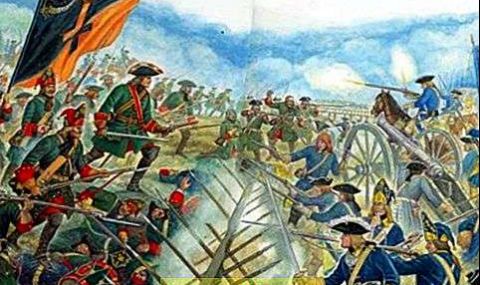

On June 27, 1709, the Russian Tsar Peter I defeated the Swedish troops at the Battle of Poltava, effectively winning the Northern War that began in the early 18th century.
The defeat deprives Sweden of its status as a great power in Northern Europe.
Charles XII, according to his contemporaries, “was in love with war.” His army often won battles with superior opponents. This happened at the Battle of Narva in 1700, when he completely defeated the Russian troops. After it, the Swedish king ordered a medal to be minted with a mocking image of a weeping Peter, who runs away, throwing away his sword and hat. After defeating Russia, Charles marched on Poland and Saxony and defeated Augustus II. The Russian Tsar, meanwhile, managed to rearm and reform his army, expel the Swedes from the Russian Baltic coast and establish himself at the mouth of the Neva River in St. Petersburg.
But the country desperately needed a wide outlet to the Baltic Sea for the development of trade with Europe. In 1707, Charles, realizing that Russia was still his main opponent, led the army through what is now Ukraine to Moscow.
The Battle of Poltava showed that the Russians had mastered the best military and technical achievements of the time in a short time. Peter I's artillery was significantly superior to the Swedish. Carefully thought-out fortifications were built. Charles XII's calculations of a bayonet charge, in which the guards were strong, did not prove true. The battle was fierce. The losses of the Swedes were two and a half times greater than the losses of the Russian army. Charles was forced to flee to Turkey. This was a victory.
A few years later, Peter defeated the Swedes in the naval battles of Gangut and Grengam. Europe, which had previously paid little attention to the Russian Tsar, has since learned to take into account the interests of Russia in international politics. Peter I, whose true calling, according to historians, was the water element, received the requested access to the Baltic Sea. The warlike Swedish king was killed in a battle with the Norwegians in 1718. "Ah, brother Charles" - Peter said with regret, having learned about him. And he declared a week of mourning for the great commander.