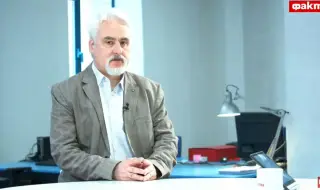
"There are such people" will withdraw its bill for amendments to the Criminal Code, which would punish the dissemination of information from someone's private life with imprisonment from 1 to 6 years. This was announced by GERB leader Boyko Borisov in parliament and explained that he spoke on the phone with Slavi Trifonov, who assured him that the bill would be withdrawn because he disagrees with some of the texts in it. About the private lives of public figures … Lawyer Alexander Kashumov speaks to FACT.
- Mr. Kashumov, you are a lawyer, married, father of three children. How sensitive is this personal information that I am providing in the question?
- From the point of view of the General Data Protection Regulation (GDPR) of the European Union, which also operates directly in Bulgaria with the force of law, any information that refers to a specific individual is considered personal data. The main idea in the protection of personal data is to protect people's privacy from interference, whether by the state or by other private individuals. However, here it turns out to be very complicated to judge which information is part of the public and which - from the private sphere. The distinction between public figures and private individuals is of key importance. Public figures are state bodies such as ministers, members of parliament, the president, mayors, etc., high-ranking civil servants, magistrates, as well as various types of celebrities such as actors, musicians, writers, athletes, businessmen and businesswomen. Naturally, lawyers and prosecutors are also such figures, as is anyone who speaks publicly. In these cases, these figures have exposed themselves “consciously and inevitably to close scrutiny“ by the media and society, in the words of the European Court of Human Rights. Therefore, the information that I am a lawyer, married and a father of 3 children is rather public for me as a person with public positions, while for a large part of the citizens it is part of their private life. This delicate assessment should be made, for example, by ethical journalism. But precisely because the dividing line is sensitive and dynamic, it is unacceptable to introduce severe sanctions for crossing it, let alone the most severe possible state repression - prison.
- And if you don't like the question, you can put me in prison. Is that how it comes out of the draft law of the ITN?
- That's exactly what it comes out of. Because this issue contains personal information, and if someone decides to apply a formalistic understanding and apply the same yardstick, regardless of whether it is a question of public figures and public situations or private individuals and private situations, then distortion occurs. The possibility of activating the system of criminal repression constitutes censorship in itself, since it will have a deterrent effect on free speech and criticism. The Strasbourg court has also had reason to accept that the very existence of criminal repression affecting fundamental human rights may constitute a violation of the European Convention on Human Rights.
- The Ministry of Internal Affairs will withdraw the controversial bill on amendments to the Criminal Code criminalizing the dissemination of personal information after Borisov's intervention. Was this a test of society?
- This is a test - and a serious one. The truth is that only a sensitive society is able to stop such manifestations that can strike democracy and open the doors to state arbitrariness. Borisov is behaving reactively, not proactively. His party actually supported the dark bill in the leading parliamentary committee, as is well known. This means that the public's sensitivity is being tested. It is very important that there was a strong public reaction.
- What is the main problem with this bill…
- There are many problems. Criminal liability for publications that affect "private life" cannot exist in a democratic society. Criminal liability is for public manifestations that are categorically unacceptable and socially dangerous. It is clear that a theft or robbery cannot be of public benefit. However, this is not the case with speech. A critical speech can be extremely useful for society if it is in place and at the right time. The free dissemination of opinion, ideas and information is the basis of the concept of a "democratic society". And although freedom of speech is not unlimited, it should be considered as a principle, and its restriction - as an exception, as the Constitutional Court emphasized 29 years ago, in 1996. Due to the delicate nature of the boundary between permissible and impermissible speech, the means of restriction must be adequate, namely - a civil lawsuit, as is currently the case. We should not forget that there was no criminal repression for publications affecting private life even in the darkest periods of the communist regime.
- What does private life mean when a person is a public figure…
- As I said, when it comes to a public figure, then the personal sphere is protected to a much lesser extent than in the case of private individuals. This has been clearly stated by both the Constitutional Court and the ECHR. This is so, because citizens have the right to information not only about the actions, but also about the individuals who carry them out, in order to be able to assess their moral character. In some cases this is because of the right to informed choice - in the case of deputies, the president, mayors and municipal councilors, in other cases it is because of the influence of certain public figures on public life - in the case of ministers, actors, singers, athletes, influencers. People have the right to know not only what, but also who is speaking.
- The deputies themselves had not clearly written what private life means. Then…
- They even openly admitted in the explanatory notes to the bill that they were having difficulty defining the concept of “private life“ and that it is difficult to define. And that is so. A photo in a restaurant can be part of a private person's private life, and it can be part of public life when we find the Prosecutor General there. The same applies to other private spaces, such as a private car, private parties, yachts, etc. Whether someone travels around the world and which borders they have crossed is part of private life, but if this someone is close to a member of parliament and his travels coincide in route with those of Taki, things change. Therefore, there is no way to give a formal definition of “private life“ and this makes the introduction of such a crime even more undesirable and absurd.
- Again, according to this bill, journalists can be monitored and their emails checked. Where then is the private life of journalists, who are also mostly public figures…
- In the 2022 decision of the ECHR in the case of Ekimdzhiev and Others v. Bulgaria, in which I am an applicant, together with the Access to Information Program, and a lawyer, the regime of secret surveillance in Bulgaria was declared for the second time to violate the European Convention on Human Rights (ECHR). This applies especially to groups of professions whose surveillance is even more unacceptable, such as journalists, lawyers and others. Monitoring a journalist can lead to the easy disclosure of his sources, and this is another violation of the Constitution and the ECHR. And all this – with such a compromised secret surveillance system as ours.
- 6 years in prison is a sentence given for what crimes?
- Initially, crimes punishable by over 5 years in prison were considered "serious". In 1999, the prison sentence for "insult" and "slander", which was much less, was abolished. This happened under pressure from the Council of Europe, due to the unacceptable nature of such a sanction. Someone has clearly neither read the history of our transition nor is interested in European standards for the protection of fundamental rights. Not to mention that if such a crime is of a general nature, then the hands of our unreformed prosecutor's office are untied to deal with its critics in the form of prosecution for violating privacy. Here, deterrent measures such as detention are also possible. Even if it is based on a complaint by the victim, the criminal repression can still be initiated by “aggrieved“ politicians, civil servants and others.
- Was this proposal a “stick“ law or outright censorship…
- Whatever we call it, the important thing is that it was an attempt to introduce repression that did not exist at the legal level even in a totalitarian state. That it thick-skinnedly crosses out the entire history of the transition to democracy. That it is an attempt to parry freedom of speech, on which the entire construction of the rule of law, democracy and the protection of fundamental rights is based.