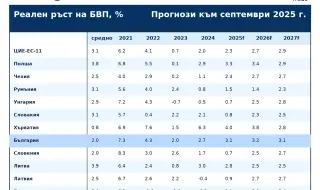
Bulgaria could be among the fastest growing economies in Central and Eastern Europe in 2025-2027, with annual GDP growth expected to remain above 3%. This is predicted by the current report of the leader in trade credit insurance globally and in our country - Allianz Trade. The optimistic prospects are based on stable domestic demand, driven by strong household consumption and the serious pace of wage growth in our country. The labor market will remain stable, and unemployment will drop to around 3.3% by 2027, analysts believe. Inflation in our country will calm down to levels below the average for the region and will have a downward trend – from 3.6% in 2025, through 2.8% in 2026 to 2.6% in 2027.
With GDP growth of 3.1% in 2025, Bulgaria will perform better than all countries in the region except Croatia (4%) and Poland (3.3%), according to the forecast report by Allianz Trade. In 2026, with an expected growth of 3.2%, our country may once again take third place after Croatia (3.8%) and Poland (3.4%), and in 2027, with a projected growth of 3.1%, it will take the leading position in CEE.
According to analysts, along with domestic consumption, investments will also play a key role in the growth of the Bulgarian economy during these three years. They are directly related to the development of EU-funded projects under the National Recovery and Resilience Plan and the large-scale public spending on infrastructure and defense.
„Bulgaria's upcoming accession to the eurozone at the beginning of 2026 will increase confidence and activate the internal engines of the economy. In anticipation of the transition to the euro, households and companies are increasing deposits and credit activity. Lower financing costs and stronger money supply are expected to further support both consumption and investment,” explains Giovanni Scarpato, economic analyst for Central and Eastern Europe at Allianz Trade. “All these factors underpin an expected period of robust and demand-led economic growth, which makes us think that Bulgaria will outperform most countries in the region,” he concludes.
According to the report, the Bulgarian economy will also see a cumulative additional growth of 2.8 percentage points by 2030 due to the country’s defense commitments. On this indicator, Bulgaria ranks eighth out of 20 European countries covered, and although the contribution is more moderate, it still places the country in a solid position in the region. For comparison, within Central and Eastern Europe, Latvia leads with an additional 11.7 percentage points, followed by Lithuania (+6.9 percentage points) and Hungary (+6.6 percentage points).
„According to our experts, the ongoing global „tariff war“ will have a relatively small direct effect on Bulgaria. The impact is estimated at a decline of 0.2 percentage points in GDP growth in 2026 compared to a scenario without tariffs. This reflects Bulgaria's limited direct exports to the US. However, Bulgarian business also remains exposed to indirect risks, including weaker demand from key European partners, higher input costs due to disrupted supply chains and delayed investment decisions amid growing global uncertainty.“, commented Kamelia Popova, manager of Euler Hermes for Bulgaria, which already operates under the Allianz Trade brand.
Therefore, although the optimistic prospects are there, Bulgarian companies, especially export-oriented ones, should not underestimate the risks and turbulences at the global level, experts believe. The serious growth of bankruptcies around the world that has continued in recent years is also a complicating factor. According to current data from Allianz Trade, the increase in bankruptcies for 2025 at the global level will reach 6% compared to the previous one. An additional growth of 4% is expected in 2026, and a moment of calm in the upward trend is seen only in 2027.
„In this turbulent context at the global level and given the current discussions about political and social stability in our country, despite the optimistic forecasts, Bulgarian companies must remain alert to risks. "The verification of trading partners, the careful monitoring of worrying trends in various economic sectors, the timely access to important information are crucial support that a proven partner like us can provide at any time. And trade credit insurance remains the key tool for protection," Kamelia Popova is categorical.
Allianz Trade is the global leader in trade credit insurance with proven expertise in suretyship, receivables collection, structured trade credit and political risk. With its own research network, the company analyzes changes in the solvency of over 83 million organizations worldwide on a daily basis. We give businesses the confidence to trade. We compensate your company in the event of bad debt, but more importantly, we help you prevent such situations in the first place. Whenever we provide trade credit insurance or other financial solutions, our priority is predictable protection. But when unexpected circumstances arise, our AA credit rating means we have the resources, backed by Allianz, to provide compensation to keep your business running.
Headquartered in Paris, Allianz Trade is present in over 50 countries with 5,700 employees. In 2023, our consolidated turnover reached 3.7 billion euros, and insured global business transactions represent an exposure of 1,131 billion euros.
To date, insured exposures in Bulgaria have reached a total value of over 2 billion euros.