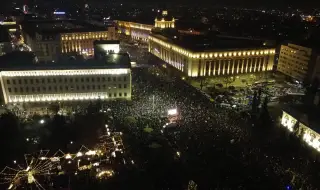
Protests in Bulgaria and the resignation of the government are among the topics in American media today. Bulgarian Prime Minister Resigns After Mass Protests, the American newspaper "New York Times" headlines, bTV writes.
Prime Minister Rosen Zhelyazkov is the sixth prime minister in five years to resign amid public dissatisfaction with corruption and poorly functioning democracy, the publication points out.
The Bulgarian Prime Minister resigned yesterday after less than a year in office, stating that he listened to the "voice of the people" after mass protests against government corruption in recent weeks.
"Our desire is to rise to the level that society expects", Zhelyazkov told journalists in parliament and added: "We heard the voice of the people who are protesting. We must respond to their demands, and right now they are demanding the resignation of the government".
The protest movement against Zhelyazkov's coalition government began over the proposed budget for next year, which envisaged an increase in taxes and social security contributions in order to finance more public spending in Bulgaria, one of the poorest countries in the European Union, notes the "New York Times".
However, the protest movement has grown and encompassed broader issues, including corruption, said Dimitar Keranov, a Bulgarian analyst at the German Marshall Fund in Berlin. He said that many people who are concerned about government corruption believe that it is being supported by politicians who support rapprochement with Russia, BTA reported.
"The protests may have started over the budget, but in fact it is about government corruption that ultimately affects the public interest," the expert said.
According to a recent sociological survey, about 70% of Bulgarians support the wave of protests, the American publication points out.
Bulgarians are disappointed by the ongoing corruption in government, as well as by years of poorly functioning democracy. The problem is common to much of Eastern Europe, especially former communist countries that are reconsidering their historical ties with Russia as they turn to the West.
Voters' disappointment contributes to Bulgaria's unusually frequent change of government, Keranov said. Rosen Zhelyazkov is only the third regularly elected Prime Minister of Bulgaria since 2021, notes the "New York Times".
Prime Minister Zhelyazkov warned yesterday of turbulent months ahead for the country, noting that in the first months after its entry into the eurozone there will be no regular cabinet "to lead the country on a stable path".
"The New York Times" quotes BTA, according to which BNB Governor Dimitar Radev has stated that the transition to the euro is still ongoing, despite the turmoil. However, the budget is likely to be blocked until the new leadership takes power, and it is unclear when President Rumen Radev will call new elections or begin the process of forming a caretaker government.
If nothing else, the protests were a manifestation of what Zhelyazkov called civic energy that "should be supported, should be encouraged," the American publication points out.
"This was a protest for values," Keranov said.
A wave of protests - Generation Z brings down a European government for the first time, the American newspaper "Wall Street Journal" headlines.
The disgruntled Generation Z protesters, who this year have toppled governments and shaken up ruling elites around the world, have scored their first victory in Europe.
Bulgaria's government fell yesterday after a wave of youth street protests against deep-rooted corruption and self-serving elites widely perceived as disconnected from the problems of ordinary citizens.
Bulgaria has become the latest flashpoint in a year marked by the unrest of Generation Z. Youth protests have toppled governments in Nepal and Madagascar in recent months.
Demonstrations against the privileges of political elites have sparked mass rallies in Indonesia and the Philippines. In Tanzania, youth anti-government protests were violently suppressed by the government, recalls "Wall Street Journal".
The resignation of Bulgaria's coalition government, announced yesterday by Prime Minister Rosen Zhelyazkov, comes just weeks before the Balkan country is set to join the eurozone, the European Union's currency union. While the fall of the Bulgarian government will not stop the planned switch to the euro on January 1, it prolongs a political crisis that has led to seven parliamentary votes in just four years. Zhelyazkov took office in January.
"Vox populi, vox dei" ("Voice of the people, voice of God"), Zhelyazkov said in parliament yesterday, quoting the Latin maxim.
"We must respond to their demands. "And their demand is the resignation of the government," he said.
The end of Zhelyazkov's pro-European government is likely to lead to early elections in the coming months, which could change the country's geopolitical prospects, the American publication points out.
According to the "Wall Street Journal", one of the potential winners is President Rumen Radev - the most popular politician, who is expected to form his own party and run in the next parliamentary elections. A former air force pilot, Radev has often criticized Western support for Ukraine in its war with Russia, describing Kiev's prospects as "doomed" earlier this year.
Corruption in the Balkan country of about 6.5 million people has long been widespread, even after it joined the EU in 2007. Consistently ranked as one of the bloc's most corrupt member states by Transparency International, Bulgaria has failed to secure convictions for high-level corruption in recent years, fueling public discontent and prompting repeated criticism from Brussels over its rule of law rating. Now, public discontent has reached a peak.
Mobilized on TikTok and other social media, Bulgarians took to the streets with signs reading "Generation Z is coming" and "Generation Z against corruption" At a demonstration in front of the parliament building in the Bulgarian capital, videos and memes mocking the government were played on a giant screen.
"The protests showed that the younger generations have enough civic energy to oppose the arrogance of an entrenched political and economic elite that uses state capture practices to stay in power," said Martin Vladimirov, director of the geoeconomics program at the Center for the Study of Democracy, a think tank based in Sofia.
For many in Bulgaria, this was their first major protest, the "Wall Street Journal" noted. Generation Z in Bulgaria grew up without having experienced the communist era, which ended in 1989, or the devastating economic crisis that followed its collapse. Their dissatisfaction covers everything from the impunity of political elites to the state of the healthcare system and the lack of well-paid jobs.
The outrage is also palpable online, where debates about democracy, corruption and media freedom are among the most popular topics. Many influential figures and actors have joined the protests. New memes have emerged, including posters that say "Take your girlfriend to a protest meeting".
Angel Ignatov, a product manager working in the IT industry in Sofia, said that after studying in the UK, he decided to return and help improve the situation in his homeland. Now, however, deepening corruption and a series of government mistakes have prompted him to join the protests.
"There is a whole generation like me," Ignatov said, adding: "We simply don't want this for our country."