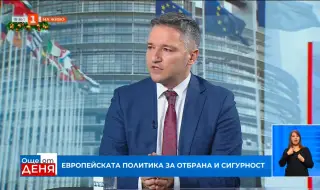
„The European Union is facing a complex geopolitical and economic situation, but it managed to achieve a realistic and legally sound solution to support Ukraine.“ This was stated by the Bulgarian MEP from the Group of the Progressive Alliance of Socialists and Democrats in the European Parliament, Christian Vigenin, to BNT.
According to him, the BSP's position remains consistent – support for Ukraine through humanitarian, financial and social assistance, but not through military assistance. „The taboo of „territories against peace“ is no longer unthinkable and is being discussed, albeit unofficially. However, it is important that any decision provides clear guarantees for Ukraine's security in the future“, said the MEP.
Kristian Vigenin also emphasized Bulgaria's future role in the reconstruction of Ukraine: “When peace returns, Bulgaria must be among the countries that will actively participate in the reconstruction. Bulgarian companies must be given the opportunity to join this long-term process.“
The MEP commented that European investments in security should not be solely for military spending. “We are talking about dual-use infrastructure – road, rail and digital connectivity, which is useful in peacetime, but also provides readiness in times of crisis – from natural disasters to security threats“, he pointed out.
Vigenin drew attention to the results of a nationally representative sociological survey by the “Myara“ agency, conducted on his initiative, which examines the attitudes of Bulgarian citizens towards key European policies. “The data show that something very interesting is visible regarding the idea of a European army – more Bulgarians support it than are against it. Over 40% express support, with a relatively even distribution of hesitations and doubts”, Vigenin pointed out. In his words, this clearly shows that despite the differences in assessments of the war in Ukraine and sometimes the divergence with the official positions of the EU, there is an awareness among Bulgarian citizens that in today's uncertain world, individual countries can hardly guarantee their security on their own.
The MEP emphasized that for more and more people, the European Union is no longer perceived solely as a union of social security and economic opportunities, but also as a community from which real guarantees in the field of defense and the so-called "hard security" are expected. "There is a feeling that we must rely on each other. This is the logic of the union and it is expanding," he noted.
Vigenin emphasized that the concept of "security" should not be reduced solely to armaments. "Defense is not just weapons. "Defense also includes good healthcare, the ability of health systems to respond to emergencies, civil protection, infrastructure and the resilience of society as a whole," the MEP stressed. According to him, it is this broader approach to security that is gradually starting to find a place in European policies.
On the topic of the so-called "military Schengen", the MEP pointed out that Bulgaria could have concrete benefits - accelerated construction of north-south infrastructure, new railway connections with Turkey and at least one more bridge over the Danube. He also stressed the importance of a report he is working on in the EP's Defense Committee, aimed at drastically shortening the deadlines for approving projects related to defense and infrastructure.
“These are not war costs, but investments in security, resilience and development. The main effect will be on civil use and quality of life“, concluded Christian Vigenin.
For contact with the Group of the Progressive Alliance of Socialists and Democrats in the European Parliament: https://www.socialistsanddemocrats.eu/