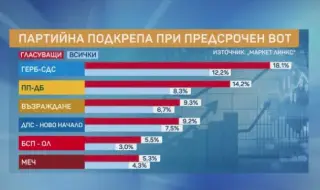
After the protest wave and the resignation of the government of Rosen Zhelyazkov, public attitudes remain strongly negative, and trust in political leaders continues to shrink. This is shown by the data from a national survey by “Market LINKS“, presented to bTV by sociologist Dobromir Zhivkov.
The national survey was financed and implemented jointly by bTV and “Market LINKS“ was conducted among 1008 people over 18 in the country in the period 18 - 29 December 2025 using the methods of direct personal interviews and online surveys.
According to the study, 70% of Bulgarians do not approve of the direction in which the country is developing, with the leading reasons being the feeling of injustice, doubts about the non-transparent distribution of public funds and corruption - topics that, according to Zhivkov, have mobilized society the most at the end of the year.
Electoral picture: GERB-SDF first, but in a “crisis of confidence“
In the event of early elections, GERB-SDF remains the first political force, followed by PP-DB. According to the data, “Vazrazhdane“ and “DPS - New Beginning“.
The most significant conclusion from the survey is that GERB has remained below 20% for a second month, which “Market LINKS“ defines as atypical and indicative of a serious crisis of confidence in the leading political force.
PP-DB has recorded a slight increase, which the sociologist linked to the mobilization around the protests and the return of some of the voters who had withdrawn.
“There are such people“ below the line
One of the big losers after the political crisis is “There are such people“, which according to the data remains below the 4 percent barrier. Zhivkov stressed that the party has previously fallen below the line in sociological surveys, but the development in the campaign will be decisive.
The survey also reports an extremely high share of undecided voters. In total, about 30% fall into the groups "undecided", "another formation" and "I do not support anyone".
According to Zhivkov, about half of the undecided voters could be attracted by a new political project, and among this group there are also positive attitudes towards President Rumen Radev.
Trust in leaders: Radev stable, Borisov declining
President Rumen Radev maintains a relatively stable profile of trust - an effect that the sociologist explained with the "supra-party position" of the head of state in the political system.
On the other hand, Boyko Borisov reports the most drastic drop in trust, with Zhivkov also pointing out an important indicator: support for the party is higher than trust in the leader, which can be read as a signal of internal erosion.
The highest share of distrust traditionally remains with Delyan Peevski, and among the leaders with a negative net rating are also key figures from the last ruling coalition.
Machine voting and the risk of new protests
According to the data, the majority of citizens continue to prefer machine voting, and the changes to the Electoral Code have been defined as the “last big battle” before the early vote.
Zhivkov warned that if confidence in the electoral process is not restored, there is potential for a new protest mobilization, since the energy from the December protests “has not been exhausted“.
Will there be a cabinet after the elections?
The sociologist predicts that in the current situation, there is no clear formula for sustainable governance, except for major compromises and crossing “red lines“. New elections are also possible if the next parliament again fails to cast a stable majority.
Regarding voter turnout, Zhivkov said that the protests have led to a temporary increase in willingness to vote, but the key will be whether the parties will convince, especially young people under 30.