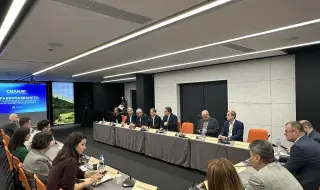
„The healthcare system is highly politicized and dominated by lobbies“. This was stated by the leader of „We Continue the Change“ Assen Vassilev yesterday at a discussion on the topic „Healthcare: restoring trust and a new social contract“. It is the first in a series of public discussions on the main topics for the future of Bulgaria, which „We Continue the Change“ is organizing under the motto „Strong Bulgaria in a Strong Europe“.
„We held this discussion so that we could say things straight, remove political correctness and get to the heart of the problems that are usually avoided. Because if we don't solve the real problems, if we don't even put them on the table for discussion, we will never have a normal healthcare system in the country“, Vassilev urged the participants. The idea of this discussion is to really say what we think and what the realities are, and not to try to paint them in pleasing colors.
„We pretend that in certain parts of the country we have adequate healthcare. The truth is that if you are up in the Rhodope Mountains, have a heart attack, adequate healthcare can only be provided to you by helicopter. And it is good to say this clearly and for Bulgarian citizens to know, and to plan the system accordingly“, said Asen Vassilev.
„We know that currently half of the places for nurses in health facilities and in schools and nurseries are unoccupied, and the other half – with an average age of over 55 years. Okay, that is also clear to say and let's see what we are doing to solve this problem, because otherwise we will not have a sustainable system“, was categorical Asen Vassilev.
The discussion leader Assoc. Prof. Vasil Pandov, member of the Executive Board of “Continuing the Change“, pointed out that the ultimate goals are clear – improving the level of healthcare, access, financing, prevention and prophylaxis, and there is consensus on them. “However, what the different opinions and organizations differ on is the way in which this can happen. That is, how to reach the goal, which is socially justified, socially mandatory. In all sociological surveys of public attitudes, healthcare is almost always the first topic, the top topic, the most important topic for Bulgarian citizens“, emphasized Assoc. Prof. Pandov. According to him, Bulgarian healthcare has many positive aspects, but also many deficits due to the lack of regulation over the last 30 years.
The first part of the discussion was dedicated to the topic:
Medical work - how to prevent the personnel collapse of Bulgarian healthcare
On the topic, Assen Vassilev pointed out three problems: first, that as commercial companies, hospitals are not sure that they will be able to pay salaries, especially regional hospitals. The second is that we have insufficient and uneven remuneration for labor. The third is that the center of the system is money, not the patient, which means that the system is poorly constructed, Vassilev added.
The trade union organization of healthcare specialists indicated that the healthcare system is about to collapse due to the lack of enough nurses and midwives. Representatives of the National Association of General Practitioners explained that the average age of doctors is high. There are also positive trends regarding the increased interest of young doctors in the specialty of general medicine. The focus of the discussion was the need to determine by law the minimum basic salaries of doctors and nurses.
The second panel was dedicated to the question:
How patients in Bulgaria should not pay more than the EU average
According to Assen Vassilev, this problem has three parts. The first is why Bulgaria has the lowest use of generics in the world. According to him, the reason is that the prescription of drugs in our country is not based on the name of the active substance in the drug, but on its trade name. The second problem is that consumables are not included in the cost of clinical pathways, so that the cheapest consumable is covered by the state, and patients pay extra only if they want a more expensive option. The third problem is the mandatory choice of a team that is paid for. According to him, a team without payment should be guaranteed.
“The system of hidden and unhidden co-payments maintains a high percentage of citizens without health insurance or citizens who can pay their contributions but see no reason to do so“, said Vasil Pandov. According to him, great social tension also arises when the patient pays for medical devices and consumables used in hospital care.
Public health spending in 2025 is over 10 billion leva, which is 4.9% of the gross domestic product, said Assoc. Prof. Anton Tonev. According to the NSI and Eurostat, we spend 7.9% of GDP on health, with this three percent difference being paid by patients or from a supplementary insurance fund, he also pointed out. According to him, Bulgaria has the highest co-payment by patients, which sets the system back and reduces access to medical care.
A consensus was formed in the discussion that the state should improve access to medical care by analyzing the most common cases of co-payments on clinical pathways for medical devices and consumables and including them in their price. The NHIF should centrally negotiate the value of medical devices, thus eliminating the huge differences in their value between individual hospitals.
The third topic of the discussion was:
Access to medical care for everyone - a possible reality or a chimera
At the beginning of the discussion, data were presented according to which hospitals and hospital beds in our country are more than sufficient. Bulgaria has the most hospital beds per capita in the EU and many times higher number of hospitalizations for many diseases than the highest value in other member states. All participants in the discussion agreed that the high hospital admissions must be stopped. It is unacceptable for patients to be admitted for 3-4 days in a hospital for tests that are performed outside the hospital for a few hours throughout Europe. There was a lot of criticism of the system's deficiencies and the restrictions on the appointment of high-tech tests in outpatient care. The importance of nursing and midwifery practices for healthcare was emphasized and the need for them to enter into contracts with the NHIF for funding.
The participants united around the need to restructure the healthcare system, with outpatient care gradually taking over all activities that do not require expensive hospital treatment.
The fourth panel was on the topic:
Do we treat the consequences or invest in prevention?
Bulgaria is the only EU member state in which cancer mortality is increasing. In all other member states, mortality is decreasing. Investment in cancer research and screening leads to benefits for the country's economy of the order of 4 billion. The state is not adequately implementing the National Cancer Plan adopted in 2022. In the discussion, representatives of patient organizations gave good examples of screening conducted by NGOs. The state does not finance the treatment of drug addiction in children and adults.
Patient and professional organizations, representatives of the pharmaceutical industry and young doctors have united around the fact that prophylaxis and prevention are mandatory. The leading role in them is played by general practitioners. Health promotion activities should be carried out by all medical specialists - dentists, pharmacists and nurses. The state needs to step into its role and create an organization for real screening programs.
In conclusion, Assen Vassilev stated that everyone wants a change in the healthcare system, but no one believes that it can happen. According to him, the change depends on each of us. “We must stop pretending that we have hospitals where we practically do not have them. The imbalance in clinical pathways leads to the inability of regional hospitals to support themselves with normal activity. “There are many leaks in the healthcare system, some of which come from the very structure of the healthcare system. "It is becoming increasingly clear that the problem is not in funding. There is money in the healthcare system, but the structure and the way and the rules of work need to be changed," summarized the chairman of “We Continue the Change“.