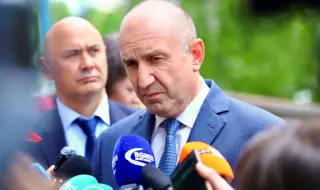
"Progressive Bulgaria" will work to stop the pressure on the Bulgarian economy and the ideology in the economy.
This was stated by the President (2017-2026) and leader of the "Progressive Bulgaria" coalition Rumen Radev at a meeting with citizens in Gabrovo. Radev emphasized that it is not normal for us to destroy our energy and industry ourselves in order to please strange ideologies, which even their creators are beginning to deny. He added that the EU itself is already rethinking the green transition and the closure of nuclear energy.
A pragmatic approach to the development of Bulgaria's economy is needed to bring it out of the crisis, Rumen Radev also pointed out, highlighting inflation and rising prices, which not only hit the pocketbook, but also have a severe social effect on the lives of hundreds of thousands of Bulgarians.
„Yesterday, on the way, I stopped in a village, entered the store and asked the saleswoman how people were coping. She took out a notebook and told me: „This is how they are coping. Everything is already on the line. People can barely make it through half of the month and I just don't know how we'll continue," said Radev.
Rumen Radev defined the state of healthcare as a serious challenge for our country, recalling that Bulgaria is the champion in the EU in terms of the number of hospitals and the number of hospital beds per capita.
„Why have so many hospitals been created - because the Bulgarian healthcare model is designed so that we just circle around the hospital and they take us inside. And if we don't go in, at least they write that we are in hospital - lying down, staying, so that money can be taken from the clinical pathways. We must put an end to this and move towards a real healthcare model that invests money in prophylaxis, in prevention, in early diagnosis“, said Rumen Radev.
The leader of „Progressive Bulgaria” once again stressed the need for an adequate and rapid emergency medical care system that would operate within the so-called “golden hour” and recalled the struggle of the presidential institution to introduce the air emergency medical care system (HEMS) into the Recovery and Resilience Plan, despite the refusal of the then government.