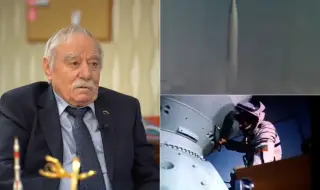
1 day, 23 hours, 1 minute and 31 orbits around the Earth. That's how long the flight of the first Bulgarian in space lasted.
Georgi Ivanov holds a world record that has not been improved to this day. During the entire mission, he remained calm and his pulse did not flutter.
„On April 12, 1961, Yuri Alekseevich Gagarin flew into space for the first time. And he made one orbit for 108 minutes. With this, he paved the first furrow of humanity in space exploration“, recalled the first Bulgarian cosmonaut.
He shared that when Gagarin came to Bulgaria in 1961, the Bulgarians from the Air Force School could not even dream of space. “We thought that hardly a Bulgarian would fly into space by the year 2000“.
“In the late 1960s, the “Intercosmos“ program was created, through which Bulgaria also entered the annals of cosmonautics“, he said.
According to him, the preparation for the space flight began on March 20, 1978. “Theoretical training began. The spacecraft, flight dynamics, astronomy and, accordingly, the ships we will fly with - the ship “Soyuz-33“ and the station “Salyut-6“ which we were supposed to reach with my commander Nikolai Rukavishnikov“ are being fully studied.
“Sergey Korolev used to say that if a person, going into space, feels any fear or excitement - it is better not to go“, commented Ivanov.
The first Bulgarian cosmonaut shared that before the start of the mission, the Soviet cosmonaut Alexei Leonov woke him and Nikolai Rukavishnikov up and gave them a small pickle. “Maybe he wanted the cucumber to remind us of the salt and acids of life here on Earth as we flew up.“
“We went to the launch pad, put on our spacesuits, tried on the suits, and got into the space rocket. There was a possibility that they would postpone the flight because there was a very strong wind in Baikonur. A young meteorologist said that after 20 hours the wind would die down, and that's what happened,“ Ivanov said.“
The “Soyuz-33“ ship took off on April 10, 1979.
“In many of the shots of our flight, you can see how between me and Nikolai Rukavishnikov there is a small doll, which we had taken for the first time on the instructions of our instructor-methodologist. The reason is that a few days before we took off, a baby girl was born to him in Moscow and he gave her to us as a symbol of his daughter“, shared the cosmonaut.
The start of the mission begins with the rocket being turned on and launched into orbit for about 9-10 minutes.
“In orbit, we stay in our spacesuits while we make our first lap around the Earth. Then, absolutely everything is checked and only then do we take them off. After certain laps, the spacecraft is maneuvered to reach the height of the space station. And during one of these launches, our main engine failed with a rather serious bang“, said Ivanov.
The head of the Flight Control Center, Alexei Eliseev, gives them the command to terminate the approach and docking with the station. The mission turned out to be unsuccessful.
„We were about 3 km away. We could see the station, but we couldn't help ourselves with an engine that would bring us closer to it“, the cosmonaut shared.
The reason was the explosion of the high-pressure pump to the engine, which supplies fuel. Despite this, Georgi Ivanov managed to remain calm.
„During training, we performed dozens, if not hundreds, of such failures and how to act in such a situation. That's why we were relatively calm. They gave us a 12-hour break. During this time, ground teams of specialists searched for the cause and the root cause. The next day they told us that we had to prepare to return to Earth“, Ivanov said.
He said that the return was also problematic, as the lander was damaged and did not fully fulfill the impulse it was supposed to give. “That's why we landed a little further from the designated point - near Zhezkazgan in Kazakhstan“.
“The helicopters came immediately. Nikolai opened the hatch, we went outside, and the rescue teams had already landed“, said the cosmonaut.
According to him, when a person studies space, his horizons expand. "That's why I so often mention a maxim that my American and Russian colleagues say - that it's best for those who run the government on Earth to make at least one space flight, to broaden their horizons a little," he commented.