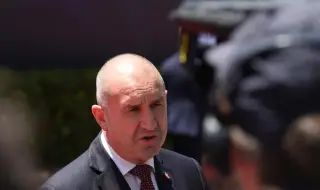
Bulgaria will veto the new sanctions package against Russia. Our country does not agree with the part about the Russian Church. This was stated by Prime Minister Rumen Radev before the regular meeting of the European Council in Brussels. According to him, Bulgaria will demand that Patriarch Kirill be removed from the sanctions package, Nova TV reported.
However, the Prime Minister emphasized that our country will not obstruct the common decisions of the EU on Ukraine. “We will support the process of negotiations for Ukraine's accession to the EU”, he is categorical.
”The Ukrainian president has expressed a desire to meet and we will do so today”, Radev announced.
According to him, his cabinet does not agree with the sanctions, as they threaten our economy. As an example, Radev pointed to the risk to the functioning of “Lukoil”, the supply of the capital's metro with parts and the delivery of fertilizers. “We will talk about it later, but if there is a significant risk to the operation of “Lukoil Neftochim Burgas, we will also want it to be excluded from the list,” said the Prime Minister.
The war in Ukraine has long gone beyond the trenches and spread to the economy, energy, sports, culture, and now it is starting to affect religions. I think the time of the crusades is over. Bulgaria always defends its interests, especially in energy. This was stated by Prime Minister Rumen Radev, commenting on the new 21st package of EU sanctions against Russia.
In his words, “we will not allow sanctions that would negatively reflect on the Bulgarian economy”. "You will find out today how Bulgaria will vote, after discussing all the specifics with my colleagues", emphasized the Prime Minister, who will participate in the European Council meeting in Brussels.
Regarding the Russian Patriarch Kirill, who falls under the new EU sanctions package, Radev asked: "What message are we sending when we extend the sanctions and the war on religion? Do we realize where this is leading? I told you - the time of the crusades is over. I am not interested in the Russian Patriarch. I am interested in the fact that he is the head of the Russian Orthodox Church, which is Eastern Orthodox, as is our church. I am interested in all those millions of people who are part of this church,", the Prime Minister emphasized.
He emphasized that this is the 21st sanctions package and asked: "In what way have these sanctions so far stopped the war? And in what way did they contribute to peace at all?".
Regarding the expected peace agreement between the United States and Iran, Radev stressed that "the situation is very fragile". "There is also a third country - Israel, which also pursues its goals and acts independently of the United States. I expect there to be a balanced approach to this peacemaking process, so that Israel, the two main countries - the United States and Iran - participate, and a lasting solution is found. At the moment, things are still very unstable", he pointed out.
The Prime Minister expressed optimism that very soon "fuel prices, which are important for citizens and the economy, will begin to fall in connection with the trend of cheaper crude oil against the backdrop of the expected ceasefire in the Middle East".
The Prime Minister also commented on our relations with the Republic of North Macedonia. "Unfortunately, the political leadership of the Republic of North Macedonia is stubbornly going against the interests of its own citizens and against their European integration. The policy at the highest level there is the instillation of hate speech, lack of tolerance and distortion of history, using it as a political tool. This will not lead to anything good either for the country or for our relations", he pointed out.
The Prime Minister recalled that it was Bulgaria that managed to defend its position in the European Union with the support of all member states, including on the issue of the rights of Bulgarians in North Macedonia. "We will do everything necessary to protect Bulgarian national interests. When I represented Bulgaria in the Council of the European Union years ago, I was alone against everyone. Leaders of member states consistently insisted to me that North Macedonia immediately begin negotiations. "I managed to convince all these leaders to change their position and to become aware of the problems related to human rights, so that the most important thing would be included in the negotiating framework - the inclusion of Bulgarians in the Constitution and the implementation of the agreements," Radev recalled.