Over 4,000 acres of fir trees have been affected this spring in the forests around Smolyan. The alarming signals are for the drying out of a traditional tree species in the Rhodope Mountains.
This year the fir trees are visibly drying out. More and more brown-red hues are appearing on the slopes with coniferous trees around Smolyan. However, the beautiful-looking mosaic in the landscape is proving devastating for the forest.
„We are observing the drying out of the fir trees. Those that have suffered are brown and bright red in color“, shared Eng. Dimo Yanchev, Director of the State Forest Service – Smolyan.
The reason is climatic.
„The summer of 2025 is one of the driest summers. We have a change in the annual temperature norms by nearly 1.2 degrees Celsius“, said Eng. Pencho Dermendzhiev, director of the Forest Protection Station – Plovdiv.
„The physically weakened tree predisposes to the settlement of stem pests and pathogens. During our inspection, we mainly found three stem pests – two spruce bark beetles and one blue bronze beetle. Unfortunately, once it dries out, it cannot recover“, he said.
Foresters are inspecting the fir forests along the road to the village of Mugla to determine the extent of the disaster. The terrain is extremely difficult.
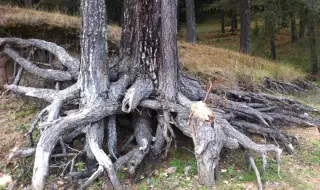
„The terrain is extremely steep. The soil is extremely poor. There is almost none - the trees are located on the rocks themselves. The diseased trees are in places where the soil is extremely poor - the rocks", explained Eng. Kadir Kropov, senior forester at the State Forest Service - Smolyan.
There are only two ways to deal with the pests - quickly removing the affected trees or setting up pheromone traps. In both cases, the almost impossible is required of foresters.
„The necessary sanitary measures must be carried out - cutting down these diseased trees, which create a prerequisite for the multiplication of insect pests. But the terrain is extremely difficult and complex. Perhaps there will be areas that will remain uncut, undeveloped, with impossible access", shared Eng. Yanchev.
„We must react quickly. After the tree has died, and the insect pests have eaten its bark and have already completed their reproduction process, then we even have to remove it from the forest“, he pointed out.
“Dry trees are a prerequisite for forest fires. Therefore, my colleagues, I believe that wherever they can, they should remove them from forest territories“, explained Eng. Dermendzhiev.
This spring there has been heavy rainfall, but the water drains into the ravines. In order for the fir trees on the tops to survive, snow is needed, and it has hardly held on this year.
“Of these 4 thousand acres, nearly 3 thousand are with a drying rate between 1 and 5%. And 900 decares are between 10 and 15%“, pointed out Eng. Dermendzhiev.
The extent of the drying is still far from the massive one it was 40 years ago.
“The only peak of drying of fir trees was 1987-1988. Then they reached 71 thousand decares“, said Eng. Dermendzhiev.
The good news for now is that unlike the 1980s, currently no drying of young trees and saplings is observed.