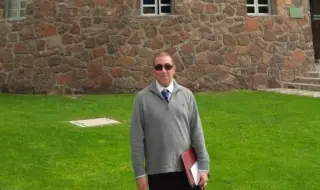
Four years after the outbreak of the full-scale war in Ukraine, the world is still searching for an answer to a fundamental question: what will the new international order look like? What are the root causes of the conflict, what interests are driving the major powers, how has Russia's military strategy evolved, and what are the possible scenarios for Europe's future security? These are the questions discussed by political analyst José Miguel Alonso-Trabanco, a contributor to Geopolitical Monitor, in an interview with FAKTI.
- Mr. Trabanco, the Russia-Ukraine war is a conflict that has reshaped the international order, both militarily and diplomatically. If you had to describe the fundamental cause of this conflict, what would it be?
- This war responds to mutually incompatible strategic rationales. The Russians want to halt NATO expansion, remake the structural order of European security and partially compensate the setbacks derived from the dissolution of the Warsaw Pact and the downfall of the Soviet Union. For them, an alliance between NATO and Ukraine ―official or unofficial― is a national security threat because of Ukraine’s geographic proximity to the Russian European heartland. Without Ukraine as a defensive buffer, Russia loses strategic territorial depth that can mean the difference between relative security and vulnerability.
In turn, Washington needs a pro-American Ukraine to permanently keep Russia in check and, above all else, to prevent the potential emergence of a Russo-German partnership in the coming decades. The sum of German wealth and technology plus Russian manpower, firepower and natural resources would challenge American control over the European peninsular rimland.
- You discuss the Orange Revolution in your analysis. What did it ultimately lead to, and how did it change Ukraine?
- The Orange Revolution was a major watershed for three reasons. First, this “Colour Revolution” highlighted Ukraine’s geostrategic condition as a perpetually contested borderland between Russia and the West. Second, from the Western perspective, it revealed that Russia was not powerful or resourceful enough to keep Ukraine locked in its strategic orbit. Therefore, Russia’s positional anchors in post-Soviet Eastern Europe could be challenged. Third, this Western-backed regime change operation convinced the Russian leadership that Americans and Western Europeans, despite conciliatory rhetorical platitudes, were determined to encircle Russia. This is the moment when President Vladimir Putin realised that the Cold War had resurfaced.
- Four years after the start of the full-scale war, has your assessment of the causes that led to the conflict changed in any way?
- Aside from the military, geopolitical and strategic roots of the war, Ukraine is also worth fighting for because of its far-reaching geoeconomic potential. Thanks to its agricultural advantages, especially for growing cereals such as wheat and rye, Ukraine is well-positioned to act as Europe’s breadbasket. The country is also rich in mineral resources, particularly rare-earth elements, needed for various frontier techno-industrial applications. Unlike other underdeveloped former Soviet Republics (e.g. Moldova or Tajikistan), Ukraine has the material capacity for large-scale industrial manufacturing, as well as a skilled workforce. Ukraine possesses the infrastructure that connects European Russia to EU states, so it represents a potential pivotal highway for economic exchanges. Finally, Ukraine, unlike Russia, is not de facto landlocked. Thanks to the Dnieper River and warm water ports such as Odessa, whoever controls Ukraine has a profitable opportunity to engage in international trade. This is why the Russian-led Eurasian Economic Union cannot successfully take off without the addition of Ukraine.
- Has Russia achieved its strategic objectives in Ukraine, or is the war simply turning into a prolonged conflict with no clear winner at this point?
- There are ambivalent results. Russia has partially succeeded because ongoing military hostilities de facto block Ukrainian accession to either NATO or the EU. Russia has also achieved modest military breakthroughs in the Donbass, but no game-changing outcomes. However, these are pyrrhic victories because NATO-backed Ukrainian counterattacks have proved to be effective and, moreover, Moscow has not yet managed to alter Ukraine’s pro-Western strategic orientation.
- Is this primarily a battle over ideology or over territory? How do you interpret the nature of this conflict?
- his high-intensity land war is not primarily driven by colliding ideological mindsets. However, ideological discrepancies, even if they are biased oversimplications, are not irrelevant because they discourage diplomacy and restraint. For Western European elites, Russia as an “illiberal Great Satan” that despises the totems they hold dear, including liberal democracy, the Enlightenment, feminism, LGBT activism and militant wokeness. In this perception, Russian barbarian hordes, commanded by an evil imperialist dictator, threaten the peaceful and prosperous European Edenic garden built by the proverbial ‘Davos men’ in the post-Cold War era as a role model for humankind. Leaders like Macron or Merz genuinely believe that the Russians are providentially destined to be defeated because, in their view, the EU represents the highest state of human civilisation. Interestingly, nationalist forces in Western Europe have a less adversarial view of Russia.
In Russia, Western European nations are often portrayed as overrated Weimar-like dystopias ruled by self-righteous globalist elites and plagued by decay, degeneracy, low birth rates, effeminacy and frivolity. In opposition, Russia presents itself as a martial Eurasian civilisation-state whose worldview embraces the traditional heritage of Orthodox Christianity, pan-Slavism, the Byzantine Empire and steppe horsemen. For the Russians, Brussels’ threats are empty because average EU citizens would rather cling to a life of luxurious comfort rather than enlist, endure hardship and fight a single campaign. They think that the balance of resolve is favourable thanks to their resilience and warrior ethos.
These fault lines run through Ukrainian soil and they pull different parts of the country in opposite directions. Due to the legacy of the Polish-Lithuanian Commonwealth, the Austro-Hungarian Empire and Roman Catholicism, Western Ukraine is closer to the EU. This region is historically inimical to their former Russian and Soviet overlords. In contrast, Eastern Ukrainian Oblasts and the Crimean Peninsula are more related to the socio-cultural codes of the so-called “Russian world”.
- There is increasing discussion about exhaustion on both sides. Do you believe a genuine peace is possible in the near future, or is the conflict entering a new long-term phase?
- This is an attritional proxy war whose internationalisation is turning increasingly dangerous. Ukrainian forces are supported by Western powers with weapons, cash, intelligence and logistics. Their objective is to undermine Russia as a great power so that it can be forever kept in a defensive position and unable to regain control over the so-called “near abroad” in the post-Soviet space. The Americans also want to burn bridges between Russians and EU states. In turn, the Russian war effort is transactionally backed by North Korean and Iranian direct military assistance and economic exchanges with China. Considering its trajectory, the outcome of this conflict is likelier to be settled in the battlefield than at the negotiating table. A stable peace would require the wisdom, prudence and diplomatic creativity of pragmatic European statesmen like Machiavelli, Metternich, Richelieu or Talleyrand.
- How do you assess U.S. President Donald Trump's policy toward the war? Do you see a shift in the American strategy toward Ukraine and Russia?
- I think Trump himself and some counterintuitive people in his Administration are, in principle, inclined to normalise bilateral ties to Russia so that the bandwidth of US statecraft can focus on both the American hemisphere and the Indo-Pacific. The late Henry Kissinger observed that, as the global balance of power is shifting, Washington needs to approach the Russians and negotiate some sort of accommodation to contain a rising China. However, it seems the American ‘deep state’ is inertially committed to prolong the fighting as much as necessary. From their perspective, even if Russia prevails as the ‘last man standing’, the point is to increase the political, strategic and economic costs. If anything, the Americans are doubling down. This is evident in Ukrainian attacks on Moscow because they would not be possible without Washington’s explicit approval.
- The European Union is increasing defense spending and accelerating its rearmament efforts. Does this make Europe more secure, or does it increase the risk of a broader confrontation?
- The facts on the ground show that Russia is neither as strong as it believed nor as decrepit as some Westerners suspected. Hardened by battlefield performance against NATO-backed Ukrainian forces, Moscow now commands a formidable warfighting machine. The Russians also possess a vast nuclear arsenal. However, the idea of Russian tanks overrunning the Fulda Gap is badly out of touch with reality. They lack the material capacity and the political ability to pull off something like that in the near future.
Still, the risk of escalation is very real and both EU states and Russia are trapped in a security dilemma. What is regarded as defensive preparedness by one side is classified by the other as an imminent sign of aggressiveness. High-profile members of the Russian strategic community believe that it is time to take off the gloves and pursue the war much more vigorously, even if that means the deployment of tactical nukes or targeting European states materially supporting Ukrainian forces. The Russians have tested the security perimeters of Eastern European states with operations below the threshold of war. Both Russians and Ukrainians are intensifying the qualitative and quantitative scale of their offensive operations. Reluctant to foster a diplomatic détente, NATO states like France, Germany, Poland and the UK are increasing defence expenditures. It is a matter of time before Berlin or Warsaw seek their own nuclear deterrents.
As a result of the war, history has now returned to Europe. States that had presumably retired from power politics are now involved in arms races, geopolitical hostilities and security competition. As situational awareness about these unpleasant realities comes back, distrust amongst European states is likely to proliferate. Post-historical European societies that had forgotten that “only the dead have seen the end of war” are going to experience a very rude awakening. As individuals, Europeans may not be interested in war, but war may be interested in them anyway.
- Who is benefiting economically from the continuation of the war―Russia, the West, or third countries such as China and India?
- There are some clear economic winners. From the view of the US military-industrial complex, Ukrainian military procurement needs and European politico-strategic anxieties are good for business. Now that the Russians are ‘decoupling’ from economic exchanges with the EU, China and India get the benefits of preferential market access to Russian commodities. In contrast, the increasing costs of the war effort and the fallout of sanctions are complicating the full-spectrum industrial modernisation of the Russian economy. On the other hand, Germany is a major loser because the war has brought de-industrialisation, damage to critical infrastructure (e.g. Nord Stream) and the partial loss of access to Russian natural resources. At this point, it is unknown who will end up controlling Ukrainian assets (industrial capacity, workforce, fertile soil, rare-earth minerals and ports). Likewise, reconstruction offers profitable long-term potential opportunities for US investment banks/hedge funds and Chinese pan-Eurasian geoeconomic projects such as the Belt and Road Initiative and the Asian Infrastructure Investment Bank.
- Do you see evidence that Russia has changed its military strategy compared with the early years of the conflict? If so, what are the main differences today?
- At first, my impression was that Russian forces intended to conquer all of Ukraine, behead the Ukrainian Government and orchestrate a regime-change operation at gunpoint. Now, Moscow’s strategy has been recalibrated to pursue narrower military objectives such as the full-fledged uncontested control of Eastern Ukraine and the instigation of chaos so that the rest of the country remains politically and economically dysfunctional.
- If the war ends with a ceasefire rather than a comprehensive peace agreement, what risks will remain for Europe's security over the next decade?
- Sooner or later, all wars eventually come to an end. However, in this case, since a ceasefire is unlikely to settle the underlying dispute, the best-case scenario would be an armistice that may lead to a frozen conflict, but this would not discourage geopolitical tensions or security competition. Under these conditions, the spectre of a rematch would haunt post-Soviet Eastern Europe. A comprehensive peace agreement would require a diplomatic negotiation between Moscow and Washington so that their rivalry over Ukraine can be managed in a way that does not threaten systemic strategic stability. A hypothetical deal may involve formulas like the consensual redistribution of spheres of influence, the constitutional adoption of Ukrainian military neutrality or the design of a new European security architecture that does not disregard Russian national interests.
------------------------------
José Miguel Alonso Trabanco, PhD in Defence and Security Studies.
Born in Mexico, José Miguel Alonso Trabanco is an international relations professional who holds a PhD in Defence and Security Studies from Massey University, New Zealand. As a scholar, his research focuses on geopolitics, national security, power relations, strategic foresight, warfare, statecraft, grand strategy, foreign policy and international political economy. His analytical work has been published by platforms such as Geopolitical Monitor, RealClearWorld, and Modern Diplomacy.