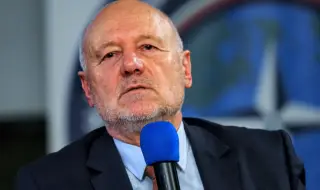
How the personnel changes in the government of President Volodymyr Zelensky will affect the development of the war in Ukraine, as well as the decisions of the "Coalition of the Willing" to build a European missile defense system, commented on "The Network" on the "Hristo Botev" program Todor Tagarev, former Minister of Defense of Bulgaria.
Prof. Tagarev begins his analysis with President Zelensky's decision to replace the Minister of Defense - a move that, according to him, has profound consequences for the Ukrainian army. He emphasizes that although this is not officially mentioned, people in such positions "wear out in these difficult conditions" and often work much longer than their formal mandate. But the real reason for the replacement, says Tagarev, is the tension between Minister Fedorov and Commander-in-Chief Syrsky:
"Initially it was speculation, but Zelensky admitted it to deputies from "Servant of the People". It seems that he has sided with Syrsky."
Tagarev also notes another hypothesis being discussed in Kiev - that the replacement could be part of a broader operation that would allow Zelensky to release other senior officers if necessary. "We have no way of knowing", says Tagarev, but emphasizes that the tension is real and that his public appearance "is not in Ukraine's interest", especially since Russian Z-bloggers are reacting with open satisfaction.
Why is Fedorov's removal such a sensitive topic?
Prof. Tagarev emphasizes that the interest in Fedorov's release is unusually high because he is one of the most visible and successful figures in the Ukrainian government.
"He is in very good public standing", says Tagarev, recalling that Fedorov not only accelerated innovation in the army, but also created mechanisms for the rapid introduction of new developments based on real data from the battlefield. "Before him, ministers had tried such moves, but he was very successful", he adds. Fedorov made several public demands upon taking office and "practically fulfilled everything". That is why the reaction to his dismissal is so strong - both inside Ukraine and among Western partners who perceive him as a driver of modernization.
Tagarev notes that according to recent information, the deputies did not agree with Zelensky's wishes, and a former high-ranking security service officer was appointed as acting head, who is believed to be the "brain" behind the "Cobweb" operation that led to the destruction of strategic bombers in Siberia.
The conflict between Fedorov and Syrsky and the clash of two philosophies
Prof. Tagarev explains that the tension between Fedorov and Commander-in-Chief Syrsky is not just a personal conflict, but a clash between two different philosophies of waging war. According to him, Sirsky and some of the top military leadership are pushing for more traditional weapons - systems that the army has known for decades and that fit into the classic model of the Soviet school. Fedorov, on the contrary, has built a system that monitors the effectiveness of new products in real time and gives priority to those that have proven to work on the front.
"Those that are more effective get priority", says Tagarev and emphasizes that Fedorov has created a competitive environment among manufacturers, provided advance financing and opened the way for the rapid implementation of innovations. This has inevitably affected the interests of the traditional defense industry and the political circles that support it. "There are deep interests… and this is one of the reasons", says Tagarev. According to him, Fedorov has gone so far as to speak extremely directly to deputies: "Come on, don't you have any balls? When are you going to want to understand what is really happening on the front?" – a line that clearly shows how sharp the clash between the two visions of the war was.
Ukraine's successes under Fedorov: deep strikes and the blockade of Crimea
Prof. Tagarev emphasizes that under Fedorov, Ukraine achieved its most visible successes in deep strikes against Russian infrastructure - successes that, in his opinion, are directly related to the modernization, digitalization and new operational approaches introduced by Fedorov.
"These are the most impressive deep-sea strikes", says Tagarev, recalling the attack on the largest refinery in Omsk: "The Ukrainians hit the largest refinery in Omsk... the drones flew 3,000 km." The military expert specifies that Omsk is "further east of Astana", which shows how far into Siberia the Ukrainian capacity reaches. Tagarev lists other strikes – in Tyumen, in the European part of Russia, as well as successive attacks on the logistical routes to Crimea. "They managed to impose a blockade on the Crimean peninsula", he says, describing the consequences: a lack of gasoline, power outages, the suspension of shipping through the Sea of Azov and the blocking of the Don Canal. According to Prof. Tagarev, these results are cumulative and "appeared during Fedorov", as part of the new asymmetric strategy that he supported and developed.
Ukraine and the technological race: drones, missiles, guided bombs
Prof. Tagarev explains that the technological race between Russia and Ukraine is a continuous process, in which each side constantly adapts its tactics. "This is a continuous process. From the very beginning of the war, these systems, in the form in which they were used at the beginning, are no longer used", he says. According to him, the Ukrainians have managed to equal Russia in drones, and in guided bombs they even have an advantage. At the same time, Russia maintains strong positions in ballistic missiles and in the number of cruise missiles it has.
Tagarev emphasizes that the Russian army should not be underestimated: "It is wrong. They should not be underestimated. They know how to fight – even Ukrainian soldiers say so." He notes that the Russians are adapting to technological developments and that each new Ukrainian tool works for a while, after which Russia finds a countermeasure – and the process starts all over again. In this context, Tagarev also mentions the French initiative to license the production of "Scalp" missiles in Ukraine, which could change the balance, but requires time: "And how long does it take to start this production, so that it covers, helps?" – he asks, emphasizing that such projects are strategic, but do not give an instant result.
The technological leap: artificial intelligence, Palantir, digitalization
Prof. Tagarev describes Fedorov as a person who comes from the IT sphere and brings the logic of digitalization and artificial intelligence to the defense: "Fedorov has a huge merit – that's why they say "the state in his phone". Simply from his phone, a Ukrainian citizen today can use as many services as are not observed in other European countries."
He emphasizes that this is not just "technology", but a rethinking of the way the administration and the army work: "Here it is not a question of technology or the Estonian model… he wants a rethinking of the way the entire administration works. Fedorov is definitely very strong there… and his knowledge and experience are useful for improving the way the army and combat operations are managed."
And it is this profile that explains why one of the world's leading companies for artificial intelligence systems – Palantir – immediately invited him: "It is already claimed that Palantir immediately invited him to start working for them at a high level. Palantir… they are one of the first companies with artificial intelligence systems not only for image processing, but also for overall management. Even NATO is implementing one of their systems."
Tagarev adds that this would be "super" – because it shows how the experience of war and defense management is transferred directly to the highest level of technology companies that work with NATO and Western countries.
Ukraine and missile production: cooperative models and European participation
Prof. Tagarev explains that future missile production in Ukraine cannot start "from scratch", because that would take years. According to him, the realistic scenario is cooperative production with the participation of European countries that already have experience with similar systems. "Here we assume that there is some cooperative production – there will be French participation, Italian participation, which are involved in "Scalp" anyway, he says and recalls that the missile also has a British version related to "Storm Shadow". Tagarev emphasizes that such projects always attract interest from countries that "understand their interest, explore their interest and look for their place". He gives an example with the words of Donald Trump, who in Ankara announced his intention to grant a license for the production of "Patriot" - and the reaction of Poland, which immediately declared its desire to participate. "We should be there too", says Tagarev and adds that Bulgaria's position is completely understandable, but our country is "a bit unique" in that it does not participate in these formats, despite being a member of the EU and NATO.
The Coalition of the Willing: Paris, Ankara, B-9 (Bucharest Nine)
Prof. Tagarev talks in detail about his participation in the first meeting of the so-called "Coalition of the Willing" in Paris - a format that unites European countries ready to make specific commitments to the security of Ukraine. "I represented Bulgaria", he says and explains that the purpose of the format is to discuss principles that all countries accept: that Ukraine is a victim of aggression, that Ukraine's security is key to the security of Europe and that European countries must be ready to act in a coordinated manner in the event of a future ceasefire.
Tagarev emphasizes that this is not an abstract discussion, but preparation for real action: "You cannot wait for an agreement to be concluded and then think about what you would send. The plans are made in advance." He explains that the coalition is also working on the diplomatic part – participation in the negotiation process, seeking a diplomatic solution and preparing for a lasting peace when the fire is stopped. According to him, this is the format in which specific decisions with a practical dimension are made, and Bulgaria risks being left out of it.
Bulgarian "uniqueness"and the risk of standing out like Orban
Prof. Tagarev commented that Bulgaria turns out to be "unique" among the EU and NATO countries because it refuses to participate in key defense formats in which all other countries are actively seeking their place. "We are a little unique in this… we are even completely unique", he says and emphasizes that this "uniqueness" is not a compliment, but a warning. Tagarev draws a parallel with Hungary and Viktor Orban: "Let's stand out the way Orban stood out." He recalls how Hungary ended up freezing European funds because of Orban's actions - interference in the judicial system, problems with the rule of law, restrictions on the media. According to him, Bulgaria risks repeating this scenario: "Such uniqueness can put us in a situation where we will look at North Macedonia and Albania from behind."
The former Minister of Defense warns that isolation from European formats is not a symbol of independence, but of strategic self-isolation, which can have serious consequences.
Bulgaria outside the formats in which real decisions are made
Prof. Tagarev is adamant that Bulgaria does not participate where real decisions are made on defense projects and the future security architecture in Europe. He emphasizes that common decisions in the EU and NATO are important, but they are "policies", while the specific implementation takes place through projects in which countries voluntarily participate. "It is not true that we are in the other formats", says Tagarev and explains that when ten countries come together to develop a new missile together with Ukraine, Bulgaria is simply not there. "We will bring together 10 countries, we will make a new missile together with Ukraine" and we will not be there." According to him, this is a direct consequence of the position of Prime Minister Radev, who "is taking us out of the formats in which specific decisions with a practical dimension are made." Tagarev is adamant: "We are currently being taken out of everywhere." He warns that such isolation is not a symbol of independent policy, but of refusal to participate in processes that determine the future of European defense.
"Leaving this format means leaving the European consensus. There is a consensus in Europe that Ukraine's security is equivalent to Europe's insecurity.
National interest
"It is necessary to define what national interest means. In my opinion and in the opinion of many others, Radev is going against the Bulgarian national interest – stubbornly and with rapid steps,– believes Prof. Tagarev.