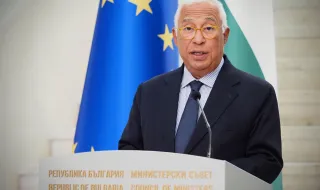
Russia's malicious attitude extends beyond Ukraine's borders - cyberattacks, violations of critical infrastructure, drones in our airspace and attempts to undermine our democracies. Threats and intimidation from Russia will not reduce our determination to support Ukraine for as long as necessary, until a just and lasting peace is achieved. Russia must understand that Europe will not back down, but on the contrary - will increase pressure on Russia until Russia stops the killings and shows a real commitment to peace. This was stated in Sofia by the President of the European Council Antonio Costa, who is visiting our country, quoted by Nova TV.
In his statement, Costa emphasized that Europe's security also encompasses enlargement. According to the President of the European Council, Ukraine, Moldova and the Western Balkans belong and must be in the European Union. He stated that this is an investment that the EU must make, and each country must implement the necessary reforms and previously undertaken commitments.
"At the same time, it is important that we also fulfill our role, to participate in a constructive dialogue with them, recognizing progress when there is any. We must continue to work together for Ukraine. Our determination to support Ukraine as it defends itself and strives for a just and lasting peace remains unwavering", Costa was categorical.
The President of the European Council pointed out that 2026 marks an important milestone for Bulgaria due to our country's accession to the eurozone. He said 2026 was also crucial for Europe, as the long-term budget for the period until 2034 had to be approved by the end of the year. Costa added that this was fundamental to ensuring continued investment from 2028 onwards.
He said this was a key element of the agenda of his discussions with leaders in each capital he visited this year. "We need a European budget that matches our ambitions and provides the means to deliver on our common priorities", Costa said, adding: "The new reality requires a new approach to our common budget with a new structure and a new way of allocating resources, because the bulk of the EU budget comes from national contributions. We must ensure that the national contribution remains within reasonable limits, which is why negotiating new sources of funds in the EU is of key importance.
"We know that it will not be easy, but the awareness of the pressure we are facing and the need to act quickly, as well as the understanding of this from the leaders I have met, give me positive faith and hope", added the President of the European Council.
For his part, Prime Minister Rumen Radev welcomed the President of the European Council to Sofia. "We held another very fruitful meeting with an open, in-depth dialogue with the President of the European Council on important issues on the European agenda. Europe today is facing many and different crises, and this forces all of us, the Member States, to be persistent, to have the strong will and to seek workable and rational solutions to overcome these crises. "In today's discussion, we discussed issues related to the multiannual financial framework, EU enlargement, ensuring Europe's security in today's challenging times, European technological sovereignty, the rapid penetration of AI into all areas of public and economic life," said Radev.
"When we talk about the multiannual financial framework, we must admit that this is a great test for the EU, because we have high ambitions to achieve many goals, but resources are limited and we fully understand and support the EU's vision to have a strong focus on the competitiveness and security of the EU. But this should not be at the expense of financing important policies - such as enlargement policy, cohesion policy and agricultural policy, which guarantee the unity of the union", said the Prime Minister.
"What we discussed with Antonio Costa is how to ensure that the need for greater competitiveness can be distributed correctly over the years, so that all member states have equal access to the large cohesion fund, so that less developed countries do not lag behind in their technological and industrial development", said Radev.
The Prime Minister added that he had suggested to the President of the European Council to think about a new term - industrial cohesion. "Let's not just talk about cohesion, as it has been so far - the classic cohesion in social programs, in infrastructure, but such cohesion that would enable all member states to participate equally in the technological and industrial development of Europe, because if we do not achieve it, the processes of fragmentation in the field of high technologies and industries with high added value will continue to deepen", said Radev.
The Prime Minister added that all the challenges we face in the field of security require us to unite our efforts - scientific, technological, industrial. "Bulgaria also actively contributes to the EU's main vision of increasing our common security, and it is based on new programs and new initiatives. Bulgaria is actively working to strengthen its industrial base, to develop its defense science, so that we can truly make an active contribution to having a more secure and stronger Europe," he added.
According to him, an important element of the EU's development is to work for greater connectivity - energy, transport, digital. "I am very glad that with the President of the European Council we find many common ideas for the future development of this connectivity and Bulgaria as an extremely important element in this chain of European connectivity. We will do so that, with the help of the European Union, we can improve our road and rail connectivity," Radev said.
The Prime Minister also said that another important topic in the discussion today was the topic of EU enlargement. "Mr. Costa knows very well that Bulgaria is a strong driver for the integration of the countries neighboring the EU, especially in the Western Balkans, as an element of expanding the space of peace and prosperity in Europe. But he also knows that we insist that this enlargement should not be subject to conjunctural geopolitical processes, but should be based on the principle of its own merits," he added.
Antonio Costa's visit is part of a tour of all the capitals of the Community countries, and he is in Bulgaria at the invitation of Prime Minister Rumen Radev.
The aim of the annual “Tour of the Capitals“ is for the President of the European Council to understand the positions of the heads of state and government, especially with regard to the next long-term budget of the European Union, so that by the end of the year the member states can reach an agreement on the next multiannual financial framework.