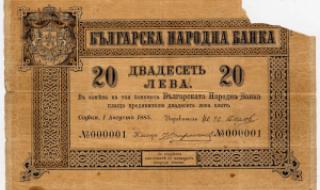
On June 4, 1880, the Second Ordinary National Assembly of the Principality of Bulgaria adopted a law creating the national currency, the lev, which is equal to 100 stotinki and 1 French franc.
The lev is the monetary unit of Bulgaria, issued by the Bulgarian National Bank. Its name comes from lev - an outdated form of the word “lion”, used in the 19th century.
The lev was adopted as the Bulgarian monetary unit shortly after the Liberation of the country, when in 1880 A law on the right to mint coins in the Principality was passed, and the first coins were minted the following year.
In the first years after the Liberation, mainly silver coins were in circulation on the territory of Bulgaria, a large part of which were physically depreciated.
The majority of them were silver Russian rubles, which entered the country en masse during the war, but there were also exotic coins, such as Tunisian, Iranian or Indian, some of which are no longer used in the countries in which they were issued.
Fiscal accounting is kept in French francs, with the state artificially maintaining an inflated exchange rate for silver coins in order not to devalue savings. This led to an additional influx of silver coins from neighboring countries, also strengthened by the ban on the use of foreign silver coins in the Ottoman Empire in 1883. By 1887 foreign silver coins are widely used in Bulgaria, along with the Bulgarian lev.
The Law on the Right to Mint Coins in the Principality, adopted in 1880, provides for fiscal accounting to be kept in levs, determines the amount of gold, silver or copper in the various coins and limits the total money supply to 15 million leva. The leva has a value equal to that of the French franc. The use of coins is allowed, both of the Latin Monetary Union and of other countries that the state accepts at rates approved by the Ministry of Finance.
The BNB began issuing banknotes in 1885. The first issue was relatively small (213,000 leva) and was poorly received by the people. The main goal of the BNB in the following years was to increase the share of the banknote issue and gradually impose a de facto gold standard in the country, with the quantity of silver coins being significantly reduced.