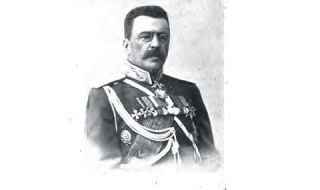
On June 23, 1882, Prince Alexander Battenberg appointed a caretaker government of the Principality of Bulgaria headed by Russian general Leonid Sobolev.
Leonid Sobolev took part in the Russo-Turkish War of 1877-1878 in Bulgaria as a staff officer of the active Russian army. He participated in the battles at Pleven, Mount Shipka and the winter crossing of the Stara Planina. He received the Order of St. George IV degree. He managed the office of Prince Cherkazsky - head of the civil administration of the newly liberated Bulgarian lands. He reached the military rank of Major General (1880), writes istoria.bg.
After the introduction of the Powers of Attorney Regime on July 1, 1881, Prime Minister Gen. Ernroth resigned and dissolved the government. Until mid-1882, Prince Alexander I Battenberg (1879 – 1886) himself led the executive power in the Principality of Bulgaria without a Prime Minister. When the liberals launched a broad public protest against the monarch's one-man regime, he sought the help of Russia and Russian generals.
On June 23 (July 5 – old style) 1882, the prince appointed Gen. Leonid Sobolev as Prime Minister, and Gen. Alexander Kaulbars as Minister of War. The two generals were sent by the Russian Emperor to strengthen Battenberg's one-man regime. Gen. Sobolev also served as Minister of Internal Affairs.
The government of General Sobolev supported the prince and his regime. It restored the activities of the National Assembly and abolished censorship of the press. It maintained good relations with Russia and protected its political and economic interests.
During the first months of his government, General Sobolev was supported by the conservatives. From 17.9.1882 to 14.1.1883, he also managed the Ministry of Public Buildings, Agriculture and Trade, and from March 3, 1883, the Ministry of Finance.
A new electoral law was adopted with the introduction of property and educational qualifications. Officials were deprived of the right to be elected as representatives of the people, the number of deputies was reduced, and their mandate was increased to 6 years.
In the elections for the National Assembly on December 10, 1882 The conservatives win. A number of laws on the structure of the state are adopted: the Law on Territorial and Administrative Division, the Law on Officials, the Law on the Conversion of the Tithe in Kind into a Monetary Tithe, etc.
Contradictions arise between the generals and the conservatives regarding the railways. The generals are in favor of the construction of the Danube line, which would connect Bulgaria with Russia, and the conservatives - for the Tsaribrod-Vakarel section, which would connect the country with Western Europe. The conservatives leave the government and the generals appoint liberals in their place. The prince's positions are threatened and he again seeks help from Russia, demanding the return of Gen. Ernroth. But the Russian government already considered Battenberg inconvenient and sent the diplomat Jonin to Bulgaria to support Generals Sobolev and Kaulbars.
But international action was taken against Bulgaria by Turkey and Greece regarding the waqf properties (former Turkish farmsteads). A movement to restore the Tarnovo Constitution flared up in the country. This forced Prince Alexander I Battenberg on September 6, 1883 to restore the Tarnovo Constitution and dissolve the cabinet of General Leonid Sobolev.
On September 7 (September 19 - old style) 1883, Dragan Tsankov was appointed Prime Minister, who formed a coalition cabinet with the participation of liberals and conservatives. Due to disagreement with the policy of the prince and the conservatives, the general resigned and returned to Russia.
In his homeland, Sobolev continued to serve in the army as commander of the 1st Rifle Brigade of the XXXVII Infantry Division and Chief of Staff of the Moscow Military District. In 1886, he published his historical work ”To the Recent History of Bulgaria”. He participated in the Russo-Japanese War in 1904-1905 as commander of the VI Army Corps.
Gen. Leonid Sobolev died on September 30 (October 13 - old style) 1913 in Russia, in Toronetsky uyezd, Pskov province.