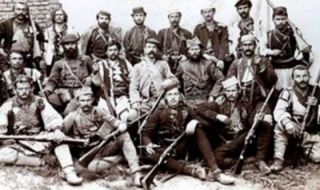
On October 19, 1925, in the Demir Kapia area, Bulgarian border guards were digging a well. The Greek guards did not correctly assess the action they were taking and believed that they were digging a trench - something they had no right to do. At 2:30 p.m., a Greek border guard quite unceremoniously walked towards them, entering Bulgarian territory. Bulgarian guard Radoy Georgiev shot the intruder and killed him. A shootout ensued, in which another Greek soldier was wounded, who later also died, reports the Bulgarian History website.
The Bulgarian government insisted that the case be resolved in a civilized manner
by forming a commission with representatives of both sides to investigate the case, reveal who the culprits were and punish them. The Greek Prime Minister refused. He saw the opportunity to attack Bulgaria. On October 22, 1925, without declaring war, General Pangalos ordered the 6th Greek Division, stationed near Syar, to invade Bulgaria. It crossed our southern border, stretched along a 40-kilometer-wide front. The Fourth Army Corps was ordered to move from Drama and Kavala to the town of Nevrokop (today Gotse Delchev). The size of the Greek army reached nearly 100,000 soldiers. It was confronted by the Bulgarian border guards, who, according to the Treaty of Neuilly, were reduced in number and numbered 300. In a short time, the villages of Kulata, Chucholigovo, Marino Pole, Dolno Spanchevo, Novo Hodzhovo, Piperitsa, Lehovo, Topolnitsa, Marikostinovo, Kartechno were captured.
Bulgaria was faced with a fateful decision. The question was whether to counter the Greek aggression with force or to seek a diplomatic solution. The government decided to act on the second option and, as it turned out, this was the right choice.
The Bulgarian government, headed by Alexander Tsankov,
immediately informed the UN Secretariat in Geneva about the Greek aggression.
To the zone where the invasion took place, the Minister of War, General Ivan Valkov, sent reinforcements consisting of 6 infantry, 3 machine gun companies with 4 mountain and 8 field guns, the total number of which amounted to only about 1,000 soldiers. The Bulgarian army sent was explicitly ordered to resist the Greeks only in case of extreme necessity. Another task that the government is faced with is to evacuate the Bulgarians from the threatened areas.
Meanwhile, the Greek soldiers begin to loot whatever they can, which slows down their offensive actions. This allows the Bulgarian troops to dig in in the area of General Todorov station and the Rupite area. The Greek delay also allows the strong IMRO organization in this region to send its reinforcements to Petrich. There are attacks on the city on October 22-23, but the most serious one takes place on the 25th of the same month.
The local residents, supported by the IMRO detachments,
manage to repel the Greeks several times.
On October 27, a note arrives from the UN to Bulgaria and Greece, in which it is insisted that both sides cease all military actions. The organization's council immediately sent military attaches from France, Great Britain and Italy to monitor whether the orders given were fulfilled. On October 28, the Greek government officially ordered its army to withdraw from Bulgarian lands.
On October 29, 1925, after the Greek army was already within the borders of its country, the UN appointed a commission of inquiry chaired by the British ambassador to Spain, Horace Rumbold, and members - General Serini from France, General Ferrario from Italy, Adler Kreutz from Switzerland and Droglever Fortuyn from the Netherlands. The purpose of the commission was to study the situation in the affected areas in order to determine the amount of compensation that should be paid to Bulgaria. It was found that the Greeks were guilty of burning down 12 Bulgarian villages. The Bulgarian casualties amounted to 4 soldiers and 5 civilians killed, 2 officers, 9 soldiers and 10 civilians, 3 women and 2 children wounded, and 11 soldiers missing without a trace. There are no official figures for the Greek casualties. According to Ivan Mihaylov, they amounted to over 120 soldiers killed.
The inquiry commission decided that
Greece should pay Bulgaria compensation in the amount of 30 million leva.
Thus ended this short war, which was called the “incident“.
The amount owed was paid, and 1 million 200 thousand leva went to the victims of the town of Petrich. Surprisingly, they waived personal compensation and decided to give the money for the construction of a high school building, which until then had been housed in a private house. In 1926, construction began, but the money turned out to be insufficient and the citizens of the town donated from their own funds and so the building was completed.
On October 31, 1937, during the celebrations marking the 25th anniversary of the liberation of Petrich from Turkish slavery, the first historical monument in the town was inaugurated. On one of its memorial plaques are inscribed the names of those who died defending the town from the Greeks. Although they participated in a conflict forgotten by history, they themselves, who gave their lives for their homeland, are immortalized.
Link to main version
Oct 19, 2026 03:06 751
October 19, 1925. The Greek Army Invades Bulgaria (VIDEO)
The Petrich Incident Almost Sparks the Third Balkan War
Снимка: Архив