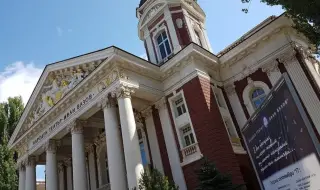
On January 3, 1907, the National Theater building in Sofia was officially opened.
The most important guest at the ceremony is Prince Ferdinand himself. The many citizens and students standing in front of the beautiful building feel neglected. Their role is that of a crowd, whose only task is to produce applause. The center of attention is not the building itself, but the powerful monarch, who behaves as if he had built the theater with personal funds.
Ferdinand arrives in front of the National Theater with a brisk step and a majestic expression. Among the faint applause, however, sporadic boos and boos are heard, which are getting louder.
Snowballs are also flying towards Ferdinand. Minutes later, the center of the capital is flooded with street fights between students and police officers. Within hours, the police stations are filled with young people who were arrested during the races in Sofia.
Ferdinand is raging in the palace. He cannot swallow the insult that the young Bulgarians are inflicting on him.
In 1907, the prince is at the peak of his political career. For two decades on the throne, he managed to transform the forgotten Ottoman province of Bulgaria into a decent-looking European state. The country's economy was modernized and on the rise, which a year later would give the Bulgarian monarch grounds to declare independence from the Ottoman Empire and dream of a Greater Bulgaria, including Macedonia and Adrianople Thrace. The student protests and the snowballs flying at him threw the imperious and vain Ferdinand off balance. The very next day, on his orders, the Council of Ministers adopted a decree that decreed the closure of Sofia University for a period of 6 months and the dismissal of all professors, associate professors and lecturers working there.
Shortly after this, the Minister of Education, Prof. Ivan Shishmanov, also resigned, unable to accept the decision to close the Alma Mater. Shishmanov's resignation put an end to the most successful reform ever carried out in Bulgarian education.
But let's return to the National Theater. The beginning of the troupe's history is considered to be an order of the Minister of Public Education, Dr. Ivan D. Shishmanov, by which, from January 1, 1904, the manager of the state-supported National Drama Troupe "Tears and Laughter", Mr. Iliya Milarov, was appointed "Intendant". Since the spring of the same year, the name of the troupe has been the Bulgarian National Theater.
From 1906 to 1952, the troupe bore the name National Theater, and from 1952 to 1962 -
National Theater "Krustyo Sarafov". From 1962 to this day, the official name is the National Theater “Ivan Vazov".
The theater building
By order of July 14, 1903, Minister Dr. Iv. D. Shishmanov appointed a commission headed by Mr. Iliya Milarov to prepare a proposal for the construction of a building for the National Theater in Sofia. The National Assembly made a decision and by Decree of Prince Ferdinand I, land was expropriated on the site of the former wooden theater "Osnova", where in June 1904 the construction of the building began according to a design by the Viennese architects Ferdinand Fellner and Hermann Helmer. The picturesque design of the ceiling and walls in the auditorium, which has 848 seats, was entrusted to the famous Viennese artist Rudolf Fuchs. The National Theater opened its doors on January 3, 1907 with a special performance. Before the grand opening, a large number of students booed Prince Ferdinand I and he decided by decree to close Sofia University for six months.
On February 10, 1923, during the anniversary performance "Apotheosis of the Native Dramatic Art", a fire broke out, destroying the theater. Since the beginning of the new season, the troupe has been performing in two parts in different cities of Bulgaria, and then for six years - on the stage of the specially renovated “Free Theatre” in Sofia.
The building of the National Theatre was reconstructed in the period 1924-1928 according to a project by the German architect Martin Dülfer. In addition to the construction of the new reinforced concrete structure, stage mechanization was delivered from Germany, manufactured by the companies “Krupp” and “MAN”, which only the best theatres in European metropolises have. This equipment has been operating since 1929 and is used in all performances on the Big Stage of the theatre.
During the bombing of Sofia during World War II, the South Wing of the theater was destroyed. After the end of the war, the building was rebuilt, and in April 1945, the National Theater reopened its doors to the public. The last reconstruction and restoration was carried out in 1972-1975 under the leadership of Prof. Eng. Venelin Venkov, when a special Chamber Stage was also built. The overall artistic design was the work of artists Dechko Uzunov, Georgi Chapkanov, and Ivan Kirkov, who was also the author of the theater's curtain - the unquenchable Phoenix.
History of the Theater
1904-1944
While the National Theater building was being built, the troupe performed its performances in the hall of the community center “Slavyanska beseda". Among the founding artists are Ivan Popov, Vasil Kirkov, Krastyo Sarafov,
Adriana Budevska, Stoyan Bachvarov, Atanas Kirchev, Geno Kirov, Vera Ignatieva, Shenka Popova, Hristo Ganchev,
P. K. Stoychev, Teodorina Stoycheva, Sava Ognyanov, Zlatina Nedeva, Konstantin Sapunov, Boris Pozharov,
Nikolina Bachvarova and others.
Plays were staged by Ivan Popov and the Croatian Sergian Tutsich, and later the prominent Czech actor was invited
Joseph Schmaha, who became the chief director and artistic director of the theater. In addition to him, performances were staged by Geno Kirov, Pencho Slaveykov, P. K. Yavorov, Hristo Ganchev, Pavel Ivanovski, Sava Ognyanov.
After the first steps of the National Theater, a process of increased interest in the stage arts by Bulgarian writers began. Some of the most significant works were created, which have become classics for Bulgarian dramaturgy: a stage version of „Under the Yoke" and „The Queen of Kasalar" by
Ivan Vazov, „Vampire" and „Above the Crossless Graves" by Anton Strashimirov, „Boyan the Magician" by
Kiril Hristov, „Majhemrazka" by St. L. Kostov, „V polite na Vitosha" by P. K. Yavorov and others. The institution of an artistic secretary and an artistic council at the theater was created, directly responsible for the relationship with the authors. Plays were staged both from world classical dramaturgy and from the most significant contemporary European authors - Strindberg, Ibsen, Chekhov.
Krastyo Sarafov, Stoyan Bachvarov, Vasil Kirkov, Geo Milev, Georgi Stamatov were also involved as directors. This period was distinguished by the leading role of the actor's presence in the performances. Fierce discussions were constantly held in the press about the repertoire, the direction or its absence and the chronic crises of the theater's management.
With the end of the first two decades of the twentieth century, an important period in the existence of the National Theater ended - its institutional and artistic development, its gradual professionalization, comparable to the Balkan and to some extent pan-European theatrical process. With the death of Ivan Vazov in 1922, the period of building the National Theater as the main cultural institute of Bulgaria ended.
After the theater burned down in 1923, the troupe toured the countryside for some time, but in late autumn it returned to Sofia and played on the stage of the “Free Theater” for six years. The famous literary critic and editor of the magazine “Zlatorog” Vladimir Vassilev was appointed director, who invited Andrei Protich, St. L. Kostov and Sirak Skitnik to join the management. New artists were appointed, including Lyubomir Zolotovich, Ivan Dimov,
Petya Gerganova, and not long after the young Zorka Yordanova, Boris Ganchev, Konstantin Kisimov, Mara Penkova, Olga Kircheva, Marta Popova, Georgi Gromov, Boris Borozanov, Vladimir Trandafilov and others. The actor Khrisan Tsankov, who had studied in Moscow and Berlin with Max Reinhardt, was appointed artistic secretary. He soon began directing, and the great poet Nikolai Liliev was brought in as a playwright. In 1925, the Russian N. O. Masalitinov was appointed chief director, proposing that a Drama School be opened at the National Theater. It included not only all young artists and trainees, but also recognized stars such as Kr. Sarafov and G. Stamatov. With his first production of Shakespeare's “Twelfth Night”, which was welcomed as a true theatrical celebration, Masalitinov showed that professionalism would increasingly conquer the theater in the future.
Until the end of World War II, a kind of aesthetic duel was fought on the stage of the National Theater between Khrisan Tsankov, who defined the director as an “author” and in which convention, stylization, expression and the search for synthesis prevail, and the “classic” N. O. Masalitinov with his realistic, psychological theater, where the direction is woven into the text and hidden in the acting. This is a period during which such plays as “Masters” by R. Stoyanov, “Golemanov” and “Vrazhalets” by
St. L. Kostov, “Zidari” by P. Yu. Todorov, “Albena” and “Boryana” by Y. Yovkov, “Svekarva” by A. Strashimirov, etc., were first performed on stage.
Some of the most significant figures of this period are the directors Hristo Tsankov – Derizhan,
Prof. Mikhail Arnaudov, Vladimir Polyanov, the playwrights Prof. Alexander Balabanov, Dimitar Podvarzachov,
Theodor Trayanov, the directors Yosif Osipov, Yuri Yakovlev and Boyan Danovski, the artists
Alexander Milenkov, Alexander Bozhinov, Ivan Penkov.
In 1943, a State Theater School was established at the National Theater. The teachers were the chief director
N. O. Masalitinov and the artists G. Stamatov, Vl. Trandafilov, P. Atanasov. The school marked the beginning of professional theater education in Bulgaria. In 1948, it was transformed into the State Higher Theater School and separated from the National Theater as an independent institution, which in 1956 was already called VITIZ “Krustyo Sarafov”.
1944 -1989
The political change of September 9, 1944 reflected, of course, on the overall artistic appearance of the National Theater. A “purge” was carried out in the theater management, Hrisan Tsankov was removed.
In addition to N. O. Masalitinov, the directors' board included the young hopes Stefan Sarchadzhiev,
Krustyo Mirski, Mois Benies. In 1947, Boyan Danovski was appointed chief director. Director Filip Filipov also had his first premiere, who would determine the artistic appearance of the theater for many years. The structure of the repertoire was completely changed, and for a while, contemporary European authors disappeared from it, and numerous Russian and Soviet plays and some minor Bulgarian works were staged. Realism took over the stage. The implementation of Stanislavsky's system became a mandatory condition for the method of socialist realism, which was officially declared the only possible aesthetic and ideological artistic principle.
Despite political supervision and the desire to subordinate art to the dogma of narrow political frameworks, the National Theater continued to create productions of a high artistic level after 1944. Among them were “The Diary of Anne Frank” directed by M. Benies, “Cyrano de Bergerac” directed by St. Sarchadzhiev, “Ivan Shishman” with dir. N. Lyutskanov, “Even the wisest is a little simple” with dir. F. Filipov, “Maria Stewart” with dir. Kr. Mirski, “Attempt to fly” with dir. Ml. Kiselov, “Last term” with dir. Kr. Azaryan and others.
The theater continues to have a very strong acting troupe, in which, in addition to the veterans of previous years, leading figures are now also Ruzha Delcheva, Magda Kolchakova, Irina Taseva, Ivanka Dimitrova,
Margarita Duparinova, Slavka Slavova, Mila Pavlova, Andrey Chaprazov, Rachko Yabandzhiev, Asen Milanov,
Georgi Radanov, Spas Dzhonev, Apostol Karamitev, Yordan Matev, Stefan Getsov, Lyubomir Kabakchiev,
Leo Konforti, Georgi Georgiev - Gets and many other talented artists.
In different years, the following directors invited from abroad have staged on the stage of the National Theater:
Rasha Plaovich and Arsa Jovanovich (SFRY), Boris Babochkin (USSR), Takis Mouzenidis (Greece), Jacek Voscherowicz (Poland), Boris Livanov and Boris Zahava (USSR), Clifford Williams (Great Britain), Andrey Goncharov,
Oleg Efremov and Georgii Tovstonogov (USSR), Brako Plesha (SFRY).