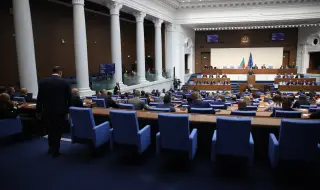
" We have a cycle of all political forces. No one is trying to get out of the opposition and aggression of who we are going to elect, not why we are going to elect him."
This position was expressed in an interview for BNR by the political scientist Georgi Prodanov, a lecturer at the New Bulgarian University.
A different campaign means not talking about a political clash, but about governance. However, the elementary approach aimed at hard electorates is chosen. The problem is not the voters. When they refuse to make a rational choice, it means that they are forced to participate in the elections, not to choose, Prodanov pointed out.
"It is right to ask ourselves who our politicians are, who broadcast them and who they represent. We have a huge amount of figureheads in the current parliaments, broadcast by various groups and lobbies, who pursue their own private interests. These people are sent there to protect the interests of the respective oligarch and nothing more. We have a very severe systemic problem."
The mega task of those who would like to show that they are different is to change the tone and the narrative, emphasized Georgi Prodanov.
As long as elections are made by PR and we only concentrate on the outer packaging, as long as parties of negation are involved and there is no political debate that clearly names corruption and influence buying with concrete cases and not with abstract and empty talk, we will get the same , which we have received so far, he believes.
Those who want to represent the unrepresented must speak to them in their language, the political scientist is emphatic.
Politicians are staring at the political scandal and all means are being sought, no matter how much society is damaged, concluded Georgi Prodanov.
In Bulgaria we have two main groups – some almost always vote, others traditionally don't vote, which doesn't mean they don't care. The biggest problem is that the systemic parties in the last years of permanent crisis have failed to develop an approach to those who do not vote.
This opinion was expressed in the program "Sunday 150" journalist Boyko Stankushev, executive director of the Anti-Corruption Fund.
Among the very large number of non-voters – 60-65%, there are people who assess the political situation very well, are aware of their quality of life, and most of them are very enlightened people, he pointed out.
Our Western partners "are not of the same type, they are not of the same mind, they are not homogeneous on the issue of how to treat those officially declared corrupt and included in sanctions lists, Boyko Stankushev said in the show "Sunday 150".
"Bulgaria has two types of Western partners – those who have pulled out sanctions lists, like the British and the Americans, and we know inside who they are, and some European countries who take pictures, shake hands, even hug. (…) Some are endlessly clear with their lists by name, and others ignore it. Mrs. Ursula will come to Bulgaria. Will she ask the question of what is the attitude towards those officially removed (on the sanction lists – note ed.) and by her partners. The big question arises – how much am I obliged to comply, and only politely, with these cries, recommendations and voices that we are very backward, very corrupt, with these same people legitimizing the most corrupt?"
"The majority of the political establishment that holds money, information, is not homogeneous. There are at least three groups of people there. Very high level ones, visible and only they maintain connections with the real scumbags of this country. The second line is of prominent political leaders who, however, do not have access to these places from where corporate, lobbying, political and geopolitical and other strategies descend. The thirds stand to fill in, and when it's time to vote, they vote as they're told. You can't negotiate with people when you know they don't make decisions. They are put together to release the tension, to blur people's ideas about the political and nothing will happen. This is the naivety that will be punished in many more elections," said the journalist.