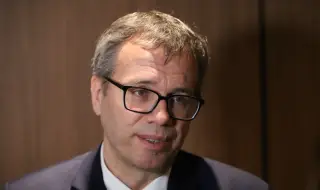
High inflation is the main stumbling block for Bulgaria to enter the Eurozone. In the European Central Bank (ECB) report, there are other details such as the business environment regarding the rule of law, the application of various legislative norms, etc. the well-known reasons why Bulgaria still remains outside the area of security and free travel known as Schengen.
This is what economist Ruslan Stefanov told FOCUS.
“It is realistic that by the end of this year our country will overcome inflation and enter within the reference value of 3.3%. The question is whether there will be sufficient political maturity and stability in the Bulgarian parliament so that the Bulgarian government takes the relevant decisions, monitors and ensures that prices are under control. There are also concerns about the technology for the introduction of the euro, there must be clarity and certainty. Bulgaria has not provided convincing evidence that it is one of the partners that clearly implements and respects the norms and fundamental principles of the community. It is a question of improving the functioning of the institutions, and that in terms of countering corruption at the highest levels of power. The report also takes into account many positive aspects - Bulgaria has a very clear fiscal discipline, a well-functioning fiscal system, well-functioning laws on the budget, how it is formed and spent," the economist stressed.
According to him, the growth of remuneration is not tied to the entry into the Eurozone.
Entry into the Eurozone means greater capital inflows and productivity gains are likely to pick up. An important element is that, in reality, the economic mechanisms for membership in the Eurozone are also currently operating for Bulgaria. The Central Bank and the Ministry of Finance have been extremely passive in the last few years in showing that Bulgaria really wants to achieve entry into the Eurozone.
“Bulgaria is macroeconomically and economically ready and in any case there is an advantage to adopting the euro. This is also politically advantageous, as a serious public resource will be freed up for investment. There will be stress in the people with the introduction of the euro, there will also be a psychological effect, since in reality for the Bulgarians this will be felt as impoverishment. In order for these things to go well, good technical preparation is needed," Ruslan Stefanov added.
“Entry into the Eurozone can happen at any moment when inflation falls to the level that allows Bulgaria to technically request a report. In the next 6 or 12 months, the Bulgarian government, seeing that inflation reaches the levels that allow us to technically cover this formal argument - may request a new assessment. And on the basis of this assessment to ask for admission to the Eurozone", concluded Ruslan Stefanov.