The referendum proposal on the introduction of the euro contradicts the Constitution, European law and national legislation and should be returned to President Rumen Radev.
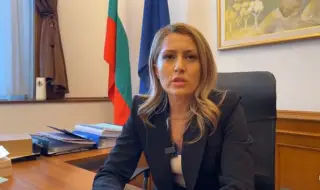
This was stated by GERB-SDF MP Raya Nazaryan in a video message on GERB's Facebook page, quoted by novini.bg. Here is what she also stated:
"The GERB-SDF parliamentary group categorically takes the position that the referendum proposal submitted by President Rumen Radev is in violation of the Constitution of the Republic of Bulgaria, European Union law and the Law on Direct Participation of Citizens. The constitutional texts clearly and categorically state that our country participates in the construction and development of the European Union. When Bulgaria has adopted an international treaty and ratified it, this international treaty has priority over other legislation.
The proposal to hold a referendum and the reasons for it, regarding the conditions or deadlines for introducing the euro in Bulgaria, are in contradiction with:
1. European Union law;
2. The Constitution of the Republic of Bulgaria;
3. The Law on the Direct Participation of Citizens in State Power and Local Self-Government;
With the Treaty on the Accession of Bulgaria to the EU, our country has undertaken to introduce the euro upon fulfillment of the convergence criteria, which are established by the EU institutions, and not at the national level. The process is not subject to a national referendum after the ratification of the treaty. Any act of the National Assembly, setting additional conditions or postponing the process, would violate the principle of loyal cooperation with the EU and would be unconstitutional.
The President's proposal should not be considered by the National Assembly and should be returned to the sender. GERB-SDF considers the President's request inadmissible and insists that the Speaker of the National Assembly return his request to the President with the following reasons:
THE TREATY ON THE ACCESSION OF THE REPUBLIC OF BULGARIA AND ROMANIA TO THE EUROPEAN UNION was ratified by the National Assembly on 11/05/2005, with 231 votes “for”, 1 “against”, 2 “abstains”.
According to Art. 9, para. 4 of the Law on Direct Participation of Citizens in State Power and Local Self-Government, a referendum on issues regulated in international treaties concluded by the Republic of Bulgaria may be held before their ratification, i.e. before 11 May 2005.
With the Accession Treaty, Bulgaria agreed to be part of the Economic and Monetary Union from the date of accession as a Member State, but due to failure to meet the convergence conditions, we are a “Member State with a derogation”.
For Member States with a derogation within the meaning of Art. 139, para. 1 of the TFEU, the derogation shall apply temporarily until the convergence criteria are permanently met.
The fulfilment of the criteria shall be established by the Council of the EU and shall not be proven at national level. The derogation shall be abrogated not by request, but upon fulfilment of the conditions.
In this sense, the request for an extraordinary convergence report is a request to establish compliance, not to abrogate a derogation. The only case in which the introduction of the euro may be postponed is if the convergence criteria are not permanently met.
Any act which makes the introduction of the euro subject to a condition or deadline other than the convergence criteria undermines the EU's objectives of establishing an economic and monetary union whose unit is the euro. Such an act would constitute a formal and explicit departure from the commitment undertaken by the Republic of Bulgaria towards the other Member States under the Accession Treaty, as well as from the obligations of the Republic of Bulgaria arising from EU law.
Furthermore, the proposal to hold a referendum and a subsequent act, which could lead to the postponement (suspension or delay) of the process of introducing the euro, would be in contradiction with the Constitution of the Republic of Bulgaria, according to which the Republic of Bulgaria participates in the construction and development of the European Union (Art. 4, para. 3 CRB), as well as with the norm that international treaties ratified in accordance with the constitutional order, promulgated and entered into force for the Republic of Bulgaria, are part of the domestic law of the country and have priority over those norms of domestic legislation that contradict them (Art. 5, para. 4 CRB). This implements the hypothesis of Art. 9, para. 4 of the ZPUGDVMS, as the issue of the introduction of the euro as a monetary unit in Bulgaria is regulated in the Treaty on Accession to the EU, ratified by the Bulgarian National Assembly. In this sense, the materials and the decision in Constitutional Case 13/2023 are.
We believe that the President's proposal is not within the competence of the National Assembly, as of the date of ratification, but as stated above - is a matter solely within the competence of the European Council, and that upon establishing the fulfillment of the convergence criteria and the lapse of our status as a “Member State with a derogation”.