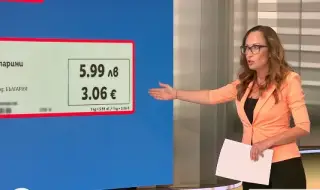
Bulgaria is at the final stage of the road to introducing the euro. On July 8, we expect the final “yes” from the Economic and Financial Affairs Council. What should the prices on the labels in stores look like?
What is written in the Law on the Introduction of the Euro and, accordingly, in the plan with specific steps and deadlines is that a month after July 8, we should already see labels with two prices. In other words, from August 8, the prices on the shop windows should be two, and this double indication will remain for almost a year and a half until the end of 2026. Until December, we pay only in levs. In the first month of 2026 - both in levs and in euros, and then only in euros, reports Nova TV.
Some stores have started putting prices in both currencies earlier. And this raised many questions. We received many photos where the price is first in leva and then in euro. On the second label, the euro is first, the lev is second. Orientation is difficult. And, if we decide to buy 10 beers for 85 stotinki and at the checkout we find out that this is the price in euro - the feeling is quite unpleasant. It may turn out that we do not have enough money to pay for our beers.
The law states that when double indicating the prices of goods and services - prices in euro and leva are placed in close proximity, are written clearly, legibly, unambiguously and easily understood, with the same font size, in a way that does not mislead consumers. It is said that in advertisements, prices can be presented verbally only in leva until the date of the introduction of the euro, and after it, only in euro. However, which on the label should be first and which second - is not described.
The Consumer Protection Commission, which is the body that will monitor violations and punish when it detects violations, has uploaded sample prices to its website. However, there is no explicit specification - which price is first and which is not. By default, it is clear that the lev is in first place - at least until the end of the year, but there is no explicit text, and the Consumer Protection Commission cannot independently introduce such a requirement given that this is not written in the law.
In addition to the fact that it is controversial where to look for levs - at the top or bottom of the label, confusion also arises when there is a discount or discounts. We are already talking about 4 prices written on one label. Separately, the discount percentage and it is not at all clear which is which.
On some labels, the currency is written so small that it is almost invisible. Therefore, the CPC recommends that all merchants, when indicating double prices, write the names of the currencies "lev" and "euro" in such a font size and formatted in such a way that they are clearly visible and understandable to consumers. This way, any doubts about the value due to the cashier will be avoided.
Even more confusing is that in one store - you may find labels that are only in levs and others - that have both lev and euro on them.
At the moment, none of the listed labels are outside the rules. At least, because the rules come into force on August 8. However, even after this date, the CPC will not be able to fine merchants for creating confusion, since it is not written in black and white anywhere which is the leading price. The option is to amend the law in the weeks leading up to August 8 and clarify this. The CPC commented that they do not have a legislative initiative to amend the law, but will hold talks with the Ministry of Finance to clear up these ambiguities.