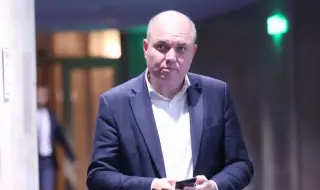
We took on a new 3.2 billion euros of debt, and since the beginning of this year there are a total of 16.2 billion leva in debt. What's next… Economist Vladislav Panev, initiator of the “Acceleration“ club, speaks to FACT.
- Mr. Panev, we have withdrawn a new 3.2 billion euros of debt. Why now?
- This is not a surprise, because the budget for this year included the withdrawal of up to 18 billion leva of state debt. At the moment, 16.2 billion leva has already been withdrawn, which is nearly 80% of the planned amounts of new debt.
- But why now?
- Because the credit agencies raised Bulgaria's credit rating.
- This was expected after they said “yes“ to the eurozone…
- Thus, access to financing was facilitated. Accordingly, 10- and 20-year issues were placed, which we had not placed recently. The yield is between 3.6% and 4.3%, which is good. Compared to Romanian issues, ours are about 2 points lower (note - Romanians are about 6%), which is more or less good. We are well positioned. But this is also the main challenge that I have been talking about for about a year before our membership in the eurozone. It is precisely access to easy money, because this could put us in the Greece scenario of 2008, if We are addicted to these cheap loans. We take them out and spend them on increasing salaries in the public sector, for example. The government will not like taking on debt at all, because it wants to buy "popular love" by throwing money out of a helicopter. Here for salaries, for public procurement, which will be available for both the people and the cabinet. This is exactly what we saw in Romania. The deficit there is 9.3% for last year and was due precisely to the attempt to buy "popular love" before the parliamentary and presidential elections. Back then, they were handing out money from a helicopter to absolutely everyone who asked. And the results are visible - the candidates of the then ruling coalition in Romania did not even make it to the runoff in the presidential elections. It was clear that "popular love" is not bought in this way.
- 16.2 billion leva in debt since the beginning of the year. What of part of this money is for covering old debts and how will we invest the rest…
- About 6 billion leva will go to covering old debts, which is a small part. Another as much - 6 or 7 billion leva, will go to capitalizing state-owned companies. There was talk when the budget was adopted to support the Bulgarian Energy Holding, because the holes there are becoming more and more serious due to the short-sighted state policy in the sector. And about the Development Bank, because the money for rehabilitation under the Recovery and Sustainability Plan had to go through it. And now there will be money for higher social spending, public procurement and capital expenditures.
- When it came to the fact that Bulgaria was accepted into the eurozone, the government said how good this was, but none of them are saying now did we withdraw 3.2 billion euros of new debt?
- The government will like it in the eurozone because they will have access to easy money. For me entering the eurozone is more of a technical issue, but we heard how we are already in the “A group“, how we are in the Champions League, but these are naive tales, because entering the eurozone is not an anti-corruption measure. The eurozone is a kind of facilitation for business, for citizens, which can act as a stimulus for investment and lead to economic growth, but it is not necessarily the case that this will happen. If we build a more efficient state administration, if we limit corruption, if we invest in infrastructure and thus manage to increase private investment, it will be good.
- You mentioned that we took on debt at a better rate compared to Romania, but we are not yet in the eurozone. But, is that the basis for getting this better rate?
- It is not only that we have “yes“ for the eurozone, but also the government's policy - especially after 2020, on balanced budgets. Romanian debt has gone from 30% of GDP to 55%, and this is being viewed critically by investors. In Bulgaria, even though we have loosened the reins recently, our debt is the second lowest in the European Union.
- And we are entering the eurozone in a fairly good financial condition?
- The point is not to indulge in low interest rates and start plugging holes in this way. Moreover, there is no longer this firm requirement of a 3% deficit, as there was in the waiting room for the eurozone. We are already in the eurozone and such a budget ceiling exists in the European Union only in writing. Otherwise, we know that a number of countries do not comply with it. It is simply a pleasure to take easy money. Right now we are entering a vice because we like to spend, but at the same time, NATO is also demanding an increase in defense spending by another 1 or 2% of GDP. At the same time, there is talk of additional social spending, the construction of new nuclear power units. We will see where it will end. Separately, there are threats from the US...
- That is exactly what I was going to ask. Trump is scaring Europe with 30% tariffs. When will the EU feel this if there is no agreement…
- Your readers will say that we do not trade much with the US and that is true. But our economy is linked to the German one, for example. The German car industry is strong and if their orders decrease sharply, what will happen to our auto parts factories.
- We will feel it a little later…
- Yes, there will be some time frame for the “butterfly effect“. And it will happen – “where you fuck it, where you fuck it“.
- Do you really expect dramatic tariffs between Europe and the US to come?
- I can't say. Trump is scaring everyone. For example, he introduced 30% for Brazil because they were investigating Bolsonaro. If there are large tariffs between the US and Europe, this will not be beneficial for the growth of either the US or the EU. But Trump is following some kind of PR script of his own, serving us something new every day.
Link to main version
Jul 17, 2025 09:02 527
Vladislav Panev to FACT: Access to easy money could lead us into the Greece scenario of 2008
The government will not like this debt withdrawal at all, because it wants to buy "the people's love by throwing money from a helicopter, says the economist
Снимка: Факти.бг/Архив