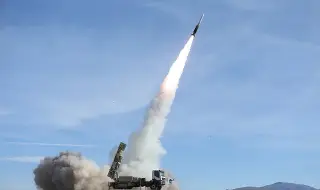
Iran is about to conclude a deal with China to purchase CM-302 anti-ship cruise missiles before possible strikes by the United States, which has deployed massive naval forces near the coast of the Islamic Republic, Wion reports.
CM-302 supersonic anti-ship missile
The CM-302 (in the cover photo - ed.) is a supersonic anti-ship missile with a range of up to 290 kilometers. It is designed to fly at low altitude and at high speed to bypass ship defenses, which significantly increases Iran's ability to threaten warships in the region. Its delivery date has not yet been confirmed.
Design and Development
The CM-302 supersonic anti-ship cruise missile, produced in China, was developed as an export version of the YJ 12 series. It is offered to the international market as a high-speed, low-flying weapon designed to engage large warships and other maritime targets by the China Aerospace Science and Industry Corporation (CASIC).
Range
The CM-302 has an effective range of about 280-290 km, allowing it to carry out attacks on surface vessels at considerable distances. The supersonic anti-ship missile is designed to meet export restrictions under various regimes, such as the Missile Technology Control Regime. The range of this missile makes it competitive with other supersonic cruise missiles, such as the Indian BrahMos, allowing it to engage targets far beyond the range of many ship-based defenses.
Speed
The missile travels at a constant supersonic speed, making it very difficult and challenging to intercept after launch. Its propulsion system allows it to maintain high speed for most of its flight and reduces the enemy's reaction time, which improves penetration against naval air defense systems.
Warhead
It is equipped with a conventional high-explosive warhead weighing approximately 250 kg, which is designed to cause serious damage to large warships, such as destroyers or aircraft carriers. This warhead - lighter than some heavy cruise missiles and combined with the missile's speed and precision - is believed to be capable of disabling or sinking valuable surface combat vessels upon impact.
Guidance
The missile's guidance system combines inertial navigation with China's BeiDou satellite navigation for mid-course guidance, along with an active radar seeker for terminal homing, resulting in a dual approach to accurately navigate to a moving naval target and correct its trajectory in the final phase to improve the probability of hitting evasive ships.
Accuracy
As for accuracy, the CM-302 is said to have a high probability of hitting - close to 90%, thanks to its low-flying flight profile and advanced guidance set. Flying low and fast, it minimizes the detection and response time of ship defense systems, and the terminal radar seeker helps refine target tracking and improve strike accuracy against large naval targets.