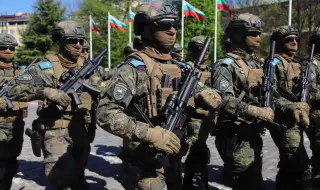
Russia's full-scale attack on Ukraine, the growing instability in the Middle East, the return of Donald Trump to the White House have thrown European defense policy into the spotlight and forced Europe to rethink its models for recruiting soldiers, the European Newsroom writes today, BTA reported.
Last month, NATO members agreed to increase defense spending to 5% of gross domestic product (GDP) for each country. But increasing spending without enough soldiers could undermine Europe's military preparedness.
This shift has made conscription a political issue across the continent.
A recent poll by the European Council on Foreign Relations in nine European countries found that in several countries, including France, Germany and Poland, a majority support the return of compulsory military service, although in the latter two this support was absent among respondents aged 18-29.
Conscription still exists in some European countries
Many EU countries ended the policy of compulsory military service with the end of the Cold War, while in others it has been maintained with varying terms of service and rules.
Nine member states currently have an active conscription system – Austria, Cyprus, Denmark, Estonia, Finland, Greece, Latvia, Lithuania and Sweden.
Croatia will soon join this group, after banning compulsory military service in 2008. Basic military training, lasting two months, will be introduced from January 2026, and those who object on religious or ethical grounds will undergo three months of civil defense training or four months of training in local teams.
Conscripts will receive a net 1,100 euros per month, and their food, transport and other expenses will be covered. Service will be counted as work experience, and those already employed on a contract will have their jobs reserved for the duration of their service. Unemployed conscripts will also have an advantage in hiring in state and local institutions.
Countries with conscription operate different models: mandatory service for all eligible citizens, a lottery system for unfilled volunteer positions, selective recruitment based on motivation and skills.
Which countries in Europe are considering (re)introducing conscription?
Several European countries that have abandoned conscription rely on volunteers to maintain their armies. In response to the security threat posed by Russia, the German army - the Bundeswehr - plans to add at least 60,000 more soldiers to its ranks.
This has led to renewed debate about the need for compulsory military service in Germany, more than a decade after it was abolished.
Chancellor Friedrich Merz said last week that it would probably be brought back. "The Bundeswehr must return to the center of our society," he said. "The abolition of compulsory military service was a mistake, as we already know."
However, under the coalition agreement between Merz's conservative bloc and the SPD, the government is obliged to provide voluntary military service. The Socialists have come under pressure over the deal, but on Saturday the party approved a proposal at its national conference that states: "We do not want any legal option to call up conscripts that could be activated before all options for voluntary service have been exhausted."
"We want to enable the recruitment, registration and tracking of young men subject to military service," it said.
Portugal is another country where the debate over conscription has recently grown.
Supporters argue that it promotes civic spirit, social cohesion and better prepares society to deal with crises. However, critics point to the high logistical costs, the impact on individual freedom and the need to modernize the armed forces with highly qualified professionals, rather than mass conscription.
Compulsory military service was a defining reality for most of the 20th century in the country, when from the First Republic between 1910 and 1926 until the late 1990s, thousands of young Portuguese men were called up to fulfill what was known as their “civic duty to the nation“.
In 2004, compulsory military service was abolished, giving way to a professional volunteer model that remains in force today.
The Portuguese Armed Forces currently recruit young people through voluntary enlistment or fixed-term contracts, with terms of service ranging from six months to six years.
One aspect that remains from the era of compulsory military service is National Defense Day. This is a one-day event aimed at raising awareness of the armed forces and national defense among young people. Although it does not involve military training, participation is mandatory for Portuguese citizens, usually once between the ages of 18 and 30, and is a prerequisite for accessing certain civil rights, such as obtaining a passport or applying for a job in the public sector.
Bulgaria, once one of the most militarized countries in the former Eastern Bloc, has relied on a professional army since the end of compulsory service in 2008, but today faces a 21.8% shortage of personnel in the army. While recruitment has lagged despite recent pay increases, Minister Atanas Zapryanov said that limited compulsory training is being considered, especially for activities involving the use of firearms. Full introduction of compulsory service is not under discussion at this time, but if voluntary recruitment is insufficient, it could be reinstated.
In Romania, compulsory military service was abolished on 1 January 2007. with NATO and EU accession. According to the legislation, in the event of war, Romania can resume compulsory military service. All citizens can be conscripted, including those who have not completed their military service.
After the start of the war in Ukraine, there were discussions, especially online, about a possible partial or voluntary reintroduction of military service, but the Ministry of Defense rejected the idea, stating that it was preferable to expand the volunteer reserves and improve the selection base.
In Poland, Prime Minister Donald Tusk announced in early March that he wanted to restore a form of military service, with the goal of 100,000 people participating annually.
France has also resumed the debate. Military service was suspended in 1997 during the presidency of Jacques Chirac. The public debate on military service was revived when Emmanuel Macron announced a “major overhaul” of universal national service (UNS) in an interview with the regional press in March. Restoring compulsory military service (for both men and women) would currently represent an annual budget of 15 billion euros, according to a recent policy commentary by France’s High Commissioner for Strategy and Planning (Haut-Commissariat à la Stratégie et au Plan).
In Belgium, conscription was abolished in 1993, but without being banned, which in theory means it could be reinstated.
Since the beginning of the Russian invasion of Ukraine, talks about reinstating compulsory conscription have begun, but without leading to concrete action. Public opinion does not seem to be in favor of conscription, and according to Defense Minister Theo Francken, Belgium is not logistically prepared to implement it because it lacks personnel, barracks, and beds.
The current government has announced the introduction of a one-year voluntary military service, for which every 18-year-old will receive an invitation. The plan is to start the service in September 2026 with a first group of 500 volunteers, and the government hopes to recruit 1,000 new soldiers each year until 2028. Volunteers will receive a monthly salary of around 2,000 euros.
Which countries in Europe are against conscription?
While the debate is open in many European countries, others are not at all inclined to such a policy. In Spain, Defense Minister Margarita Robles announced as early as March 2024 said Spain would not introduce conscription in response to the possibility that Russia's threat to Ukraine could spill over to other European countries. "There will be no conscription in Spain, absolutely none, and I don't think anyone had it in mind," she said in a statement.
Slovenia is also not considering compulsory military service at the moment, despite a shortage of military personnel in its army, according to the Defense Ministry.
Defense Minister Borut Sajovic said he was monitoring developments in countries taking steps in that direction. "It seems everywhere that conscription is not a magic wand or a panacea," he added.
Slovakia has also ruled out this scenario, with Prime Minister Robert Fico and other officials pushing for voluntary alternatives after years of failed recruitment efforts. Defense leaders and experts, including former defense minister Martin Sklenar, agree that a new model is needed, with proposals such as financial incentives and reforms to the reserve system currently under discussion.
Albania is another country that has been slow to bring back conscription. In November 2010, parliament passed a law abolishing it, paving the way for a professional and modern army. The change came after a long period of compulsory service that began in 1968.
In Ireland, the idea of introducing conscription is not on the political agenda. The country has never had a conscription army since it declared its independence more than 100 years ago.
Gender debate over compulsory military service
The debate over compulsory military service also focuses on whether conscription should apply to both men and women. Women make up about 13% of the armed forces, according to a study conducted in 2023 in 12 European countries.
Currently, in the EU, conscription applies to both men and women only in Sweden and Denmark.
The Danes introduced the measure on July 1. This means that women who turn 18 after that date will be recruited in 2026 and will be assessed for military service on an equal basis with men. According to Denmark's Defense Minister Truls Lun Poulsen of the liberal Venstre party, the increase is driven by the fact that "we have to work hard to defend our homeland."
"We simply need to have more men and women capable of carrying weapons," Poulsen said in a speech in June.
As Europe faces its most serious challenges in decades, governments are rethinking not only defense budgets but also the role of ordinary citizens in defending the continent. But whether through compulsory service, volunteer models or something entirely new, the coming years will completely change the relationship between civilians and the military in the EU.