


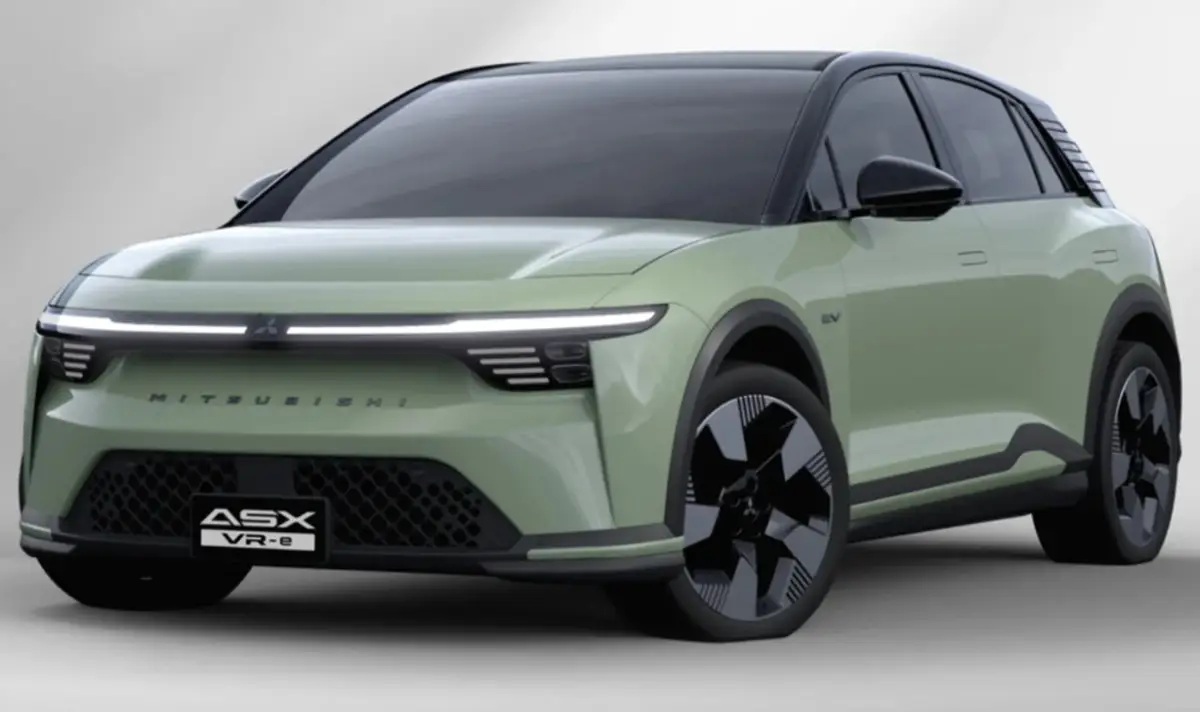

The automotive industry is witnessing increasingly curious strategic partnerships, and the latest of them bears the Mitsubishi emblem. The Japanese brand has officially unveiled the new ASX VR-e, but under the well-known shapes and logo lies a car that has practically nothing to do with the traditional engineering school of the Tokyo company. The new model is an almost complete copy of the Taiwanese electric hatchback Foxtron Bria, transformed for its new role only by changing the company logos.
The exterior of the car is the work of the legendary Italian design studio Pininfarina, which originally created the styling for the Taiwanese prototype. The Japanese crossover retains exactly the same lines and silhouette. At the front, the car is distinguished by a thin LED light strip, divided into two parts by the centrally located Mitsubishi logo, under which discreet auxiliary headlights are positioned. This visual concept radically distinguishes the ASX VR-e from all other current representatives in the brand's range.
The interior relies on a clean and distinctly minimalist approach. The interior space is freed from traditional analog controls, with almost all the car's key functions integrated into a giant central touchscreen. Physical buttons are reserved only on the steering wheel and the inner door panels.
The model is aimed at the Australian market, where it is expected to arrive in the fourth quarter of 2026. At the moment, Mitsubishi is keeping a complete silence about the pricing policy and official technical parameters for its local specification. However, given the fact that the ASX VR-e is identical to the Foxtron Bria, the powertrains and battery are completely identical to the Taiwanese original.
The basic modification of the model relies on a single electric motor mounted on the rear axle, with a maximum power of 229 horsepower. For those looking for more serious dynamics, a version with two electric motors and four-wheel drive is also planned, the total power of which reaches an impressive 400 horsepower. The energy supply is provided by a traction battery with a capacity of 57.5 kilowatt hours.