


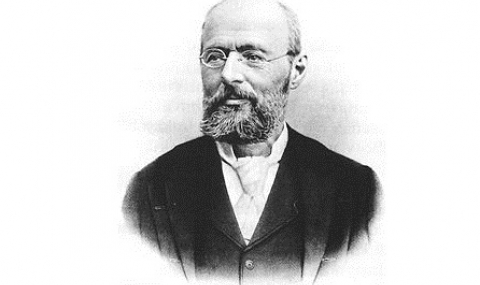

On August 8, 1900, Emil Škoda died. He was a Czech engineer and industrialist.
He studied at the Prague Polytechnic and at the Technical University in Karlsruhe, Germany. After graduating, he worked mainly in Prussia, one of the most technically advanced countries at the time. With the outbreak of the Austro-Prussian War in 1866, he retired to his hometown of Pilsen and became chief engineer of a small machine-building factory. Three years later, in 1869, he bought the factory and began to expand it, reaching a huge enterprise with 4,000 workers and 200 technicians. Emil Škoda understood that a restless Europe would need weapons and relied mainly on this strategy.
In 1886, Škoda built a railway connection, and in 1890 he built a new factory producing machine guns for the Austro-Hungarian army. The factories continued to grow and in 1899 they were reorganized into the Škoda company, known for the production of weapons during the two world wars.
Under his leadership, production of equipment for sugar factories, breweries, mills, mines and other industries began. A large part of the production went for export. In 1884, he also built a modern steel mill and rolling mill, the production of which was intended for the developing shipbuilding industry in Europe.
With his foresight, Emil Škoda understood that the time of large enterprises with one owner was passing and decided to attract external investors. Thus, on December 12, 1899, the Škoda factories were transformed into a joint-stock company, of which Emil Škoda became the general director.
Emil Škoda died on August 8, 1900, while traveling by train, near the village of Selztal, Styria, Austria, where he was at a resort. He was buried in the St. Nicholas Cemetery in Pilsen. His funeral was a major event for the city and the surrounding area.
Before his death, Emil Škoda bought the enterprise from Laurin and Klement. In 1905, they made their first car, the Voiturete. The emblem was a stylized image of a flying arrow with an eye.
The company produced the Hispano Suiza cars under license in 1923. Two years later, the brand merged with Laurin&Klement, which produced motorcycles and cars from the turn of the 19th and 20th centuries.
The first cars under the Skoda brand were designed by Laurin&Klement and bore the familiar names Popular, Favorit and Rapid.
Skoda was one of the first manufacturers to resume production in 1945. Its vehicles sold well throughout Europe.
The chassis of the 1101 model was based on the pre-war tubular structure. The front wheels had independent suspension, and the engine heart was a 1089 cc four-cylinder engine with a power of 32 hp at 3800 rpm. There are several versions, and in one of them the doors open from front to back. The wheelbase is 2480 mm, and the length - 4050 mm.
The brand's cars are specially designed for the bad roads of Eastern Europe and have a specific chassis.
The 1200 series, followed in 1952 by a new body, does not use wood. The models have similar mechanics to their predecessors, but the engines have a cubic capacity of 1221 cubic cm and a power of 36 hp. The wheelbase increases to 2690 mm, and the length to 4500 mm. "Estate" versions appear from 1970.
In 1955, the Skoda 440 was presented at the Brussels Motor Show. It has a different body again, but the mechanics are the same as before. When this model underwent a facelift, it was called Octavia. The mechanics had already been changed and were remarkable. The front suspension was for the first time with telescopic springs. 2273 copies of it with the TS designation were equipped with a twin carburetor. The 1089 and 1221 cc engines had a power of 43 and 47 hp respectively. Felicia was the "cabriolet" version of Octavia. The body was designed by Ghia from Turin and its roof was made of polyester. The 1089 cc engine now had a power of 54 hp. The maximum speed was 125 km/h.
Skoda decided to place its engines at the rear, which was not in line with fashion and that is why the 1000 MB model was not so popular in the West. The car is a four-seater, has a 988-cubic-inch engine with a power of 45 hp, and the 1107-cubic-inch version has 52 hp. The engine has overhead valves, an aluminum head and a steel block. The 110 R model won many awards in rallies in Eastern Europe. The car looks faster than it is. It reaches a maximum speed of 145 km per hour.
Since 2002, the brand has been one hundred percent owned by Volkswagen and revives the names of its previous models Felicia and Octavia. The latter has a second generation, but the first was produced in parallel with it until 2010.
After the renewal of the luxury model Superb, in 2005 the Czechs announced the new Octavia.