


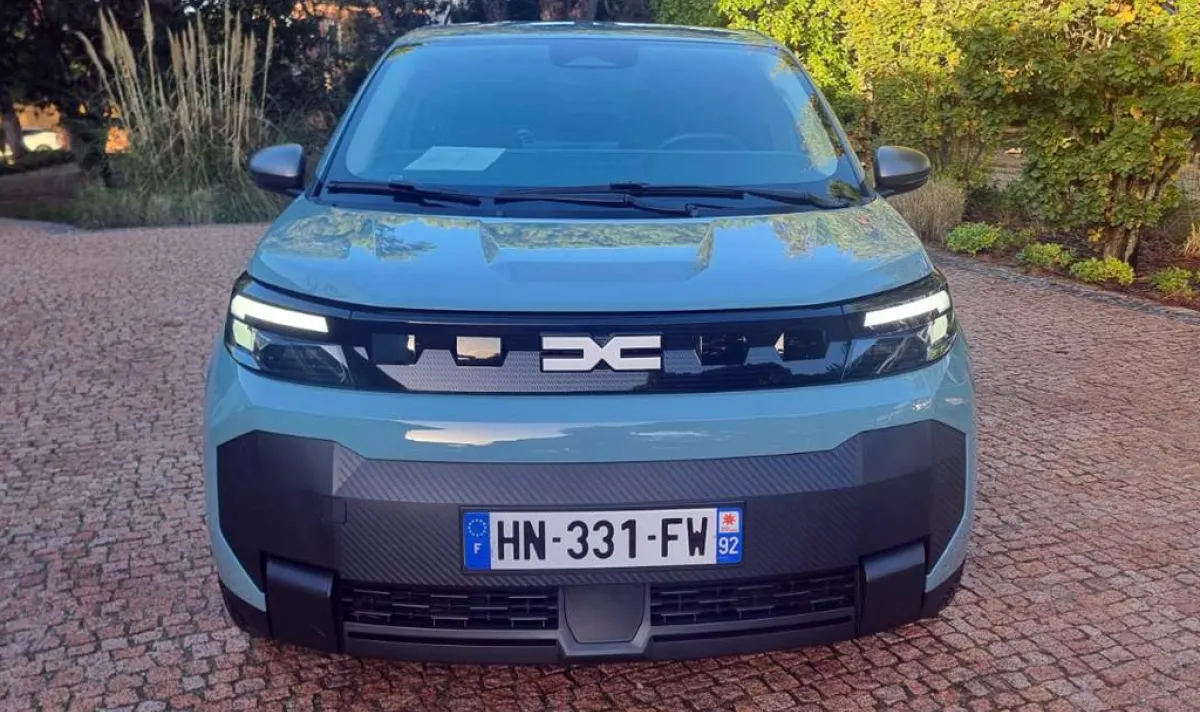

Lisbon, Portugal. A mobile.bg team on site at the event.
Dacia is entering a decisive phase of its electric offensive with the presentation of the all-new second generation of the popular Spring city model. After more than 210,000 units of the original electric car had been sold since 2021, the Renault Group subsidiary is taking a serious step forward, relying on its proven formula of maximum practicality at an affordable price.
The new Spring is the first representative of the brand’s innovative strategy, which envisages the launch of four fully electric vehicles by 2030, and in practice inherits only its name from its predecessor. Developed in less than two years together with the new Renault Twingo and Nissan Pixo, the model is now assembled on the Old Continent at the plant in the Slovenian city of Novo Mesto.
This key change eliminates the additional European Union customs tariffs faced by the previous generation and opens the door for the model to participate in a number of European electric-mobility incentive programmes, although such programmes are not available in Bulgaria.
Interestingly, although production costs themselves are higher in Europe, the model retains extremely attractive prices. And here are our first impressions of the new Spring after we carried out an extensive test drive during the model’s first tests, which the brand held in Portugal.
Exterior
Compared with the narrow and compromised first generation, the new Dacia Spring demonstrates a significantly more substantial and mature presence on the road. The transition to Renault Group’s modern RG-EV architecture for compact electric vehicles gives the body a much more confident and stable stance. The car has grown in every direction except height, reaching a length of 3855 mm, a width of 1722 mm – an increase of as much as 180 mm compared with its predecessor – and a wheelbase of 2492 mm.
The design relies on cleaner geometric lines and modern black decorative inserts connecting the front headlights and rear lights. Bulgarian customers will be able to choose between four attractive exterior colours – Agave, Schist Grey, Diamond Black and Glacier White, while the standard 16-inch wheels emphasise the car’s sensible character, prioritising practicality over purely visual impact.
The most interesting detail of the model’s different and now quite attractive exterior is related to the rear lights. A look at the rear of the car reveals an impressive design solution, in which the new light units attract attention with their original shape, reminiscent of the brand’s stylised emblem, giving the overall silhouette a unique and memorable finish.
Interior
The significant expansion of the exterior dimensions is felt immediately in the interior, where the family connection with the Renault Twingo is most clearly visible in the almost identical dashboard with pronounced horizontal lines. Although hard plastics dominate the cabin and the colourful accents of its French sibling are absent, the sense of spaciousness is incomparably better.
According to measurements, shoulder room has increased from 1170 mm to 1390 mm at the front and from 1140 mm to 1320 mm in the second row. Rear legroom has grown more modestly – from 640 mm to 680 mm, as the engineers have fixed the two individual rear seats in place, without sliding capability, in order to provide a class-leading boot with a capacity of up to 337 litres, including the practical compartment beneath the double floor, complemented by an 18-litre space for the cables.
A 7-inch digital instrument cluster is fitted as standard in front of the driver, while the steering wheel can now be adjusted both for height and reach. Base versions are started with a conventional key and do not have a central multimedia display, while the higher equipment level offers push-button starting and a 10.1-inch touchscreen with wireless Apple CarPlay and Android Auto connectivity, although without built-in Google services. It is commendable that Dacia has not succumbed to the trend of completely eliminating physical controls and has retained the convenient mechanical climate-control regulators, as well as the useful My Safety button for quickly deactivating the annoying driving assistants.
Engine and Driving Characteristics
The real revolution, however, is felt behind the wheel, where the new Dacia Spring presents itself as a completely different car compared with its compromised predecessor. The permanent-magnet synchronous electric motor produces 60 kW, equivalent to 82 hp, and a maximum torque of 175 Nm, which is entirely sufficient for nimble progress in heavy urban traffic and on extra-urban roads.
Acceleration from a standstill to 100 km/h takes 12.1 seconds, while the top speed reaches 130 km/h, allowing it to maintain motorway speeds confidently, although motorways are not the model’s natural habitat. During our test drive, the car impressed with an exceptionally low average energy consumption of around 11 kWh per 100 km, which, combined with the lithium-iron-phosphate battery with a usable capacity of 27.5 kWh, guarantees a real-world range fully covering the declared 250 km under the WLTP cycle.
Given the brand’s statistics showing that owners travel an average of 34 km per day, a single charge is enough for an entire working week. The new electronic braking system provides a precise and linear pedal feel, while the steering-column selector also offers a B mode for more intensive recuperation, although full one-pedal driving is not available.
Thanks to its wider track, Goodyear tyres and kerb weight of 1314 kg, the car demonstrates surprising stability in corners and on wet surfaces. The ride feels slightly firm when passing over sharper bumps, but this very setup contributes to outstanding stability and security, while the steering is simply brilliant – light and predictable, combined with a minimum turning radius of just 4.95 metres, turning parking into child’s play.
The only complaint when reversing remains the poor resolution of the rear-view camera, whose image appears grainy on the touchscreen, although the standard rear parking sensors compensate for this shortcoming. Charging the battery from 15 to 80 per cent takes 9 hours from a standard domestic socket through the 6.6 kW onboard charger, or 2 hours and 55 minutes at a 7 kW wallbox, while an 11 kW onboard charger and support for DC fast charging of up to 50 kW are available at extra cost, with the latter replenishing the battery in just 28 minutes.
Conclusion and Prices
Ultimately, the second generation of the Dacia Spring establishes itself as a mature, rational and extremely competitive city electric vehicle that leaves the compromises of the first generation far behind. Its indisputable advantages include the larger and functional cabin, retained physical buttons, minimal energy consumption, stable road behaviour, excellent manoeuvrability and European production.
Of course, there are also some minor drawbacks, such as the hard plastics in the interior, the firmer suspension, limited range on long extra-urban journeys and the low resolution of the rear-view camera. But despite all this, the model remains the most suitable option as a second family car for the city. This is because the price-to-quality ratio is difficult to match.
The main shortcomings of the new Dacia Spring include the lack of a heat pump and battery preconditioning system, which makes it sensitive to low temperatures, as well as its more modest performance and reduced real-world range when travelling at high speed on the motorway. Additional disadvantages are the firm ride at low speeds, the thin seats with a lack of pronounced side support, the rear windows, which only tilt open instead of lowering, and the fact that the practical front cable-storage compartment and fast charging are offered as paid options.
However, the positive aspects far outweigh them. Among the model’s most important advantages is its extremely accessible final price. The car impresses with improved and more precise steering, larger dimensions and better interior space with a fully adjustable driving position, excellent manoeuvrability retained in urban conditions, and exceptionally low energy consumption. Other positive features include physical buttons for the main functions, the redesigned and more stable chassis without any feeling of "floating" on the road, production in Europe, and the practical boot with improved modularity and a two-piece floor.
As for the prices of the new Spring in Bulgaria, the starting price for the base Expression level is €17,900, while the better-equipped Journey version starts at €19,700, keeping the model’s price below the psychological threshold of €20,000 even in its most fully equipped version. In conclusion, we would say that, in our opinion, there is no better city electric vehicle on the Bulgarian and European markets for this money.