


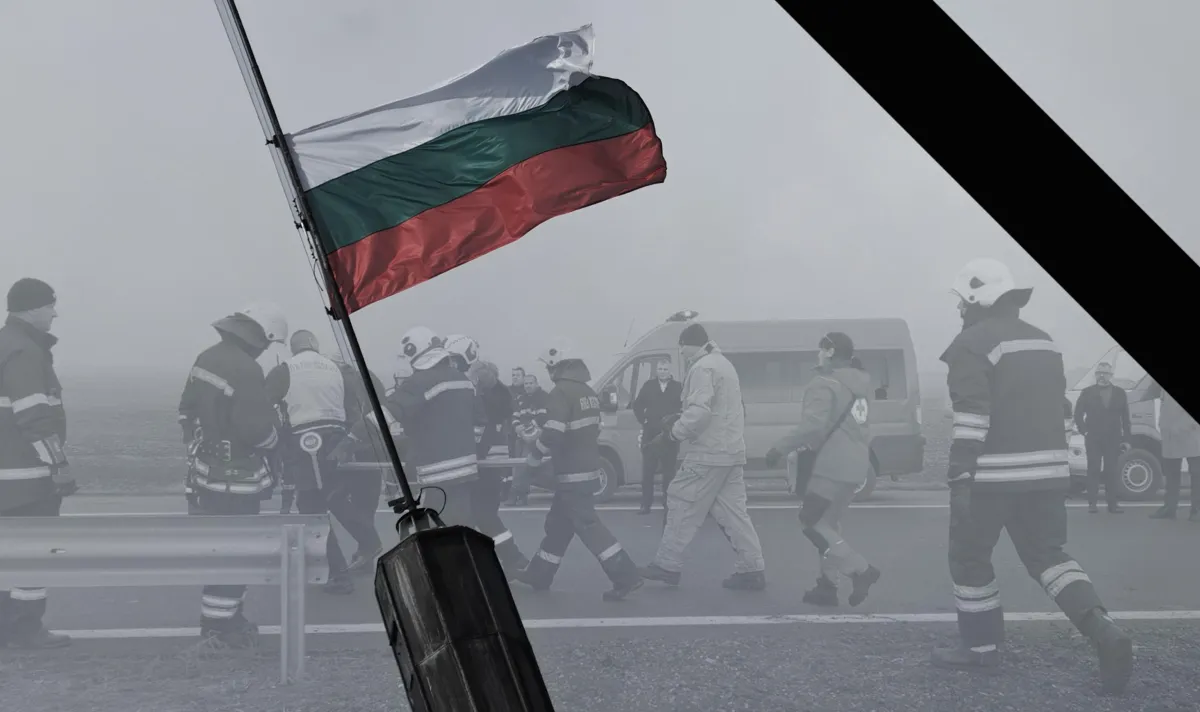

Missing road markings on the Trakia Motorway, unclear signage and a 100 km/h speed limit in a new section due to ongoing repairs are among the problems identified during a road safety inspection. A bTV team and Krasimir Georgiev, chairman of the Association for the Qualification of Motorists in Bulgaria, inspected several locations on the motorway and in Sofia. The inspection follows the serious crash on the Trakia Motorway on November 10. The causes of the incident are still being investigated.
Road markings are missing in one of the inspected sections of the motorway. In fog or other conditions of reduced visibility, drivers can mainly orient themselves by the reflectors on the guardrails, provided they are clean. According to Krasimir Georgiev, the problem is particularly serious for drivers passing through for the first time who are unfamiliar with the dangerous spots.
“If they are installed in the right place and in an appropriate manner, drivers can receive sufficiently clear information,” Georgiev said regarding road signs and their warning and informational functions.The expert also questioned the organization of exits to commercial sites near the motorway. In his words, leaving the motorway should be done gradually, so that drivers have time to reduce their speed and do not obstruct those traveling in the main lane.
100 km/h speed limit due to repairs
On a new section of the Trakia Motorway in the direction of Burgas, the maximum permitted speed is 100 km/h. The Road Infrastructure Agency explains that the section between the 33rd and 39th kilometers is under repair until October 1, 2027. Temporary road markings have been laid there and the speed limit has been introduced for traffic safety reasons.
Georgiev warned that at a speed of 140 km/h, even a brief distraction can lead to serious consequences. “Between one and two seconds. If we allow ourselves to become distracted, we will cover the distance from the billboard to us. That is no less than 150 meters,” he said.
Violations by drivers were also recorded on the motorway. According to Georgiev, however, responsibility for road safety cannot be sought solely from drivers when signage and traffic organization also create risks.
Ambiguous signage in Sofia as well
In the capital, the inspection identified an intersection on Milen Tsvetkov Street where the traffic lights and road signs could be interpreted in more than one way. Georgiev pointed out that in fog or when the traffic lights are not working, drivers would find it difficult to determine which instruction takes precedence.
“I could take you to another 50 examples of such signs in Sofia,” he said. In his words, the incorrect placement of signs leads to a lack of trust in the signage and reduces drivers’ attention.
In September, the government announced its intention to establish a new road safety agency, which is expected to begin operating by the end of 2027. According to Georgiev, responsibilities are currently divided among 11 institutions, which dilutes accountability. He identified improper maneuvers, excessive speed, distraction, poor road surfaces and adverse conditions as some of the main factors behind crashes.
Sources: btvnovinite.bg