


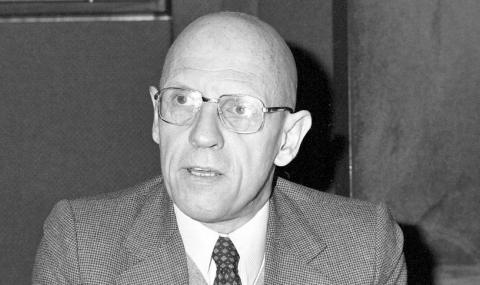

On June 26, 1984, Michel Foucault died. He was born on October 15, 1926 in Poitiers, France. His father was a famous surgeon who wanted his son to follow in his footsteps. However, Michel was a thoughtful and withdrawn child, with tendencies towards crime. Therefore, his father sent him to study at the College of St. Stanislaus - a Catholic school known for its strict discipline and iron rules.
Then Michel Foucault entered the prestigious Paris Lycée Henri IV. When he was 20 years old, he was accepted into the Pedagogical Institute, where he ranked fourth among the best graduates. He studied philosophy and his knowledge were highly regarded. The young Foucault showed an astonishing intellect. In just a few years he passed through the departments of philosophy, psychology and psychotherapy. Then he taught French at the universities of Uppsala, Warsaw and Hamburg.
In 1960, Foucault returned to France and became dean of the philosophy faculty at the University of Clermont-Ferrand. In the same year, his work "Madness and Civilization" was published, for which Michel Foucault received a doctorate. At that time, he met the philosophy student Daniel Defer, ten years younger than him. Defer's political activism had a serious influence on Foucault. In an interview, he himself said: "I spent 18 years of my life in a state of passionate infatuation with one person. At one point, this passion grew into love. But, to tell the truth, we experienced this passionate infatuation together."
The book "The Order of Things" brought Foucault fame in France, especially among intellectuals. The statement at the end of the book that man - this is the last contradictory formation that has become possible in the last 150 years thanks to the radical changes in the systematization of knowledge - and he, man, is approaching his end is especially often quoted: the day is not far off when he will be erased, like a portrait drawn in the sand on the seashore. If Foucault's intellectual predecessor - Friedrich Nietzsche, proclaimed the death of God, then Michel Foucault predicted the death of man.
When Daniel Defer voluntarily went on a mission to Tunisia, Foucault went with him. There he devoted himself to teaching. According to some statements, he became addicted to drugs. When the two returned to Paris, Foucault headed the philosophy department at The University of Paris, and Defer was teaching sociology.
In May 1968, the student unrest reached its peak. The unrest had a huge impact on Foucault. He joined the Group for Information on the Prison Situation. The organization's goal was to give prisoners the opportunity to talk about the problems they faced in prison. Michel Foucault devoted the last 10 years of his life to his work "History of Sexuality" - a monumental work that remained unfinished and caused many controversies. His work in San Francisco, where Foucault taught at the University of Berkeley, became a turning point in his development. There he was struck by the sexual freedom of people and considered this to be free self-expression.
Over the next few years, he returned to San Francisco many times - the last time was in 1983. At that time, when AIDS was raging there and when he himself probably had AIDS without suspecting it.
Years after Michel Foucault's death, his ideas about the evolution of Western civilization over the past three centuries continue to have enormous significance. No one has ever presented his scientific thought so fundamentally and well-foundedly. His views are known as the theory of social construction. According to it, sexuality is understood as a cultural model that changes depending on time and place. Foucault suggests that its power should be discussed by everyone - from the point of view of medicine, psychiatry, religion and law: both by the scientist who studies these problems, and by the working person, and by the activist of the AIDS movement.
Foucault's revolutionary thought in the last years of his life was directed towards a direction that he himself called "pessimistic activity". The influence of this direction is constantly growing.