


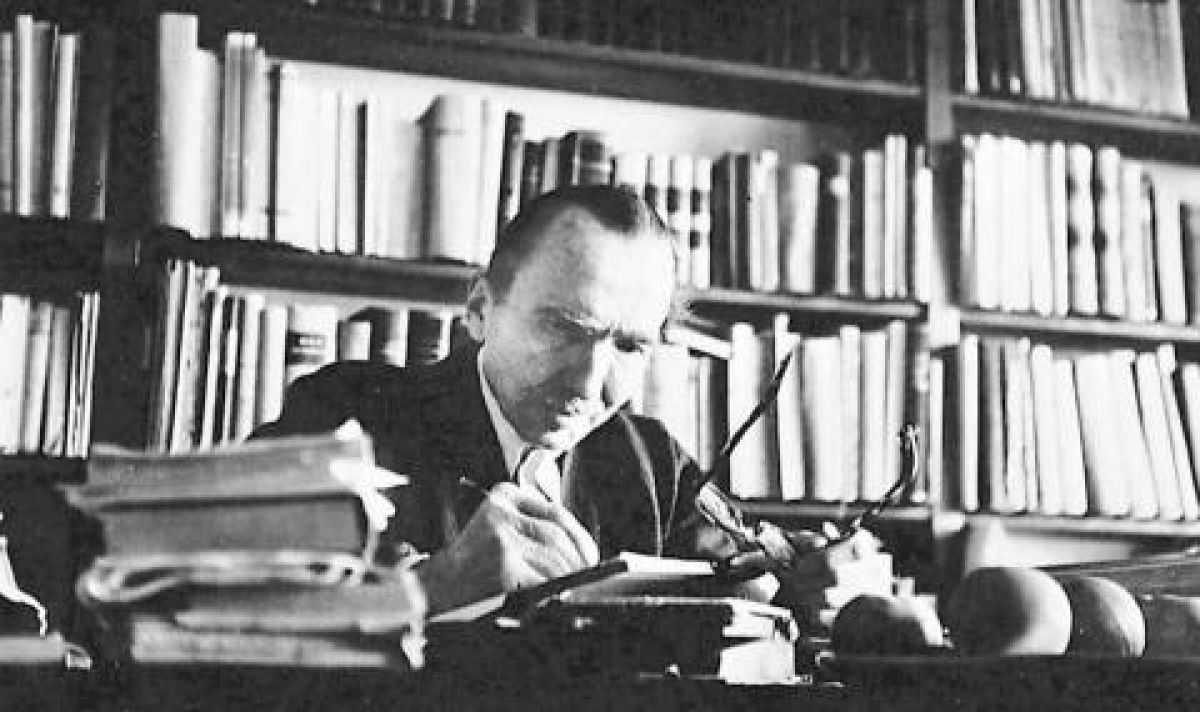

On October 26, 1957, Nikos Kazantzakis dies.
On the writer's grave stands a large wooden cross with the following epitaph:
„I hope for nothing, I fear nothing. I am free.“
He was born on February 18, 1883 in Heraklion, Crete.
He is among the most talented Greek writers. He is the author of essays, short stories, poems, tragedies, travel guides and translations of classic works such as Dante's „Divine Comedy“ and Goethe's „Faust“. Like his hero Odysseus, Kazantzakis spent most of his artistic life outside Greece - with the exception of the years of World War II. Some of his works are related to the history and culture of his homeland and to the mystical connection between God and man.
In 1957, Kazantzakis did not win the Nobel Prize because of one - a single vote - it was won by the French writer Albert Camus.

His father is Michalis Kazantzakis, a farmer and fodder merchant, and his mother is Maria. After the Cretan Uprising, the family fled to Piraeus, where they found refuge for 6 months. At the age of six, Kazantzakis was already forced to lead a life of refugee.
The writer was raised among peasants and, although he left Crete very young, in his works he often returned to his fatherland.
He attended the Franciscan School of the Holy Cross in Naxos, where he learned French and Italian. After the restoration of peace in 1899, Kazantzakis returned to his hometown and graduated from high school in Heraklion (1899 - 1902).
In the autumn of 1902, he went to Athens, where he enrolled to study law. He studied for 4 years at the University of Athens, where he graduated with a doctorate in law in 1906. His first book “The Dragon and the Lily“ was also published in 1906.
In October 1907, Kazantzakis went to Paris, where he continued his legal education, and until 1909 he also studied philosophy at the famous Collège de France in Paris under Henri Bergson. Here the young author developed and deepened his Nietzschean views. During the period 1910 - 1930, he wrote plays, poems and travel guides. He traveled frequently to China, Japan, Russia, England and Spain. Kazantzakis' first novel, "Toda-Raba", was published in French when he was 51 years old.
The writer spent a lot of time working in the public sector. In 1919, he became director of the Greek Ministry of Social Welfare. He resigned from the post in 1927. Although he was never a member of the Communist Party, in his youth Kazantzakis sympathized with leftist ideas, and was even awarded the Lenin Peace Prize. However, after a three-year trip to the Soviet Union, he became disillusioned with Bolshevik ideas.
Before World War II, Kazantzakis settled on the island of Aegina, and in 1948 he moved to Antibes, southern France. After the war, he worked as a minister in the Greek government of Aegina, and from 1947 to 1948 he worked for UNESCO.
He died of leukemia on 26 October 1957 in Freiburg, Germany. His body was transported by land from Freiburg to Athens, and then by air from Athens to Heraklion, where he was buried in the Cathedral of St. Mina.