


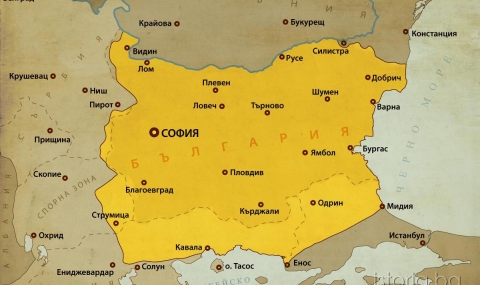

The Peace Treaty between the Balkan Allies and the Ottoman Empire is signed in London. The Sultan cedes all territories west of the Midia-Enos line and the Aegean Islands. The treaty ends the war, but does not eliminate the military situation in the Balkans. The reason is the tension that has arisen between the main players in the winning coalition. If a year ago Bulgaria managed to create an effective and successful bloc against the Ottoman Empire through diplomacy, then in the months surrounding the preparation of the peace treaty in London, Sofia fell into international isolation.
The London Treaty guarantees the creation of an Albanian state, which also includes Shkodra. All other issues and claims remained unresolved (the division of Macedonia, the status of the islands in the Aegean Sea, war reparations).
The Balkan War (1912-1913) was the crowning achievement of the Bulgarian state's decades-long efforts to throw off the shackles of the Berlin Treaty of 1878. Significant territories inhabited by Bulgarians remained outside the borders of the homeland and their unification with the Principality of Bulgaria (from 1908 the Kingdom of Bulgaria) and Macedonia became a major task on the agenda of both political parties and society as a whole. The failure of the Ilinden-Preobrazhenie Uprising of 1903 showed that the liberation of Macedonia could only be achieved through war. For the successful implementation of this national program, a series of negotiations were held between 1909 and 1912 to establish a Balkan Union. Along with Bulgaria, Serbia, Greece and Montenegro were successively included in it. A significant role in the realization of the alliance was played by Russian diplomacy, which saw in it a counterweight to German and Austro-Hungarian influence in the Balkans.
The geographical features and military-strategic decisions of the warring parties led to the separation of several theaters of combat operations in the perimeter between Constantinople, the waters of Varna, Shkodra and Arta (on the Ionian Sea). The attempts of the Ottoman command to win the strategic initiative in the first days of the war were unsuccessful, which is why the terrain and intensity of the battles were dictated by the allies. The Bulgarian army struck the main blow in Eastern Thrace. Smaller formations operated in the Rhodope Mountains and Western Thrace. Bulgarian and Greek troops attacked Thessaloniki, respectively from the north (along the Struma River) and from the south, through the Bistritsa Valley. The Bulgarian command underestimated the importance of Thessaloniki as a strategic city when drawing the post-war borders between the allies and allowed a Greek detachment to enter the city first.
After the signing of the London Peace Treaty, relations in the victorious coalition became strained. According to some historians, blinded by military successes, Tsar Ferdinand ordered our army to attack the recent allies Greece and Serbia on June 16, 1913. He was impatient to wait for the arbitration of the Russian Tsar. The consequences were deplorable for Bulgaria. On June 27, 1913, Romania declared war on Bulgaria and reached Vratsa with almost no resistance. At Belogradchik, it met the Serbian army. Vidin fell into encirclement. The reason is that the main Bulgarian forces were thrown against the Greeks and Serbs.
The Sultan observed the events and on June 30, 1913, ordered his army to occupy Adrianople.
The impatience of Tsar Ferdinand and the lack of vision among politicians led us to the first national catastrophe.
You can read how the events of the Second Balkan (Inter-Allied) War developed on the pages of Fakti.bg.