


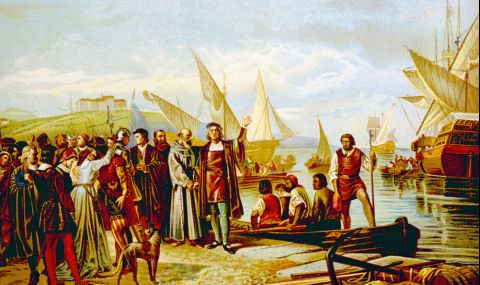

On August 3, 1492, the Genoese Christopher Columbus and 90 sailors set off on their flagship, the “Santa Maria”. Two more ships – – – – – Pinta”, follow him. They sail west.
Three long months pass. The sailors, exhausted and sick, threaten to head east to return. Columbus encourages them, convinced that they will discover the spice route to the East. On October 11 at 10 p.m., Columbus notices a light. – – Pinta” continues sailing and brings the news that the light is actually on land. At dawn the next morning – October 12 - The ships dock.
Christopher Columbus and his crew expect to see the natives of India and be introduced to the khan - their great leader. Therefore, they think the first people they see are Indians. They go ashore, dressed formally, kneel and thank God that they have reached there alive. They learn from the native population that the island is called Guanahani. Columbus christens it San Salvador and immediately declares it a Spanish possession. When they dock on another island - now called Cuba - they think they have reached Japan. After three successive voyages, Columbus remains in the dark. He dies rich and famous, but never realizes that he has discovered a land whose existence few people suspected.
Columbus stopped on an island that is now classified as part of the Caribbean group. It was either Watling Island, Grand Turk, or Samana Cay. In 1926, Watling Island was renamed San Salvador and recognized as the first discovered land in the New World. Recently, however, this claim has been disputed. Three people from Miami, Florida, have founded a movement that wants Concepcion Island to be recognized as the island sighted by Columbus's men, on which they landed. This controversy has not yet found its solution.
Centuries pass, during which this discovery is very rarely celebrated. Even the continent is named not for Columbus, but for the Italian navigator Amerigo Vespucci. In 1792, a ceremony was organized in New York in honor of Columbus and a monument was dedicated to him. Soon after, the city of Washington was officially named the District of Columbia /Columbia/ and became the capital of the United States. In 1892, a monument to Columbus was erected at the beginning of Columbus Avenue in New York City. That same year, models of the navigator's three ships were displayed at the Columbus Exposition in Chicago.
If Christopher Columbus had not been born in Italy, Americans might not have had Columbus Day. Proud of their compatriot, on October 12, 1866, New Yorkers of Italian descent organized the first celebration of the discovery of America. The following year, Italian organizations from other cities prepared banquets, parades, and dances for this date. When Italians from San Francisco celebrated October 12 in 1869, they called it Columbus Day, the American Embassy in Sofia recalls.
In 1905, Colorado became the first state to celebrate Columbus Day. In the following decades, this served as an example for other states. In 1937, President Franklin Roosevelt officially declared October 12 as Columbus Day. Since 1971, this holiday has been celebrated on the second Monday in October.
Although it is generally accepted that Christopher Columbus was the first European to discover the New World of the Americas, there is still some controversy about this claim. According to some researchers and supporters of other travelers, before it was discovered by Columbus in 1492, America was discovered by ancient Scandinavian Vikings and wandering Irish missionaries. This controversy will probably never be resolved to everyone's satisfaction, but in 1992 the 500th anniversary of Christopher Columbus' discovery was celebrated.