


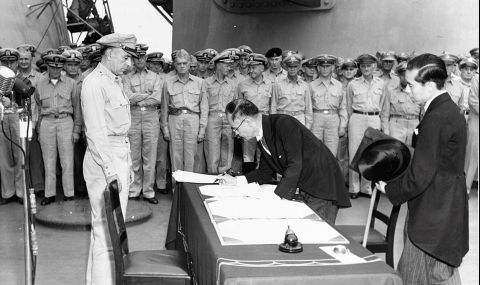

If only the day before we told you about the beginning of World War II, today we will remind you how the last, bloodiest conflict in human history ended.
On September 2, 1945, World War II ended. Japan signed the act of unconditional surrender. This took place on board the American ship Missouri in Tokyo Bay.
On August 14, 1945, the Japanese Emperor Hirohito declared unconditional surrender. Japan participated in World War II as part of the “Rome-Berlin-Tokyo” Axis and signed the Tripartite Pact on September 27, 1940.
On December 7, 1941, Japan declared war on the United States with an attack on the American naval base at Pearl Harbor (Hawaii). On December 8, the United States and Great Britain declared war on Japan. On December 11, Germany and Italy declared war on the United States. In late 1941 and early 1942, Japan captured Malaya, the Philippines, Indonesia, and Burma and defeated the British fleet at Singapore.
On July 26, 1945, the governments of Great Britain, the United States, and China issued the Potsdam Declaration, demanding Japan's surrender. On August 6 and 9, 1945, American air forces dropped atomic bombs on Hiroshima and Nagasaki.
The atomic bombs forced Emperor Hirohito to declare the unconditional surrender of Japan. After that, the country was occupied mainly by American, British, Australian and New Zealand troops, commanded by American General Douglas MacArthur.
On August 8, the USSR declared war on Japan, implementing the agreements of the Yalta Conference. The Soviet army liberated South Sakhalin, the Kuril Islands, Korea, and defeated the Kwantung Army in China and North Korea. Mongolian and Chinese troops participated in the offensive against the Japanese invaders.