


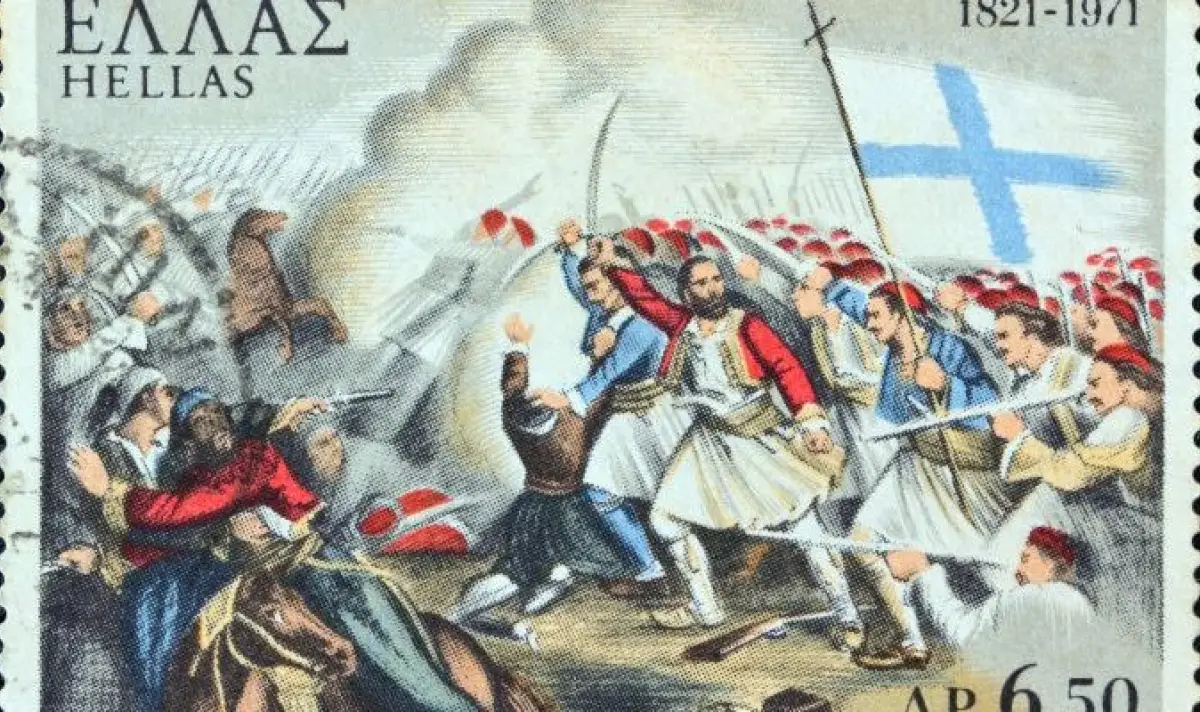

On March 25, 1821, the Metropolitan of Patras, German, blessed the flag with a blue cross on a white background. It was the raising of this flag that marked the beginning of the Greek revolt against Ottoman rule, which officially began in the spring of 1821. The motto of the uprising was “Freedom or death“, recalls "Deutsche Welle".
Second-class subjects
The Greeks lived as subjects of the Ottoman Empire for almost four centuries. But some of them enjoyed special privileges - especially merchants and the Orthodox clergy. The official church language was Greek, and Greek elites had relatively easy access to the Ottoman hierarchies. These elites were concentrated in the "Phanar" district of Istanbul, where the seat of the Ecumenical Patriarch was located - hence the term "Phanariotes". The deep historical trauma of the capture of Constantinople in 1453 was remembered, but at the beginning of the 19th century not all Greeks were convinced that Ottoman rule should be rejected. These sentiments were mainly due to the comparative autonomy in the practice of the Orthodox religion and to the aforementioned fact that Greek elites had access to high positions in the Ottoman government.
At the same time, large sections of the Greek population lived in poverty, the peasants worked as tenants for large Turkish landowners, were not allowed to bear arms or ride horses, and paid higher taxes than Muslims. Christians who refused to convert to Islam remained second-class subjects.
The Greek uprising against the Sublime Porte began in the Peloponnese, where the rebels managed to quickly capture several cities. Thus the hour of violence struck. Ottoman power was weakened, and in the mountainous regions the local Greek nobles, large landowners, millers and clan leaders had the say. They also had their own “battle groups”, hardened in the battles of traditional blood feuds. They were joined by ordinary robbers who presented their robberies as a fight against the Turks. In this regard, the German “Süddeutsche Zeitung” quotes the Munich historian Marie-Jeanine Kalich, who speaks of the brutal actions of the rebels against the Muslim population and recalls that in Tripolitsa the rebels slaughtered more than 6,000 people: “Prisoners were hardly taken“.
The Ottoman authorities responded with equal brutality. During the Easter service, the Ecumenical Patriarch Gregory V was dragged from the church in Constantinople, lynched by an angry mob, and hanged on the church doors, where his corpse fed the birds for days. Many Phanariots were also slaughtered, further deepening the tension between Muslims and Christians, which more and more people recognize as the core of the rebellion. In December 1821, when fighting was still ongoing in a number of regions, the first Greek National Assembly was constituted, which declared the country's independence on January 1, 1822.
In Western Europe, the Greek uprising caused an outburst of solidarity and even enthusiasm. Support societies were formed, manifestos were written, and money was collected to support the rebels. At the root of this reaction was the relatively recent, hot interest in ancient Greece as the cradle of European culture and democracy. Among the most enthusiastic supporters of Greek independence were the British romantic poets Percy Shelley and Lord George Byron, who donated as much as 4,000 pounds to equip the Greek fleet, and in 1823 he himself joined the liberation movement. Byron even took command of a brigade of elite soldiers, but he did not die heroically in battle, but from a fever. Despite this, the Greeks still worship him as a national hero.
Despite Western support, however, the rebels found themselves in increasingly difficult situations. In February 1825, a 17,000-strong Egyptian corps, trained by French military specialists, landed in the Peloponnese. This army recaptured much of the Peloponnese and lifted the siege of the sea fortress of Messolonghi. The defenders of the fortress made a desperate attempt to break through the siege and escape, but the plan failed and the remaining rebels behind the walls blew themselves up.
The beginning of the end of the Ottoman Empire
Initially, the Great Powers feared that the Greek uprising might upset the political balance, but gradually they found themselves forced to intervene. In July 1827, England, Russia and France reached an agreement and initially attempted to mediate. Their plan was for Greece to become an autonomous state within the Ottoman Empire. After the Sultan did not accept this proposal, the three countries defeated the Ottoman-Egyptian fleet near Navarino and the French took over the Peloponnese. It was the naval battle near Navarino that is considered the beginning of the end of the Ottoman Empire. It was also at this time that the proverbial “Eastern Question“ arose (directly affecting Bulgaria), which ultimately was one of the causes of World War I.
After the Battle of Navarino, disagreements gradually arose among the Greek rebels. The National Assembly decided to appoint the experienced diplomat and former Russian Foreign Minister Count Ioannis Kapodistrias as regent, but on October 9, 1831, opponents of this decision assassinated him. However, the Europeans wanted to restore stability and decided to turn Greece into a monarchy.
The three great powers involved in the conflict had different interests. Russia emphasized the "Orthodox brotherhood", but in fact traditionally tried to bring the straits under its control, while France and England sought to limit the influence of the Russian emperor in the region. It was precisely because of these tensions that the three powers eventually agreed on a compromise candidate for the Greek throne: the 17-year-old Bavarian Prince Otto von Wittelsbach. This decision was not entirely to the liking of the forgers of Greek liberation, but the National Assembly nevertheless elected him king of Greece.