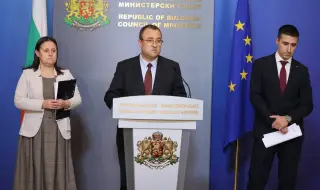
Out of over 400 inspections for illegal construction in riverbeds and ravines throughout the country, violations of the Spatial Planning Act and the Water Act have been found in 370 cases. 50 constructions have been identified so far that are operating without being put into operation, for which the relevant municipalities will be notified, because they are of the 4th, 5th and 6th categories. This was announced by the Minister of Regional Development and Public Works Ivan Ivanov, who presented data on the inspection of the DNSK and AGKK initiated by him. The two structures carry out inspections based on documents and on site for sites located near rivers and ravines. Properties, buildings and movable objects were checked.
No construction was found in 30 of the properties, but violations were found in the rest for buildings, mainly of the 5th and 6th categories, as well as movable objects. “Their construction was carried out over the years based on detailed development plans approved by the mayors of municipalities or municipal councils, and a large part of them were not coordinated with the Basin Directorate or the regional environmental and water inspectorates“, the regional minister pointed out. Some of the objects were processed before the entry into force of the Water Act, and representatives of the basin directorates or regional environmental inspectorates were not present at the meetings of the Expert Councils for Spatial Planning of each municipality.
The issued construction permits and the acts for legalization or placement of objects were also issued by the municipalities without their coordination. It is a common practice not to announce the acts to the regional governors. “A large part of the constructions have construction documents. They were built legally and were put into operation with a Certificate of Commissioning and an order of the chief architects of the municipalities or regions, or with protocols for establishing the suitability for use of the constructions, form 16, issued by the DNSK or RDNSK according to the category of the constructions“, the regional minister also pointed out.
As another serious problem identified during the inspections so far, Minister Ivanov pointed out the lack of clearly defined boundaries of water bodies and that they coincide with the boundaries of the land property. Separately, there are cases in which the properties fall into the flood zone of rivers with dynamically variable boundaries that change during high water. In order to clarify these cases, a more objective inspection will be carried out jointly with the Ministry of Environment and Water. It has also been established that rivers are not marked on the cadastral maps and are not taken into account as such when developing development plans. Another serious problem is the restoration of properties on riverbeds and ravines. “According to the ZUT, such properties can be forcibly expropriated for geoprotective and other types of preventive activities in favor of the municipalities, which may happen later“, noted the regional minister.
Ivan Ivanov also presented some of the urgent measures that the state will take to prevent incidents like the one in Elenite due to built-up riverbeds. Among them are the Basin Directorates to commission the development of specialized cadastral maps for the boundaries of water bodies and the determination of floodplains, while also guaranteeing public access to them. For this purpose, the Ministry of Environment and Water needs to provide funding, which will provide proper documents. In addition, the directorates will be committed to ex officio notify municipalities and spatial planning authorities of the boundaries of water bodies and restrictions on properties.
After the specialized cadastral maps are prepared by the basin directorates, they will be provided to the AGKK to be entered into the cadastral maps, because it is not an obligation by law and the Cadastre cannot make an official entry. This is done by the owners - municipalities, regional governments, various departments. In this case, these are the basin directorates. And from now on, there will be no excuses for violations. “We are proposing a change to the Water Act, which prohibits the placement of buildings and farm buildings in floodable terraces, dam walls, easements of hydrotechnical facilities, etc. We will propose this measure immediately in the new Water Act“, Minister Ivanov also said. He added that it is also planned for the state to acquire private properties in floodable areas to prevent incidents during high water. “Chief architects must be very careful when issuing building permits. In order to prevent further incidents, all institutions must work in sync. We at the MRDPW will strictly observe this process and impose sanctions. Inspections will continue throughout the country. We hope that there will be no more deviations with the registration in the cadastral maps“, emphasized the regional minister. He also called for full synchronization between all responsible institutions.
Eng. Lilyana Petrova- Head of DNSK, presented some of the most striking violations found during the inspections. She explained that a large part of the sites were built on covered rivers and ravines. “The municipality first covered the ravine, and then allowed construction. We saw what happened with a covered ravine in Elenite“, she pointed out. In the village of Debren, Garmen municipality, back in 2013, with the approval of the PUP by the mayor of the municipality, 8 land properties above the river were separated. There are 2 built buildings there that have not yet been removed despite the order. In Balchik, a street, a parking lot, and 6 buildings have been established on the bed of a ravine that passes through several properties. On the Batova River in Dobrich District, a private building has been established that is used to draw water for irrigation purposes, which impedes the water flow and must be removed. In Varna District, in the “Zelenika” area, there are 3 properties through which a river flows and which is not reflected in the cadastre. And it is very deep, which is dangerous and it is fortunate that there is no planned and implemented stagnation yet. In the town of Zlatograd, a development has been established on Malka Reka with 6 buildings and a parking lot. There are construction documents for the sites, but a metal pavilion has been placed on a retaining wall that corrects the river bed. In Kardzhali, along the Chamdere River, 27 garages with construction permits have been established and put into operation. There is also a tire service station above the Beli Kladenets River in the district. “Opinions from the authorities will be required, because the sites may not interfere and only corrective measures may be taken. If they are illegal sites, however, there will be an order for removal,‘ said Eng. Petrova.